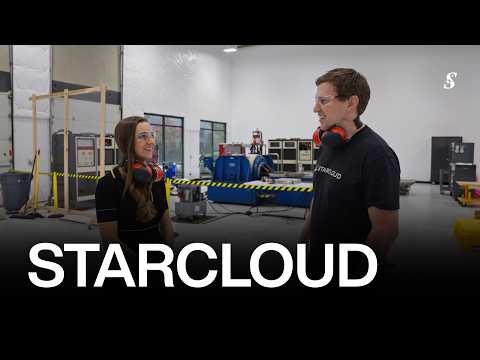
Inside Starcloud’s $2B Space Factory
Molly O'SheaPhilip JohnstonEzra FeildenAdi OlteanBailey MontañoMiguel RiveraCamilo Lopez
Orbital compute’s cost case hinges on launch falling below roughly $500/kg, versus about $5,000/kg on Falcon 9.Government customers are testing radar and hyperspectral inference, aiming to turn large image downlinks into actionable coordinates in minutes; Starcloud 2’s planned January launch tests radiator claims.Johnston says a 10% or 20% higher chip failure rate in space could break the economics, despite three months of chip burn-in.

How to Build the Next SpaceX or Tesla
Erin Price-WrightConnor LoveElena Burger
Defense customers can fund capacity commercial buyers would reject, creating a base that also serves robotics markets.Technicians using Claude can reconfigure lines in 20 minutes, versus three months and hundreds of thousands of dollars through a systems integrator.Love says first-half 2026 defense risk capital exceeded all of 2025, but factories still take years to build.

Freedom of Action: America's ASI Strategy, w/ RAND's Joel Predd, Ben Boudreaux & Matt Chessen
Nathan LabenzJoel PreddBen BoudreauxMatt Chessen
RAND urges the U.S. to build capabilities before choosing among seven ASI strategies, since five unresolved questions could change which path is viable.Its 106-capability agenda spans verification, evaluations, secure data centers and incident response, but remains unpriced; as frontier models diffuse, Chessen warns of a possible 12–24-month cybersecurity rough patch.

From a $27,500 Charter Company to a $4 Billion Private Jet Giant | Kenn Ricci, Flexjet
Fractional ownership raises utilization, but Flexjet still holds roughly 70 of its 365 aircraft as unsold core fleet.Buffett’s June 1998 $750 million NetJets acquisition helped unlock nearly $300 million in debt; Flight Options’ sales reached $400 million the next year, teaching Ricci that free cash flow and balance-sheet strength, not EBITDA, govern growth.
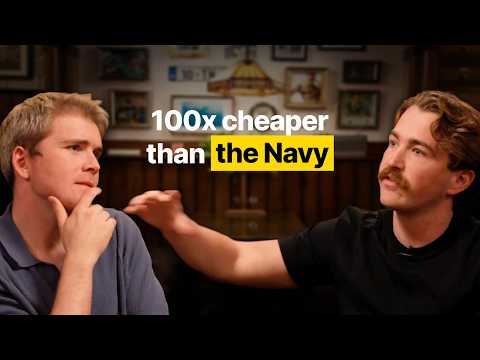
The company building underwater drones for $50,000
John CollisonChris SaccaWill O'Brien
Ulysses’ Mako can sell for as little as $50,000 to navies versus roughly $5 million for the common U.S.Navy autonomous underwater vehicle, while Leviathan supports persistent, modular missions.Demand already exceeds manufacturing capacity, with a factory planned next year; slow procurement could become a moat once deployments make undersea monitoring sticky and bankable.

Most VCs Are Afraid to Be Wrong | Rohan Pujara
Pujara avoids consensus-heavy seed categories where inflated prices, copycats, and weak margins destroy early economics, underwriting distinctive founders instead.Valhalla’s $80 million–$100 million fund makes only two to four new investments annually and can concentrate 20%–30% behind a clear fund-returner.K2 Space’s more than $1 billion of signed business and $6.8 billion valuation illustrate the playbook, while the roughly 30-check diversification case remains unresolved.

How did a few hundred Spanish soldiers topple two empires? – Si Sheppard
Spain’s conquests were coalition takeovers: indigenous allies supplied most manpower, while horses, steel, and firearms created a decisive initial battlefield and psychological edge.Capturing Moctezuma and Atahualpa exploited centralized systems with a single point of failure, allowing tiny forces to decapitate local elites and seize control.The longer-term advantage came from reusable knowledge, naval power, disease, migration, and organization, while Potosí silver globalized trade but weakened Spain through a resource curse.

The $500B Opportunity in Europe’s Defense Buildout
Molly O'SheaAistis ŠimaitisGeorge HadjiminasBruno Wejchert
Ukraine has made production scale as important as technology: Europe’s fragmented manufacturing base and years-long component lead times leave a clear opening for Onodrim’s acquisition-led model.Autonomous fleets also reset unit economics, turning $30,000 radios and other exquisite components into products that must become cheaper and available in thousands or millions; execution and procurement remain the watchpoints.

Palmer Luckey: Autonomous Weapons Are Ancient and Why Anduril Won't Build Humanoids | EP #295
Peter DiamandisSalim IsmailDave BlundinAlexander Wissner-GrossPalmer Luckey
Anduril’s $2.2 million wildfire XPRIZE win, including $1 million from Lockheed, shows its autonomy workflow can transfer to emergencies where a 10-minute versus hour-long response requires different tools.Luckey’s specialized, verifiable systems and self-funded product model challenge a market where five companies once captured roughly 80% of major defense acquisition programs, while Anduril’s choice to use rather than build humanoids keeps platform scope and procurement scale in focus.

Blake Scholl: Why Plane Speed Stalled, Supersonic Commercial Flight, & Revolutionizing the Engine
Boom’s 42 MW, water-free, behind-the-meter data-center system repurposes its Mach 1.7 engine core, with the first engine due next month, while vertical integration targets multiple gigawatts annually and more than 10 GW added to the grid over five years.Overture targets a $3,500 round-trip break-even fare and a four-year goal, but the actual service date remains uncertain as regulatory momentum accelerates.