SHOW DIRECTORY
All-In
Industry veterans Chamath Palihapitiya, Jason Calacanis, David Sacks, and David Friedberg cover economics, technology, politics, society, and poker.
SOURCE DESCRIPTION · RSS

Jake Paul & The Chainsmokers: Turning Fame into Funds, Jake Enters Politics? & Venture Bubble Signs
Chamath PalihapitiyaJason CalacanisDavid SacksDavid FriedbergJake PaulDrew TaggartAlex Pall
Jake Paul is turning owned attention into distribution and talent infrastructure, citing 138 million Netflix viewers for the Mike Tyson event and 400 MVP fighters.His $100 million Anti Fund and The Chainsmokers’ fund target venture economics, but later tranches priced at two or three times earlier valuations without operating improvement leave realized DPI—not TVPI—as the test of Chamath’s bubble warning.

Daniel Ek: Life After Spotify, Broken Healthcare Incentives, Catching Disease Early & AI's Potential
Spotify passed 700 million active users and 300 million premium subscribers; Daniel Ek became executive chairman January 1 and returned to building.Neko's $499 unit-economic-positive visit combines 53 blood markers, 6,000 images and clinician review in roughly an hour.Over 100,000 scans found serious, previously undiagnosed conditions in roughly 1% of members; population outcomes and budget effects remain unresolved.
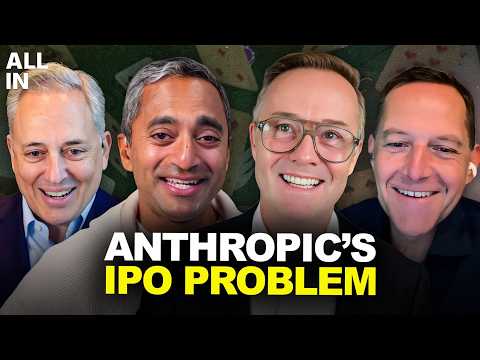
Anthropic IPO at Risk, Meta’s Muse Pop, Token Prices Fall, Open Source Gains Share, Alignment Fails
Chamath PalihapitiyaJason CalacanisDavid SacksDavid Friedberg
Open-source token usage flipped from 20% to 80% in 12 weeks; if more than 60–70% of frontier tokens are replaceable, Anthropic’s S-1 revenue must be discounted.Meta’s free Muse hit #1 in the App Store with 3M downloads in roughly 10 days, challenging the App Store’s 30% rev-share as agents make services headless.Converging models push OpenAI and Anthropic toward higher-value applications, while their six-to-12-month frontier lead remains the central risk.

Luca Ferrari, Bending Spoons CEO: The $40K Start, Buying Product-Market Fit & Beating Private Equity
Bending Spoons converts acquired product-market fit into a repeatable model, using 50+ proprietary tools and an approximately 800-person shared talent base to replace technology foundations.Historically consistent unlevered returns above 25% and debt costing about 9%, fully hedged and maturing in 2031, support the model, while limited customer synergies, competition and replication risk remain watchpoints.

Steve Hilton & Spencer Pratt: Fixing California, Cheaper Gas, Ballot Fraud & CA Republicans
Hilton frames California’s gubernatorial race as a referendum on whether one-party control has converted unmatched assets into extreme costs, citing a nearly $1 million median home, a $65,000 median individual salary, and more than 420,000 regulations.His cuts and tax-relief package targets financially stressed former Democrats, while September 30’s debate tests whether support can broaden before business departures become a “stampede for the exits.”

Blake Scholl: Why Plane Speed Stalled, Supersonic Commercial Flight, & Revolutionizing the Engine
Boom’s 42 MW, water-free, behind-the-meter data-center system repurposes its Mach 1.7 engine core, with the first engine due next month, while vertical integration targets multiple gigawatts annually and more than 10 GW added to the grid over five years.Overture targets a $3,500 round-trip break-even fare and a four-year goal, but the actual service date remains uncertain as regulatory momentum accelerates.

Naveen Rao: 4D Computing, AI's Energy Wall & Beating Biology
Naveen RaoChamath Palihapitiya
Unconventional AI taped out a physical dynamical computer five months after starting in earnest, generating images at 500 nanojoules each versus millijoules on a GPU.Its 4D architecture co-locates compute and memory, targeting 1,000× power efficiency as AI demand approaches an energy wall in about 3 years.A rack-scale product is promised within two years, with adoption hinging on model-layer porting and a new Python-based software stack.

Adam Foroughi, Applovin CEO: Surviving a 92% Drawdown, Ads as ML 1.0 & the $50B Game Ad Market
AppLovin is extending a roughly $50B mobile-gaming ad market, with platform ad spend growing from $11B to about $20B, into e-commerce discovery.Its April 2023 deep-learning model improved advertiser performance and enabled scaling, while roughly $6B in buybacks retired 20–25% of shares after a 92% drawdown.Discovery may expand activity beyond Google Search, but stated 84% EBITDA margins depend on differentiated data, complexity and scale.
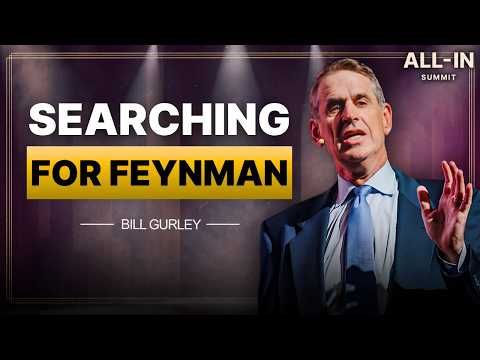
Bill Gurley: Searching for Feynman
Bill Gurley argues COVID-19—15 million deaths and $45 trillion in losses—broke the established catastrophe-investigation pattern, despite being 3,000 times larger than five cited disasters.His CAPA framework points to the missing search for root cause, including the DEFUSE proposal rated “highest-tier evidence class,” while he declines to name an origin and warns another pandemic could be handled worse.

Jared Isaacman: A New Era for NASA and American Space Exploration
NASA is shifting capital from consensus-driven programs toward explicit national objectives, targeting Artemis 3 in summer 2027 and Artemis 4 in 2028.Repeated lunar missions could create demand for landers, rovers, and resource experiments, while public funding concentrates on fission power and nuclear-electric propulsion.SR1 Freedom’s 2028 target, uncertain lunar returns, and China’s ambitions make execution and launch capacity key watchpoints.