SHOW DIRECTORY
The a16z Show
The venture firm’s view of startups, AI, software, markets, company building, and the technological shifts creating new categories.
BIDCLUB DESCRIPTION

Former Intel CEO: Why This is the Best Time to Build Hardware
Raghu RaghuramGuido AppenzellerPat Gelsinger
AI is compressing logic design faster than silicon, packaging, and rack deployment, shifting value toward manufacturing, memory, power, cooling, and integration.With roughly 100 AI processor vendors, consolidation is likely as workloads evolve and winners require major capital, software, and customer backing, though agent-generated kernels may preserve some heterogeneity.Memory may be positioned for its first major reset in 30 years, while optical scale-up I/O around 2028–2029 and power shortages, including eight-year turbine lead times, define key catalysts and risks.
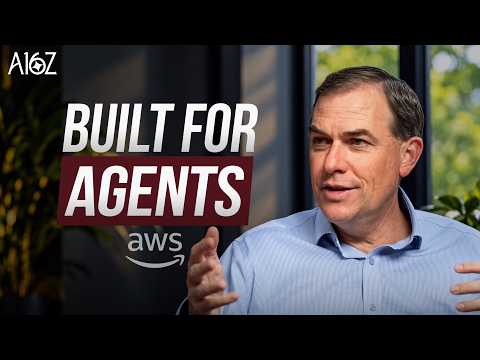
Building the Cloud for AI Agents | AWS CEO Matt Garman
AWS is underwriting durable AI demand with $220 billion of 2026 capex while reserving scarce accelerators for startups as well as frontier labs.Positive-ROI production workloads and single-digit maximum customer concentration temper demand risk, while AWS plans to buy 2 million NVIDIA GPUs over the next couple of years.Agentic workloads may strengthen AWS’s architectural edge, but power, memory, chips and enterprise evaluation remain constraints to monitor.

Why AI Demand Is Outrunning Compute Supply
AI demand accelerated through July and August, with usage concentrated among possibly sub-10 million heavy users and no leader identifying a worsening quantitative metric.Nebius suggests nine-to-ten-month paybacks on $50B-per-gigawatt builds, supported by 50-60% customer prepayments; undersupply through ’28 could lift token prices, while shifting capacity to training could cut lab revenue from $480B to $120B.

How AI Is Reinventing Computing from Chips to Power
Ben HorowitzMartin CasadoRaghu RaghuramErik Torenberg
a16z’s new AI infrastructure fund captures a founder migration into hardware, with top-founder hardware pitches rising from roughly 3–5% to “north of 20% or 30%.”Hyperscaler capex, booked-out GPUs and resale premiums support opportunities across chips, power and cooling, while grid shortages, regulation and uncontrolled agent spending remain constraints.

How Open Source Became AI's Backbone | Inferact with a16z
Elena BurgerMatt BornsteinSimon Mo
vLLM has become the execution layer linking more than 1,000 open-weight model architectures to GPUs from NVIDIA, AMD, Google, Amazon, Intel, and others, making inference a strategic systems layer.Open weights increasingly offer controllable latency, data, security, and fine-tuning rather than merely cheaper tokens, while licensing and moderation pressures test whether the ecosystem can fund frontier development and trusted specialized use cases.

Marc Andreessen's 2026 Outlook: AI Timelines, US vs. China, and The Price of AI
Andreessen sees AI three years into an 80-year revolution, with customer revenue validating unusually rapid adoption across an already-built global distribution network.Falling token costs, competing chips, smaller models, and US-China rivalry could expand demand dramatically, while state regulation remains a major unresolved risk.
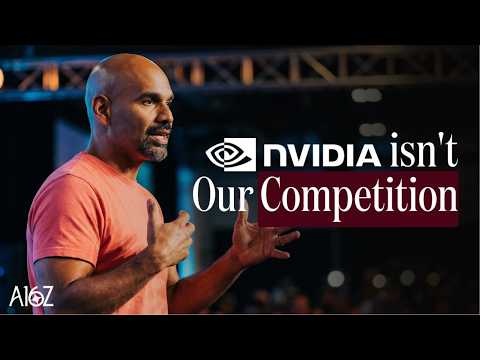
The Chip That Could Unlock AGI.
Unconventional is pursuing physical learning circuits, arguing that analog dynamics could complement digital computing for stochastic, time-dependent workloads rather than simply extend matrix multiplication.The thesis targets an energy wall: U.S. data centers use roughly 4% of the national grid, while some estimates call for 400 additional gigawatts over the next decade.Commercial significance depends on finding a manufacturable paradigm within five years, with TSMC partnership, a potentially very large analog prototype and unresolved AGI claims creating major execution risk.

"Is there an AI bubble?” Gavin Baker and David George
Gavin Baker argues AI does not resemble 2000: NVIDIA trades near 40 times trailing earnings versus Cisco’s 150–180 times, GPUs are fully utilized, and major buyers’ ROIC has risen roughly 10 points.The open risk is whether returns persist through Blackwell spending, while Google’s TPU competition, incumbent distribution, and outcome-based pricing could reshape infrastructure, SaaS margins, and AI monetization.

Building the Real-World Infrastructure for AI, with Google, Cisco & a16z
Raghu RaghuramAmin VahdatJeetu Patel
AI infrastructure demand is outpacing deployment: Google’s seven- and eight-year-old TPUs remain at 100% utilization, while power, permitting, land, and supply chains may constrain trillions in committed spending for 3–5 years.Specialized silicon, distributed networking, and inference-native systems could deliver 10–100x efficiency gains, but bursty workloads and the need for full-stack co-design make utilization, architecture, and durable product differentiation central risks.
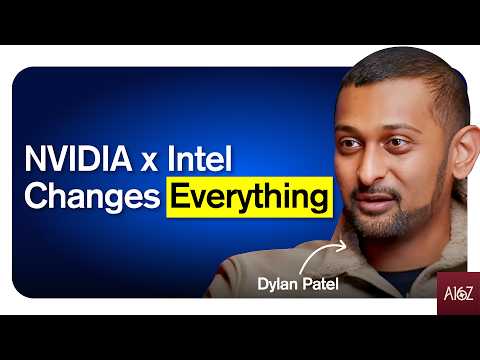
Dylan Patel on the AI Chip Race - NVIDIA, Intel & the US Government vs. China
Erik TorenbergDylan PatelSarah WangGuido Appenzeller
Nvidia’s $5 billion Intel investment, following SoftBank’s $2 billion and the U.S. government’s $10 billion, could lower Intel’s cost of capital and redraw PC and data-center competition, though Patel says Intel still needs roughly $50 billion.Huawei has credible 7 nm designs and ambitious custom-HBM products, but HBM3 yields, etch capacity, and domestic volume remain unresolved as Nvidia’s upside depends on $450–500 billion of hyperscaler capex rather than further share gains.