PERSON DIRECTORY
Anish Acharya
Anish Acharya appears in 16 indexed conversations across The a16z Show, 20VC, Moonshots. This directory brings every appearance, source, TL;DR, digest, and transcript into one searchable feed.
How AI Agents Could Start Saving You Money Automatically
AI assistants may win by recovering “free money”—HSA reimbursements, fare credits, or 50% lower water bills—not by abstract productivity gains.Proactivity can be a moat when agents act invisibly, but one unauthorized insurance switch could destroy trust.At roughly $20 per user per day for ambitious browser-driven services, economics may require narrow agents priced at $200-$300—or eventually $1,000—a month.
The State of AI: Models, Moats, and the Consumer Renaissance
Frontier AI is becoming a many-winners market: xAI moved from non-contender to one of three in two weeks while OpenAI, Anthropic and others grow through specialization.Rising B200 per-hour prices indicate constrained supply and essentially infinite demand, but coding agents threaten integration moats; open-weight models may capture bounded-upside workloads as cheaper consumer software awaits an AI-native app store.
Y Combinator CEO on Founder Psychology in the Age of AI
Pure per-seat SaaS may disappear within five or 10 years; Tan says skill files could help two or three people reach $15M ARR in about four months, if defensibility comes from data or network effects.His token-maxing model costs $50,000–$100,000 a year and points to 2027’s “harness wars,” but 20-year diffusion and organizational bottlenecks remain the timing risk.

Why Claude Feels Different (And What That Means for AI) | The a16z Show
Erik TorenbergAnish Acharyasignüll
Claude’s differentiation is framed as a premium product-and-personality advantage: less sycophancy, meaningful pushback, crafted design, and marketing strong enough to prompt signüll’s doctor sister to switch from ChatGPT.With roughly a billion users still limited to basic tasks, the commercial bottleneck is translating model capability into simple, useful agents and potentially ambient interfaces, while Anthropic’s ownership concentration and Claude’s adoption durability remain worth monitoring.
OpenClaw, Claude Code, and the Future of Software | Peter Yang on The a16z Show
Peter attributes “70–80%” of OpenClaw’s value to Telegram intimacy and extensibility rather than a major capability breakthrough, though memory, permissions, and latency remain weak points.Task-oriented apps face agent disintermediation first, while simple SaaS such as Calendly is more exposed than complex software defended by $20-a-month maintenance economics.Coding agents could compress 10-person product teams into two or three people plus agents, but the final 20% of subjective work and scarce product judgment still constrain automation.
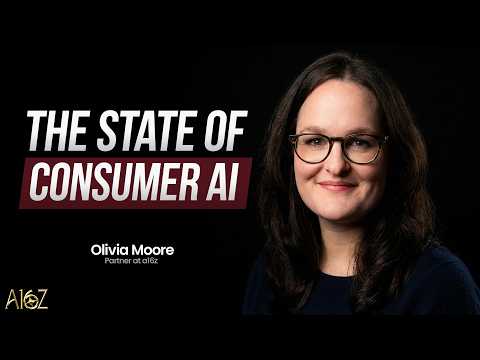
Inside a16z’s Top 100 AI Apps Report with Olivia Moore
ChatGPT leads distribution at 2.7× Gemini on web and nearly 30× Claude, while Claude and Gemini are developing differentiated prosumer and creative use cases.Context, memory, and authentication could deepen platform lock-in, but monetization remains unresolved as ChatGPT pursues ads and transaction cuts while agents face a distribution bottleneck.
a16z, Anish Acharya: Is SaaS Dead? Do Margins Still Matter? Why We Are Not in an AI Bubble?
AI is exposing SaaS’s switching-cost moat, not eliminating software: coding agents make SAP-to-Oracle migrations cheaper, while 75% of public SaaS companies raised prices after ChatGPT.Apps that orchestrate specialized models may retain value, but Harry says Cursor could lose half its revenue this year to Claude Code; OpenAI’s $20B topline, fully spoken-for inference supply, and rising prices support the non-bubble case.
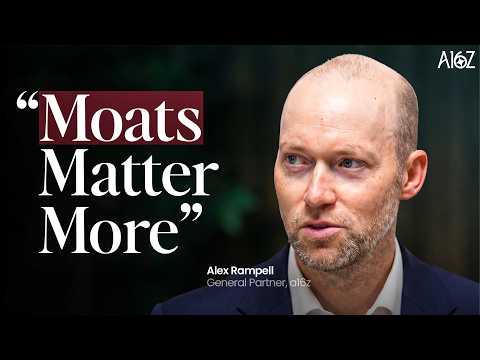
The AI Opportunity that goes beyond Models
Alex RampellJen KhaDavid HaberAnish Acharya
AI is becoming a full software cycle atop smartphones and cloud infrastructure, with roughly 15% of adults globally using ChatGPT weekly.Greenfield systems and labor automation offer the cleanest openings, while Salient’s 50% collection lift favors revenue creation over savings-only pitches.Durability depends on owning workflows and private outcome data as models commoditize and incumbents monetize installed distribution.

Where does consumer AI stand at the end of 2025?
Anish AcharyaOlivia MooreJustine MooreBryan Kim
ChatGPT retained 800–900 million weekly users while Gemini’s desktop growth reached 155% year over year, making image and video launches the clearest competitive catalyst.Labs still struggle to turn distribution into breakout vertical products, leaving openings in persistent prosumer workflows, multimodal creation, and power-user applications constrained by compute economics.
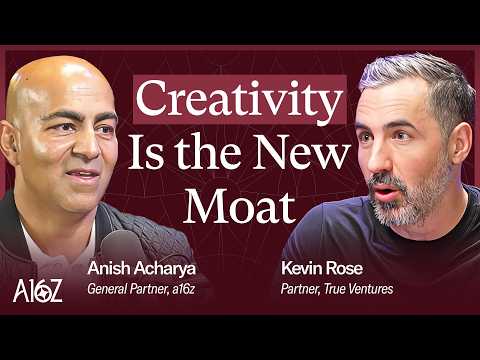
Why Creativity Will Matter More Than Code | Kevin Rose and Anish Acharya
Consumer AI is reopening a market Acharya compares with 2010–2012, with ChatGPT at $200 a month, Google Ultra at $250 and Grok at $300 signaling unusually strong willingness to pay.As software creation costs collapse, startups can win through personality, model choice, orchestration and product taste, while companionship’s agreeability and always-on memory’s privacy-preserving social contract remain unresolved risks.