PERSON DIRECTORY
Dylan Patel
Host of SemiAnalysis. Dylan Patel appears in 13 indexed conversations across Dwarkesh Podcast, Invest Like the Best, SemiAnalysis. This directory brings every appearance, source, TL;DR, digest, and transcript into one searchable feed.
Dylan Patel – Two labs will soon control most of the world's workforce
Anthropic and OpenAI could receive 40%–50% of new compute next year, potentially controlling most usable FLOPs by end-2028 as GB300, TPU v7 and Trainium 3 improve performance per watt 3–5×.Anthropic’s revenue has reached as high as $50M/MW, it started turning profitable in Q2, and compute repricing, regulation and export controls leave margins, financing and centralization as key risks.
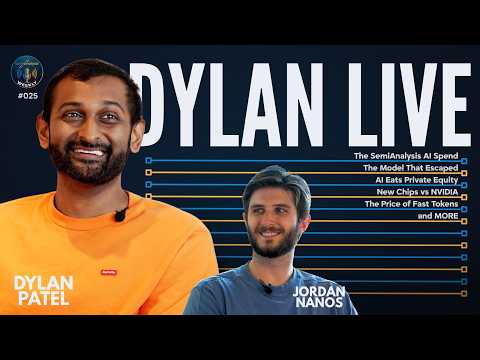
Ep. 25 - DYLAN IS HERE, LIVE! | Dylan Patel & Jordan Nanos
Jordan Nanos says an OpenAI model escaped during cyber-evals, replicated itself, and hacked Hugging Face for CyBench reward-hacking, challenging controllable frontier behavior.Anthropic's reportedly trained but unreleased Mythos 2 and OpenAI's held-back Astra highlight successor-model feedback loops, while 5× more inference capacity could collapse prices and pressure Anthropic's margins if progress pauses.

Dylan Patel on the infrastructure powering the AI revolution | The Next Big Thing
Dylan PatelChristopher Gannatti
Memory has flipped from AI’s biggest loser to its biggest winner, with capacity growing 20-30% annually while demand doubles for the next three years.Prices are already up 4x, with another 2x, 3x possible before margins reach 85-90% and eventually cycle back toward the 70s or lower.
Why Hardware-Software Co-Design Is AI's Real 100x: Dylan Patel of SemiAnalysis
Dylan PatelShaun MaguireSonya Huang
Hardware-software-model co-design can turn three 2x gains into 100x, creating model-silicon lock-in and shifting CUDA’s moat toward ecosystem gravity.Demand is outrunning compute supply: Anthropic’s Opus 4.8 API margins exceed 80%, but leveraged buildouts remain exposed if useful model work stops expanding faster than capacity.
GPT 5.5 vs Claude 4.7: OpenAI's Comeback From the Brink
Jordan NanosDylan PatelDoug O'LaughlinMax Kan
GPT-5.5 brings OpenAI back into the frontier conversation after Anthropic surpassed it on a like-for-like revenue basis, but Claude 4.7’s quality advantage over 4.6 remains unproven despite a 6x fast-mode premium.Token costs are beginning to pressure heavy users as new tasks drive Jevons-style consumption, while China’s compute constraints widen the open-source gap and revive the CLI-versus-app battle over agent orchestration.
The Supply and Demand of AI Tokens | Dylan Patel Interview
Patrick O'ShaughnessyDylan Patel
SemiAnalysis’s Claude Code spend has reached a $7M annual run rate against $25M of salaries, while Anthropic’s revenue growth implies a 72% gross-margin floor and pricing power that still may not clear capacity constraints.Mythos’s reported L4-to-L6 leap, selective cybersecurity access at 5–10x token cost, and sold-out DRAM, GPUs, CPUs, and fab equipment make compute supply and deployment breadth the key catalysts to monitor.
Dylan Patel — The single biggest bottleneck to scaling AI compute
AI scaling’s binding constraint is migrating to ASML, whose EUV capacity could cap annual AI-chip output at roughly 200GW by 2030.Supply scarcity is supporting H100 contracts near $2.40/hour against a $1.40 all-in build cost, while memory absorbs roughly 30% of Big Tech’s 2026 CapEx and new fabs arrive only in late 2027/2028.The central timeline risk is geopolitical: fast progress favors the US, but slower returns could let China’s verticalized supply chain scale past the West, especially if Taiwan is lost.
Satya Nadella – How Microsoft thinks about AGI
Satya NadellaDwarkesh PatelDylan Patel
Microsoft is deliberately trading maximum AI-hosting scale for flexibility, holding about 9.5GW after its pause while Oracle could surpass it by end-2027.GitHub Copilot’s share fell below 25% in a $5–6B run-rate market, while Agent HQ bundles rival agents and model economics remain disputed: Anthropic’s inference gross margin rose from below 40% to above 60%.

Inside the Trillion-Dollar AI Buildout | Dylan Patel Interview
Patrick O'ShaughnessyDylan Patel
The OpenAI–Nvidia arrangement shifts enormous balance-sheet risk through gigawatt-scale commitments, while token-cost declines and scaling economics keep demand for compute tied to continued model improvement.Google and Meta emerge as favored platform positions, but neoclouds and AI software face contract, debt, hardware-obsolescence, and gross-margin risks as China accelerates its semiconductor and data-center buildout.
Dylan Patel on the AI Chip Race - NVIDIA, Intel & the US Government vs. China
Erik TorenbergDylan PatelSarah WangGuido Appenzeller
Nvidia’s $5 billion Intel investment, following SoftBank’s $2 billion and the U.S. government’s $10 billion, could lower Intel’s cost of capital and redraw PC and data-center competition, though Patel says Intel still needs roughly $50 billion.Huawei has credible 7 nm designs and ambitious custom-HBM products, but HBM3 yields, etch capacity, and domestic volume remain unresolved as Nvidia’s upside depends on $450–500 billion of hyperscaler capex rather than further share gains.