Gains Network: Real Revenue, Real Burns - $39m FDV, $15M revenue, $11M buybacks, 2.5× P/E
Tl,dr:
- ◆gTrade (on Gains Network) is a trading protocol on Arbitrum, Base, Solana and Polygon offering up to 1000x leverage across 290 assets in crypto (252), forex (17), stocks (14), and commodities (3), with a strong focus on short-term scalping.
- ◆Operating a vault-based trading system where pooled liquidity backs all leveraged trades, since its launch in October 2021, Gains has generated $111bn in cumulative volume ($83bn since Hyperliquid’s mainnet launch in February 2023) and $67m in fees ($47m since Hyperliquid’s mainnet launch) proving a clear PMF and consistent staying power in face of competition (post Hype launch and post Aster/Lighter/Avantis points campaigns).
- ◆As of November 2nd 2025, Gains has $133m daily trade volume (30-Day moving average)and $42k daily fees (30-Day moving average) of which 55% are used for buybacks and burns (in addition to ~15% of total traders’ losses).
- ◆Trading at $1.47/token with a MCap/FDV of $39m and $15.3m in annualised fees (30-Day moving average * 365), Gains is trading at a P/E of 2.5x. Based on buyback and burn (BBB) of the last 30 days, Gains burns 8m tokens annually, leading to an annual deflation of 29.5%. Ceteri paribus, we will see the total supply being burnt by February 2029, making it a slow, yet steadily growing growth story.
Thesis:
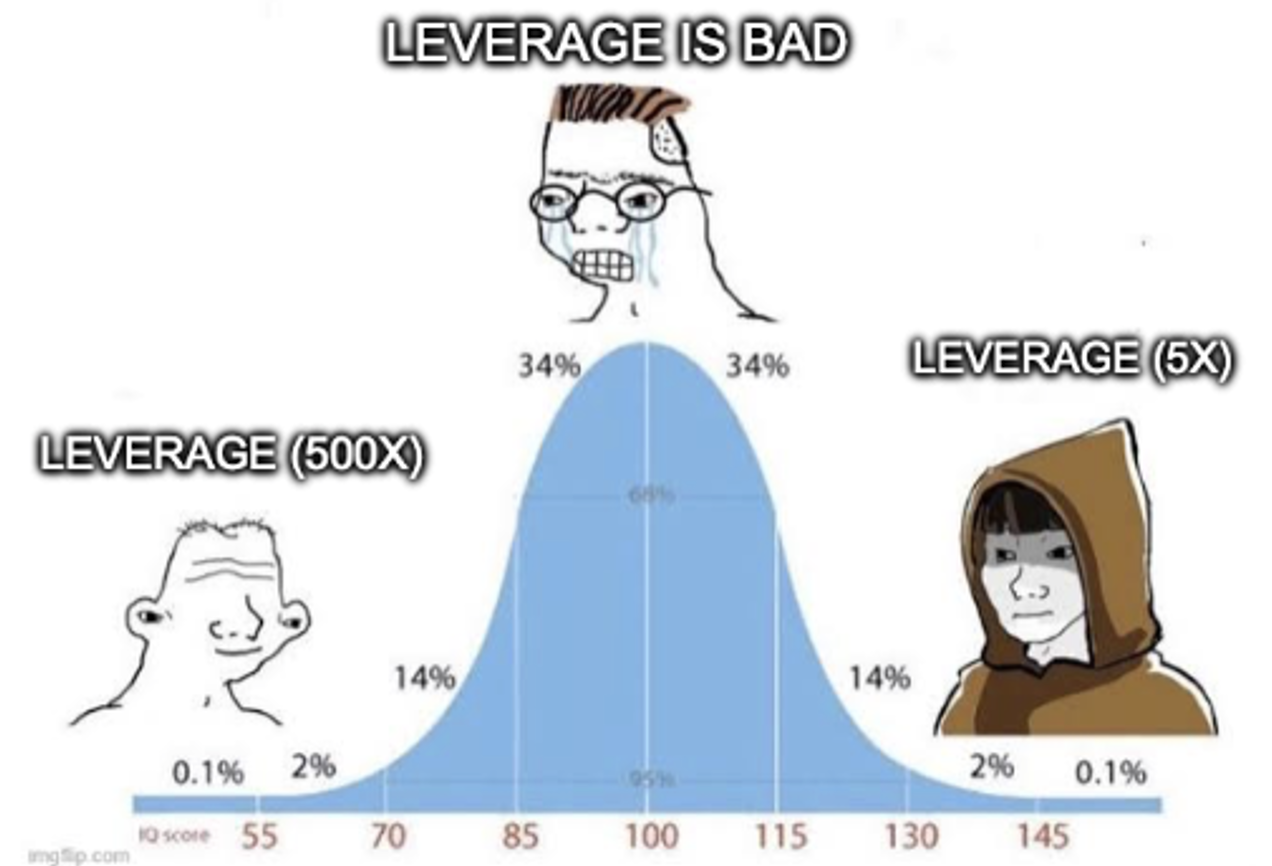
- ◆Gains has a clear PMF on the left-curve (degen) end of the trading community through its high-leverage, low-slippage, high-reliability short-term products across crypto, stocks, commodities, and forex. Proof points include consistently high daily volumes ($133m daily trade volume based on the 30-Day moving average) and a loyal user base (450 DAU based on the 30-Day moving average). The numbers have even improved following the launch of Avantis (which itself is a Gains fork), Lighter and Aster.
- ◆Because trades are typically held only hours or days, users churn positions 3–4x more often than on competing platforms, resulting in higher fees per unit of volume.
- ◆The protocol is currently generating $15.3m annualized fees (P/E 2.5x), with $8.4m (55% of total fees) directed to token buybacks. In addition to the $8.4m coming from fees, Gains uses ~15% of negative trader PNL ($2.3m annualised based on the last 30 days performance) for BBB, amounting to ~$11m in total buyback and burn pressure.
- ◆Tldr;Clear PMF, strong fundamentals ($10–20m annual revenue), and robust flow dynamics (55% of revenue funnelled into buybacks + 15% of negative trader PNL).
Product
- ◆How is the v10 product driving more trades?
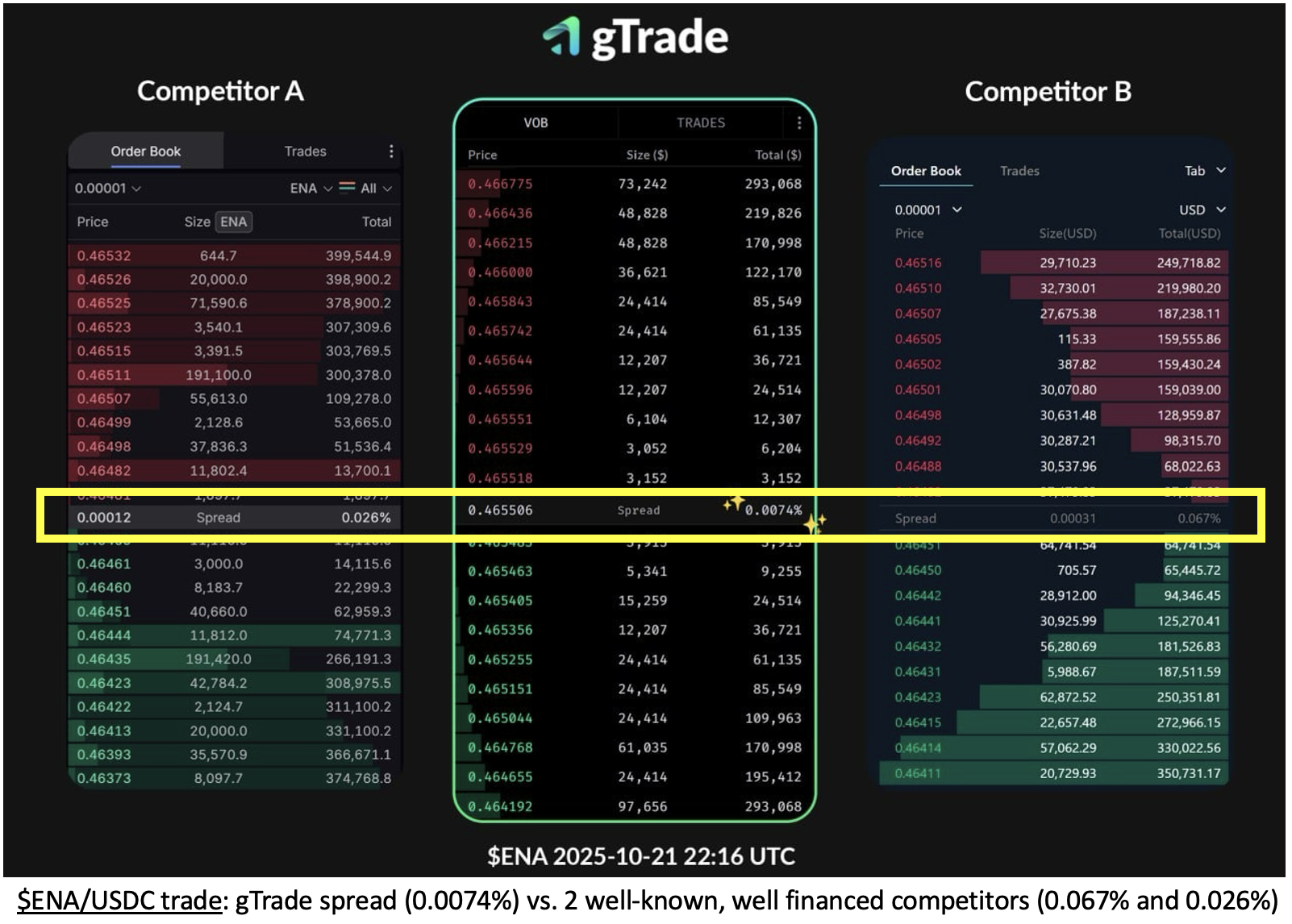
- ◆gTrade v10 upgrades the protocol from a pure borrowing-fee model to a more scalable funding-fee system with lower spreads, making holding costs more predictable and appealing to longer-term traders while still catering to short-term scalpers.
- ◆New features like counter-trade incentives, PnL withdrawals, and native price discovery improve execution quality, capital efficiency, and market sustainability. By broadening its appeal from degen scalps to directional traders, arbitrageurs, and integrators, v10 significantly expands the addressable flow base.
- ◆In short: v10 turns Gains from a niche high-leverage product into a more balanced trading platform built to scale.
- ◆What else is on the product roadmap?
- ◆Gains’ roadmap focuses on expanding products, liquidity, and onboarding users (with a $400k trading competition).
- ◆Upcoming launches include volatility perps (BVIV, EVIV), multi-collateral trading, and a deeper push onto Solana. The vault model will evolve toward “Global OI,” first unifying collateral on each chain and then enabling cross-chain liquidity, unlocking deeper pools, smoother fees, and larger open interest limits.
- ◆On the front end, gTrade Lite, social logins, and gasless transactions on Base will streamline the UX, making the platform easier and more intuitive for new users.
Metrics, KPIs, User behaviour
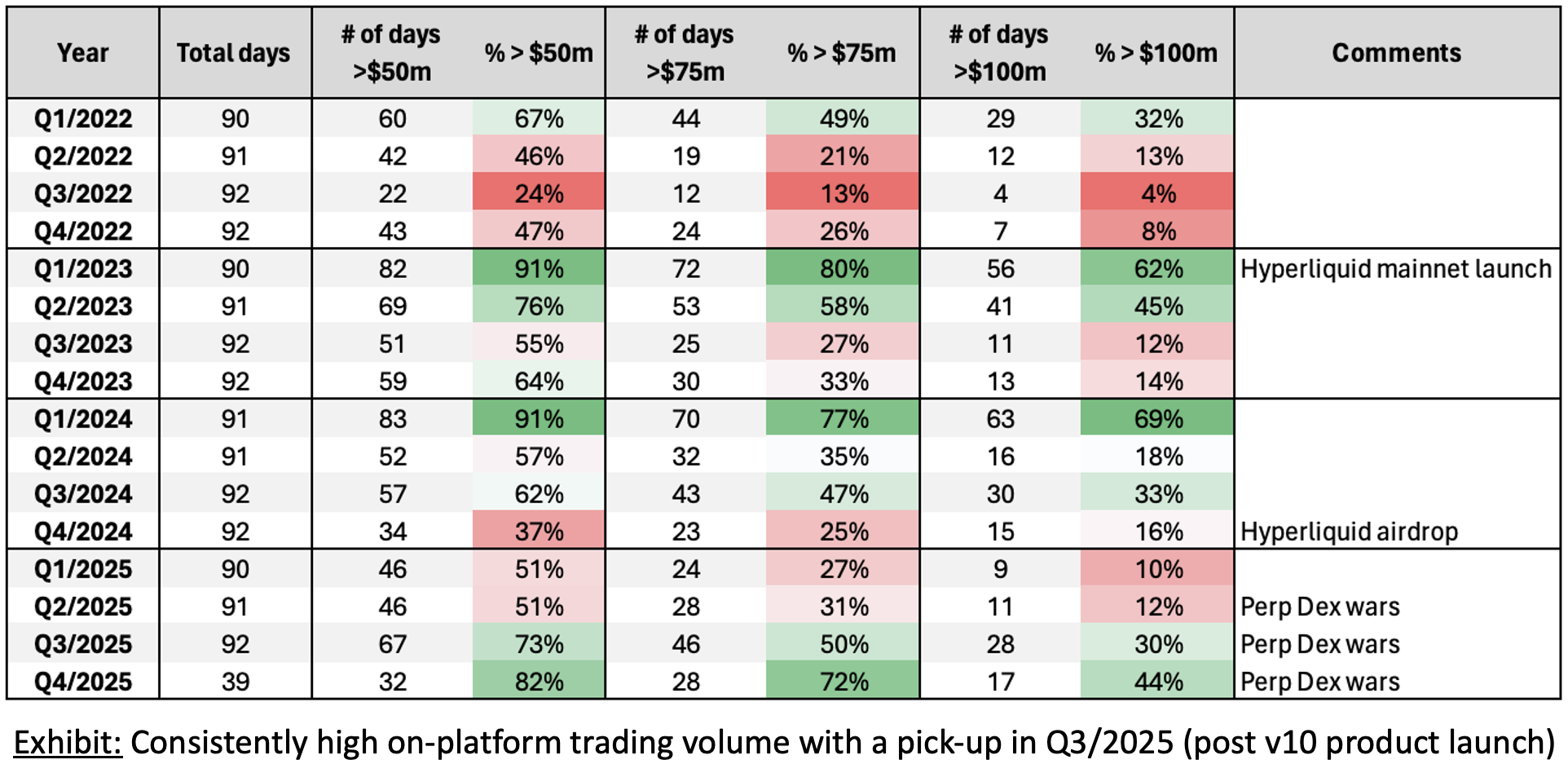
- ◆Daily trade volume: consistent daily volume of >$100m ($133m is the 30-Day moving average) even post Hyperliquid launch; volume is correlated with overall trading activity; since the launch of v10 in early August 2025, daily volume has been consistently picking up to $100m+.
- ◆Daily fees: On-off fees for open and close depend on the underlying asset: Crypto (0.06% - 0.06%), Forex (Major - 0.012% - 0.012%), Forex (Minor - 0.016% - 0.016%), Stocks (0.07% - 0.07%); in addition, there are borrowing fees when using leverage depending on demand/supply of the asset. 55% of fees are used for buy-back and burn, 24.5% go to the treasury for operations, and 15% are distributed to the vaults, where users deposit USDC, DAI, ETH, or GNS to provide liquidity that backs leveraged trades.
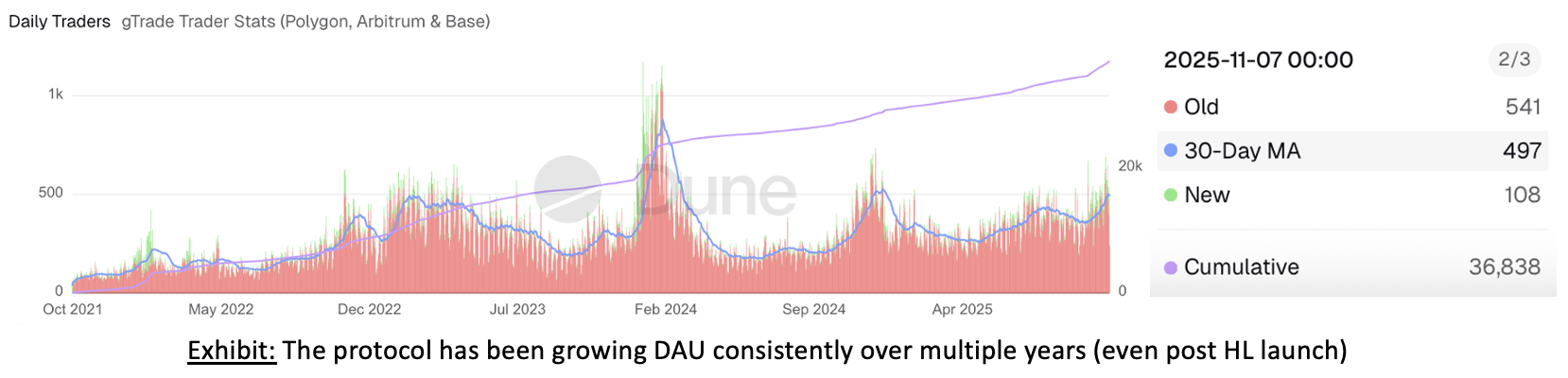
- ◆Daily traders: Even in bear markets, gTrade is consistently having 300+ DAU, which is growing to 450+ DAU during bull markets. The protocol consistently onboards 30+ new users per day (yet long-term retention is proving challenging). We see that even post HL launch, Gains is onboarding new users, indicating a PMF with users who are not served by HL and others. For us, this points to a consistent value story. Gains is one of the few things in Crypto which has a sustainable and consistent PMF across multiple years.
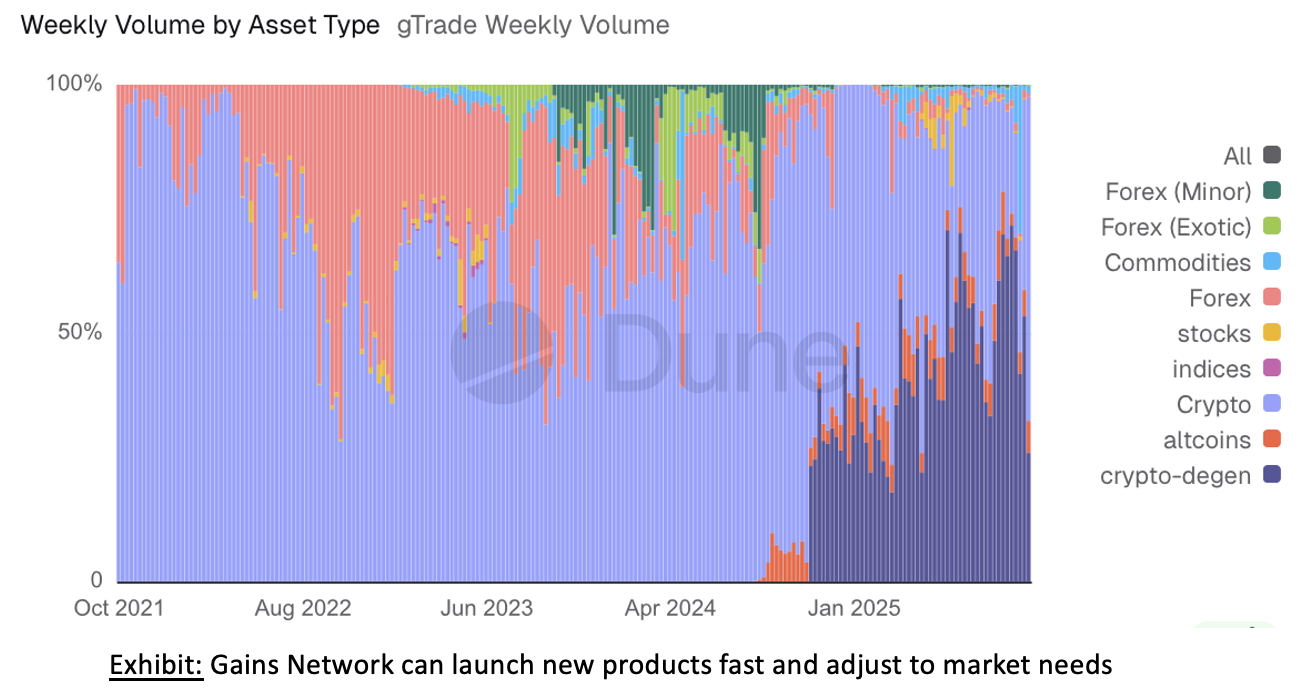
- ◆Volume split across products: Significant growth due to Degen products (launched in November 2024), which account for 35-60% of daily volume. Trading composition is changing rather rapidly (depending on what the flavour of the month is), from Forex (summer 2024), to commodities/ stocks (Gold rush + Crypto stocks in Q2/2025). This shows that the company has proven their ability to add assets who are in demand by users, meaning they can innovate on the product side (seen with the launch of the 500x leverage Crypto degen product or the 1000x Forex product).
- ◆User behaviour: gTrade allows for high leverage, yet also charges higher funding rates, making its product tailored for quick scalps of max. several hours/days. gTrade has a certain capacity for trades: i.e.: BTC has max. open interest of $15m. As users enter big positions (i.e.: $12m long), there is a Long/short imbalance leading to >50% APY, forcing the user to eventually close the long, leading to a shorter, scalping-friendly behaviour. With the new v10 update (August 2025), funding rates are now smoother and less aggressive, since liquidity providers help balance the market. This change makes it easier for traders to keep positions open for longer, not just scalp quickly, targeting new users. Early signs are promising: daily open interest has grown 5x since v10 launched, as more traders take countertrades to farm funding fees, reducing costs and supporting longer-term strategies.
Tokenomics
- ◆Staking vs. BBB: Since its creation in October 2021, Gains has created $67m of cumulative revenue, which was distributed to stakers until the implementation of its buy-back and burn (BBB) mechanism in November 2024. This made a lot of sense as staking revenue usually leaves the ecosystem (just talk with your regular founder who has a staking-reward project), while buy-back and burn drives flows to the project.
- ◆Total BBB since November 2024: Since its BBB community vote one year ago, Gains has bought back and burnt 6.2m GNS tokens, reducing the supply from 33.6m GNS (Nov, 5th 2024) to 27.4m GNS (Nov, 10th 2025) representing an annualised deflation/burn rate of ~19% over the last 12 months.
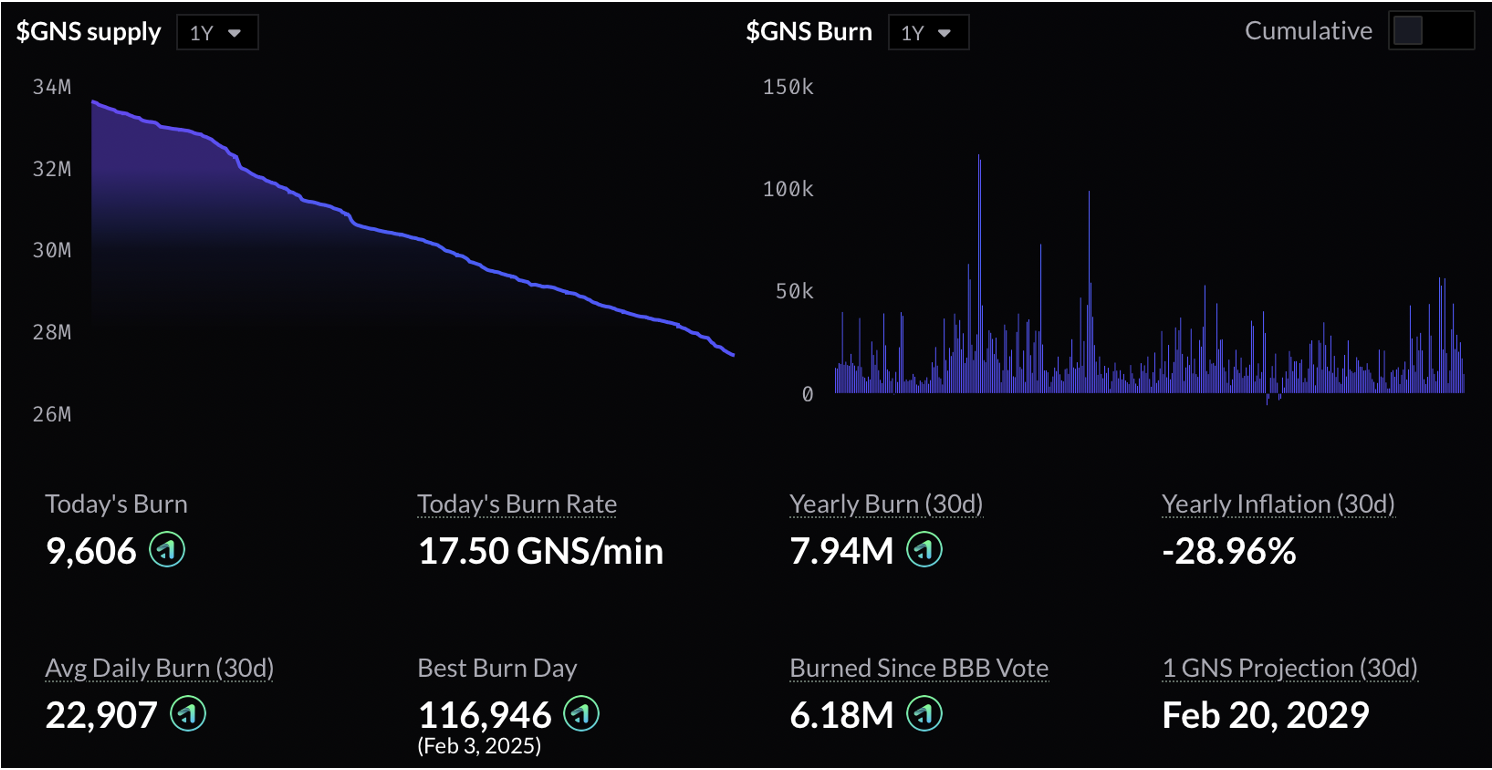
- ◆Current fees and BBB (November 10th, 2025):
- ◆Over the past 30 days, the protocol burned 676k GNS (~$1.0m), an annualized deflation rate of ~25%. If prices and burn pace remain similar to the last 30 days, supply would trend toward 1 GNS by Feb 2029, a timeline that’s become a core community meme and rallying point.
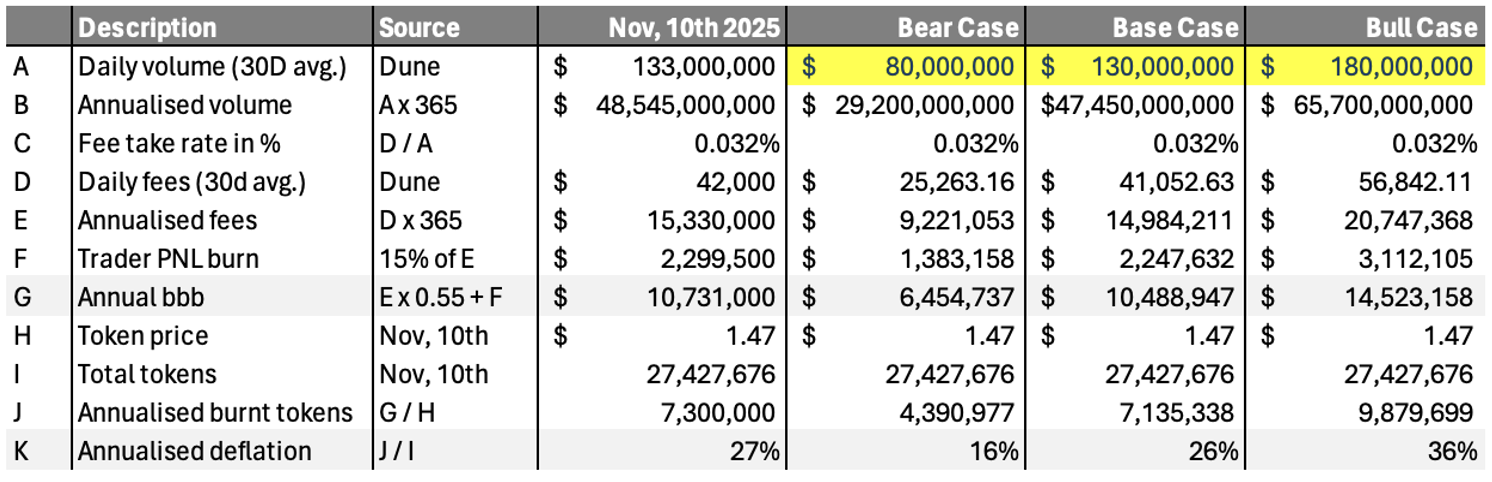
- ◆BBB projections going forward: Even in a bear case scenario (volume of bear market) the project buys back $6.5m (assuming current prices, 16% deflation).
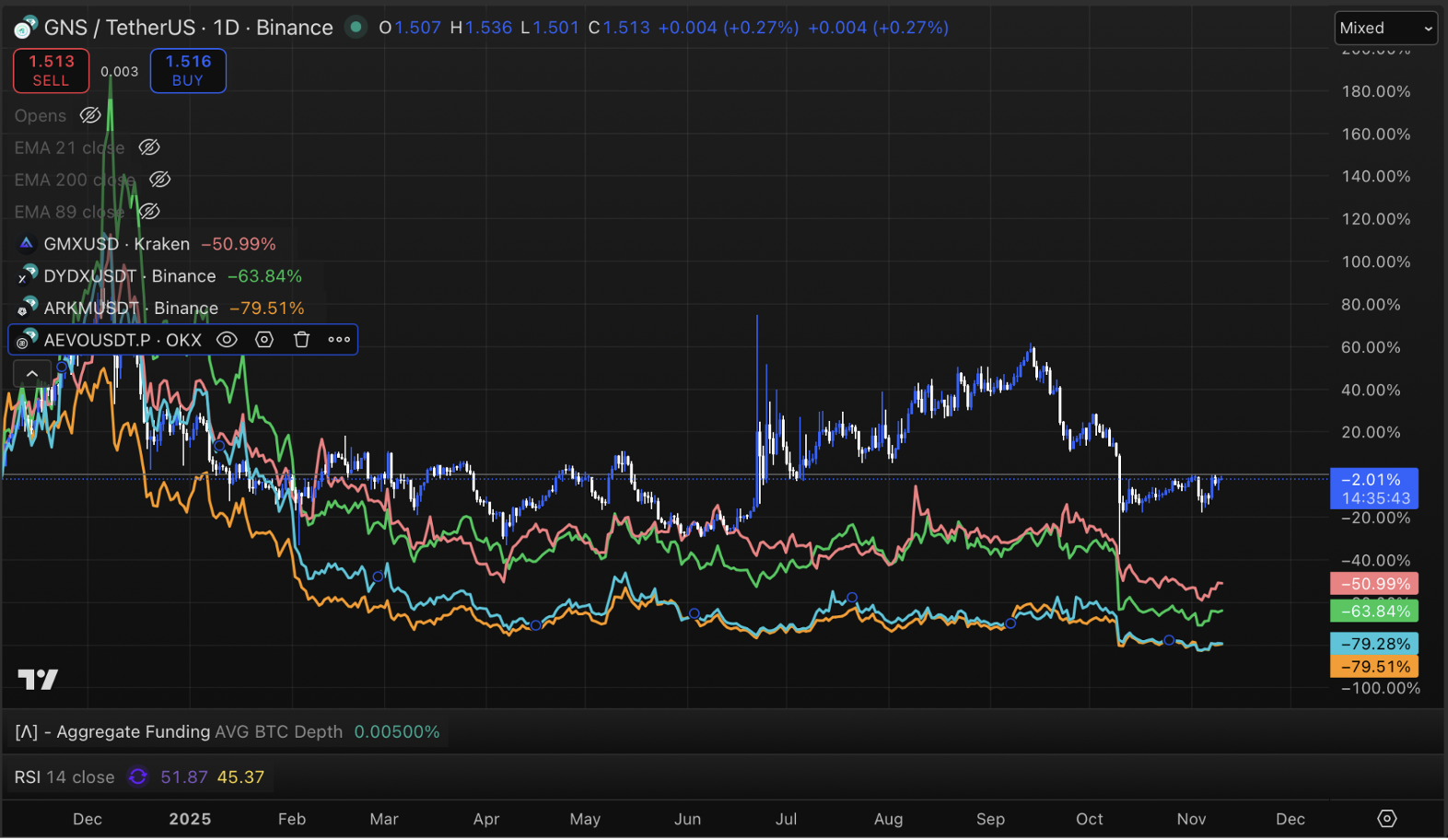
- ◆Impact on token price: Yes, it is hard to measure the causal impact of BBB on the token price action, given price is dependent on many variables. However, we can compare its performance to its peer group of GMX, DYDX, ARKM, AEVO. While the direct impact of BBB is hard to assess, GNS has outperformed its immediate peer group since the inception of GNS’s BBB program in November 2024 [GNS -2%; GMX - 51%; AEVO - 79%; ARKM - 80%;]
Risks and Mitigation:
- ◆Risk 1 - Vault-based model risk: Synthetic leverage creates the possibility of vaults being drained, as seen during the FTX crash when a “too successful” trader forced a founder backstop.
- ◆Mitigant 1: Gains introduced multiple safeguards such as higher borrowing fees, vault overcollateralization, automated screening of suspicious traders, and strict maximum trade sizes.
- ◆Risk 2 - Competitive threat (e.g. Hype, others): Could competitors steal users?
- ◆Mitigant 2: Despite multiple challengers over months and years, Gains has consistently retained its user base while growing volumes.
- ◆Risk 3 - Market perception: Is it sexy enough that the market will bid it?
- ◆Mitigant 3: gTrade has been for many years, hence being widely disregarded by the Crypto community (as it is not “flashy” anymore - which makes it less likely that CT will hail it as the next Hyperliquid). However, we believe that fundamentals are speaking louder: trading at a $39m MCAP/FDV (with 0 upcoming unlocks), delivering $15m annual revenue, and driving $11m in yearly buybacks is compelling. Even without speculative demand, gTrade’s sustained PMF, its competition resilience, and its recurring buy volume create structural upward pressure on price (ceteris paribus) over the mid (12 months) and long-term (2-3 years).
Conclusion
Gains Network and its trading protocol gTrade has established itself as a leading degen-friendly trading protocol with clear PMF, consistently high volumes, and strong revenue fundamentals. The v10 upgrade expands its reach beyond scalpers by introducing funding-fee markets, counter-trade incentives, and capital-efficient features, setting the stage for broader adoption. With $15m of annual revenue, GNS combines growth with structural value accrual. While risks exist, Gains has shown resilience through innovation and risk management, making it a fundamental growth story over the mid- to long-term.
General Disclaimer
This presentation is not an offer to sell securities of any investment fund or a solicitation of offers to buy any such securities. An investment in any fund, including the digital asset strategies described herein, involves a high degree of risk. There is no guarantee that the investment objective will be achieved. There is the possibility of loss, and all investment involves risk including the loss of principal. The author makes no representation as to the accuracy or completeness of such information. Opinions, estimates and projections in this presentation constitute the current judgment of the author and are subject to change without notice. Any projections, forecasts and estimates contained in this presentation are necessarily speculative in nature and are based upon certain assumptions. The author holds the token described.
It can be expected that some or all of such assumptions will not materialize or will vary significantly from actual results. Accordingly, any projections are only estimates and actual results will differ and may vary substantially from the projections or estimates shown. This presentation is not intended as a recommendation to purchase or sell any commodity, security, or asset. The author has no obligation to update, modify or amend this presentation or to otherwise notify a reader thereof in the event that any matter stated herein, or any opinion, project on, forecast or estimate set forth herein, changes or subsequently becomes inaccurate.
Affiliate Disclosures
- •The author and/or others the author advises do not currently hold, or plan to initiate, an investment position in target.
- •The author does not hold an affiliated position with the target such as employment, directorship, or consultancy.
- •The author is not being compensated in any form by target in relation to this research.
- •To the best of the author's knowledge, the information provided here contains no material, non-public information. The accuracy of the information is the responsibility of the reader.