$RNGR Bull Thesis: The Cross-Chain Aggregator Set to Become DeFi’s Command Center
$RNGR is the culmination of DeFi’s evolution. Through the years, up until now, there are too many layer 1s, and fragmented liquidity continues to exist across DeFi products. Capital inefficiency and a plethora of user interface changes plague users.
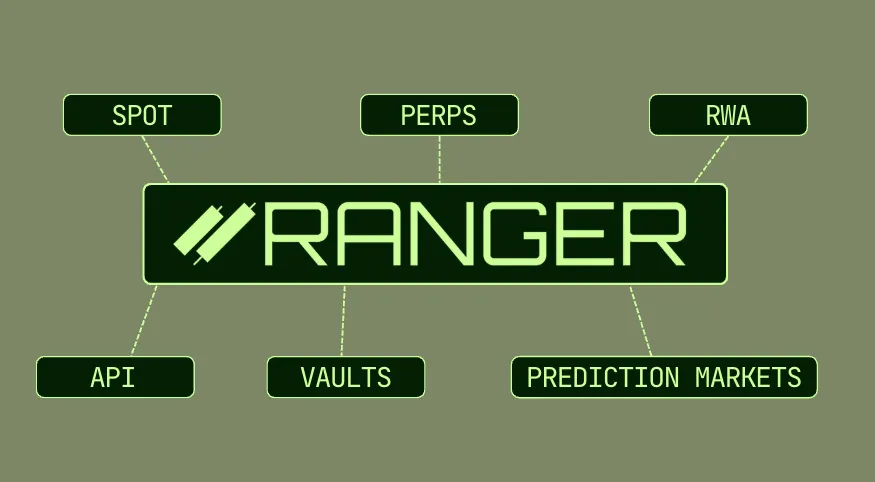
RNGR solves this through aggregation and abstraction of cross-chain DeFi:
- ◆Brings the best of Solana DeFi to users in 1 app: Seamless access to top protocols (perps, swaps, vaults).
- ◆Cross-chain integrations = more robustness: If one chain or protocol goes down, the app stays up. User-centricity skyrockets.
- ◆Aggregators drive discovery for DeFi protocols: Especially when complexities are abstracted away—think pair trades, DeltaNeutral strategies, iceberg orders, basis trades, and smart routing.
Trade Thesis
$RNGR aggregates perps across Drift, Jup, Flash, and HL (with Ostium/Orderly queued and Pacifica/Bulk post-TGE), plus swaps via Titan integration. Ranger targets to abstract away complexities for users, such as Delta Neutral strategies, iceberg orders, and basis trades to enhance protocol discovery and system resilience. At assumed ICO FDV of $15M (more on this below), the base case price targets are 2.6x of comparable MetaDAO projects; volume scaling supports 3-5x. Sustained execution could reach 6x as fee revenues accumulate.
- ◆Core Functionality: Perps aggregation on key Solana protocols (with Hyperliquid access); swap routing via Titan. Enables abstracted trading strategies, reducing user friction and improving uptime during protocol or dapp outages.
- ◆Valuation Foundation: 10% capture of Solana spot ($500M/day) + perps ($200M/day) + 1% of HL (~$100M/day) = $800M daily volume. At 0.05% fees, this generates $146M annualized revenue; 3x P/S multiple implies $438M FDV (29x from ICO); 5x implies $730M FDV (49x).
- ◆Base Case (30% weight): 50% of Avici’s FDV comparable ($39.5M FDV) = 2.6x from ICO.
- ◆Comparables Case: 40% of Vooi’s $115M FDV prices RNGR at $45M FDV = 3x from ICO; parity on $46M annualized fees supports 4-6x increase in prices.
- ◆Catalysts:
- ◆Expanded Solana aggregation (Bulk, Pacifica)
- ◆Prediction markets (speculated)
- ◆API access
- ◆Smart order routing
- ◆Double dip in points farming
- ◆Vaults
- ◆Cross margin optimization
- ◆Fee buybacks (speculated)
Setup: Protocol Mechanics and Launch Timing
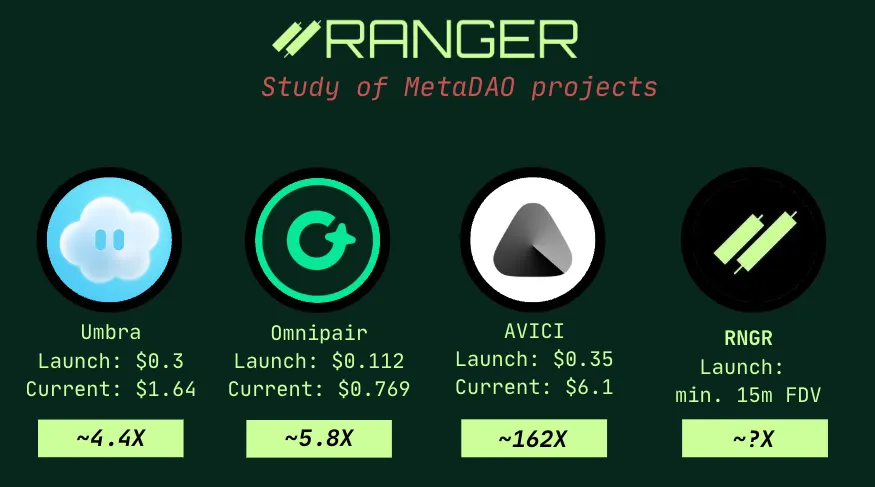
RNGR launches as a MetaDAO participant, product-ready alongside Avici and Omnipair, with immediate perps aggregation across multiple protocols. Cross-chain integrations provide robustness to the protocol, allowing users to leverage performance (from Solana and Hyperliquid) while mitigating single-protocol risks. Current market data highlights the opportunity: Solana DEX spot volumes average $5B/day (mid-November peaks exceed $7B), perps volumes ~$1.94B/day (24h as of late November), and HL at ~$7B/day (November cumulative ~$220.9B). RNGR's projected initial perps volume of $100-200M/week ($14-29M/day) can scale through efficient routing, prioritizing sustainable fee generation over short-term incentives, as users constantly save multiples through smart order routing.
The raise structure supports measured growth: $6M raised puts Ranger’s FDV at $15M, incorporating points multipliers and allocation boosts. Initial traction from MetaDAO exposure provides a valuation floor, while integration milestones drive compounding volumes, consistent with historical aggregator growth patterns.
Value Accrual: Aggregation as a Revenue Layer in Solana DeFi
RNGR functions as a unified interface for accessing protocols like Drift, Jup, Flash, HL for perps and Titan for swaps, capturing 0.05% fees on routed perp volumes and 0.1% on spot swaps. These fees, in future, can be directed toward protocol-shared revenue. From a perp DEX aggregator angle, increased integrations mean more fees earned from different venues, and also venue aggregation enhances reliability for users, as traffic automatically reroutes during disruptions, supporting higher retention.
In Solana's expanding ecosystem (spot and perps volumes up 2-3x year-over-year), aggregators can routinely secure 5-10% of direct flows by simplifying advanced strategies—pair trades, DeltaNeutral positions, iceberg orders, and basis routing. Current Ranger starts with $7-15k daily fees, scaling to Vooi-comparable $250M/day volumes yields $125k/day, or $46M annualized. Applying a 3x P/S multiple (aligned with conservative growth-stage peers) results in $138M FDV (9x from ICO); 5x implies $230M FDV (15x).
Strategic Positioning: Solana Perps Fragmentation and Precedent Analysis
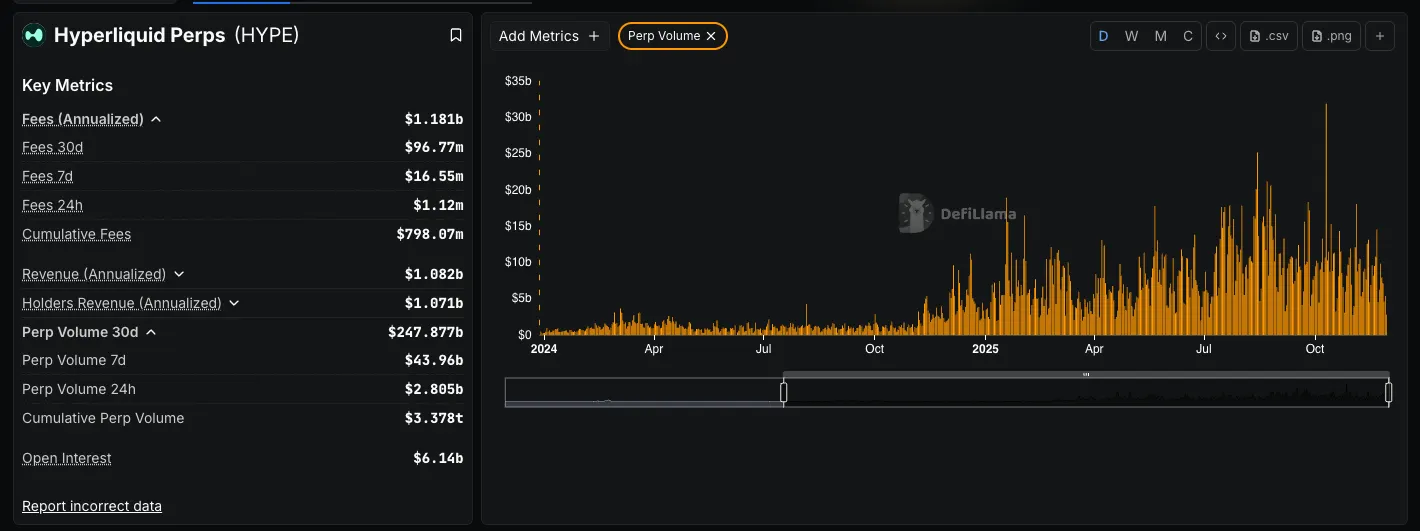
Solana's perps market, comparing with Hyperliquid’s volume at ~$7B/day, remains fragmented, creating demand for efficient routers. RNGR targets 10-20% of spot/perps volumes and 1% of HL without building proprietary infrastructure, leveraging partnerships like Titanand upcoming integrations (Pacifica, bulk trade post-TGE) for distribution. HIP-3's launch for HL in October enables permissionless perp markets, including stock indices (e.g., S&P 500, Nasdaq) and equities (e.g., NVDA, TSLA), with custom markets already hitting $500M+ daily volume—signaling broader "perpification" of traditional assets and amplifying HL's growth for RNGR to route.
Key comparables
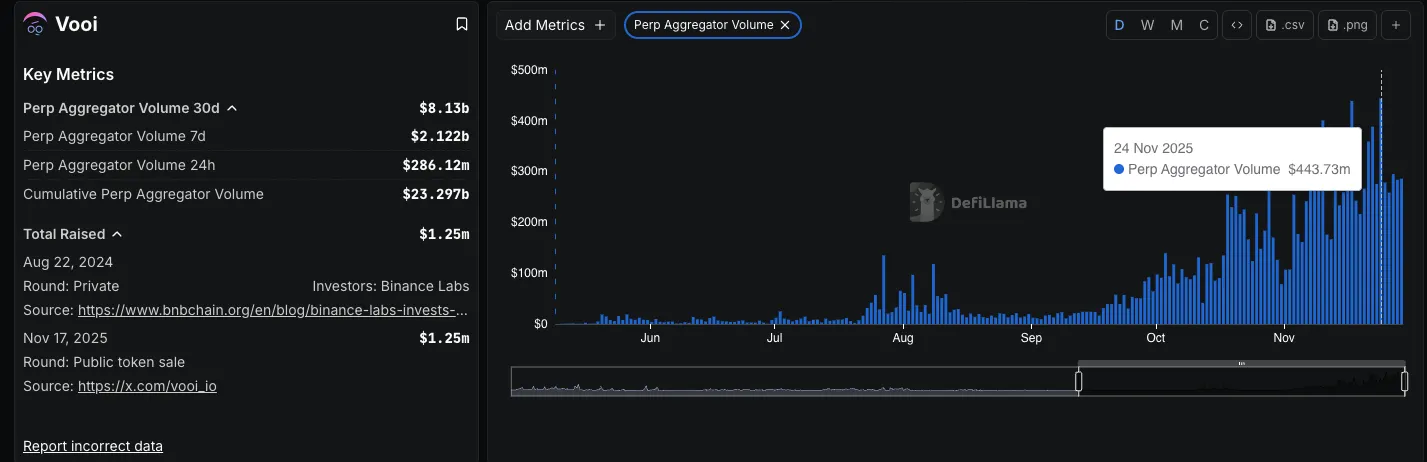
- ◆Vooi: Aggregates Ostium, HL, Orderly, Aster (Pro mode) and GMX, GNS (Light mode); 30-day average volume $271M/day ($8.13B total). Raised $1.25M at $112.5M FDV (8.6x oversubscribed), backed by Yzi.
- ◆RNGR Alignment: Solana-centric focus with similar scope; initial volumes lower but with symmetric scaling potential. At 40% of Vooi's multiple: $45M FDV (3x $15M FDV ICO). At 60%: $67.5M (4.5x).
- ◆Avici: $3.5M raised and reached an ATH of ~$93M FDV. At 50% relative to current valuation ($77.8M), RNGR would have a short term potential FDV target of $~39M (2.6x ICO).
Vooi's experience illustrates the dynamic: volumes doubled or tripled from early to October-November periods, lifting multiples. Will not go into details w.r.t. user experience on both platforms as bugs are expected to be ironed out for both teams. RNGR's MetaDAO entry establishes the 2-3x base, with fee realization extending to 4-6x in medium time-frames
Sensitivity Analysis: Volume-to-Fee Projections and Implied Valuations
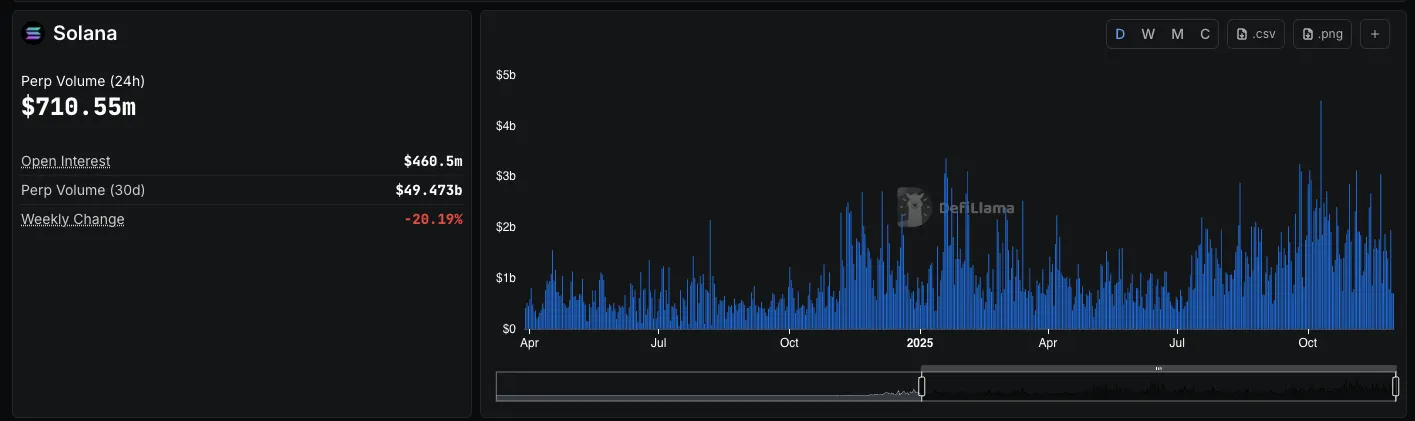
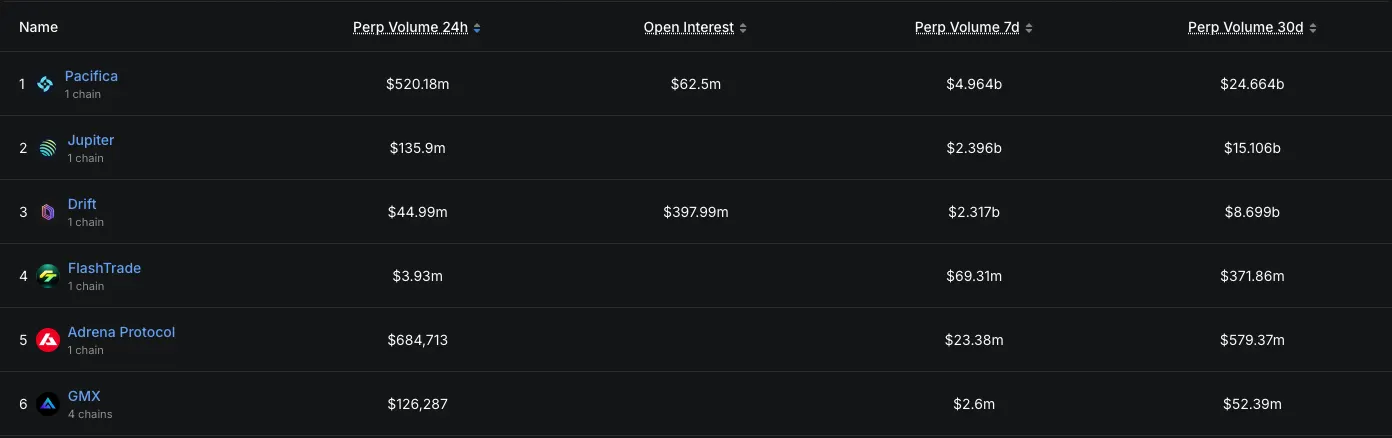
- ◆Base Capture Scenario: 10% of current volumes ($700M/day routed) → $350k daily fees → $~128M annualized → 3x P/S = $~438M FDV (25x ICO on full scaling); 5x = $640M FDV (49x).
- ◆Comparables-Adjusted (VOOI): $270M/day perps parity → $135k daily fees → $49M annualized → 3x P/S = $147M FDV (9x ICO); 5x = $245M FDV (15x).
- ◆Ownership Narrative (MetaDAO): 2.5-3x.
- ◆Execution Phase (Volume Parity in 1 year): 4-6x.
- ◆Catalyst Add-Ons: 20-30% revenue uplift (e.g., API and prediction markets contribute $10-15M annualized).
Yield Aggregation Extension
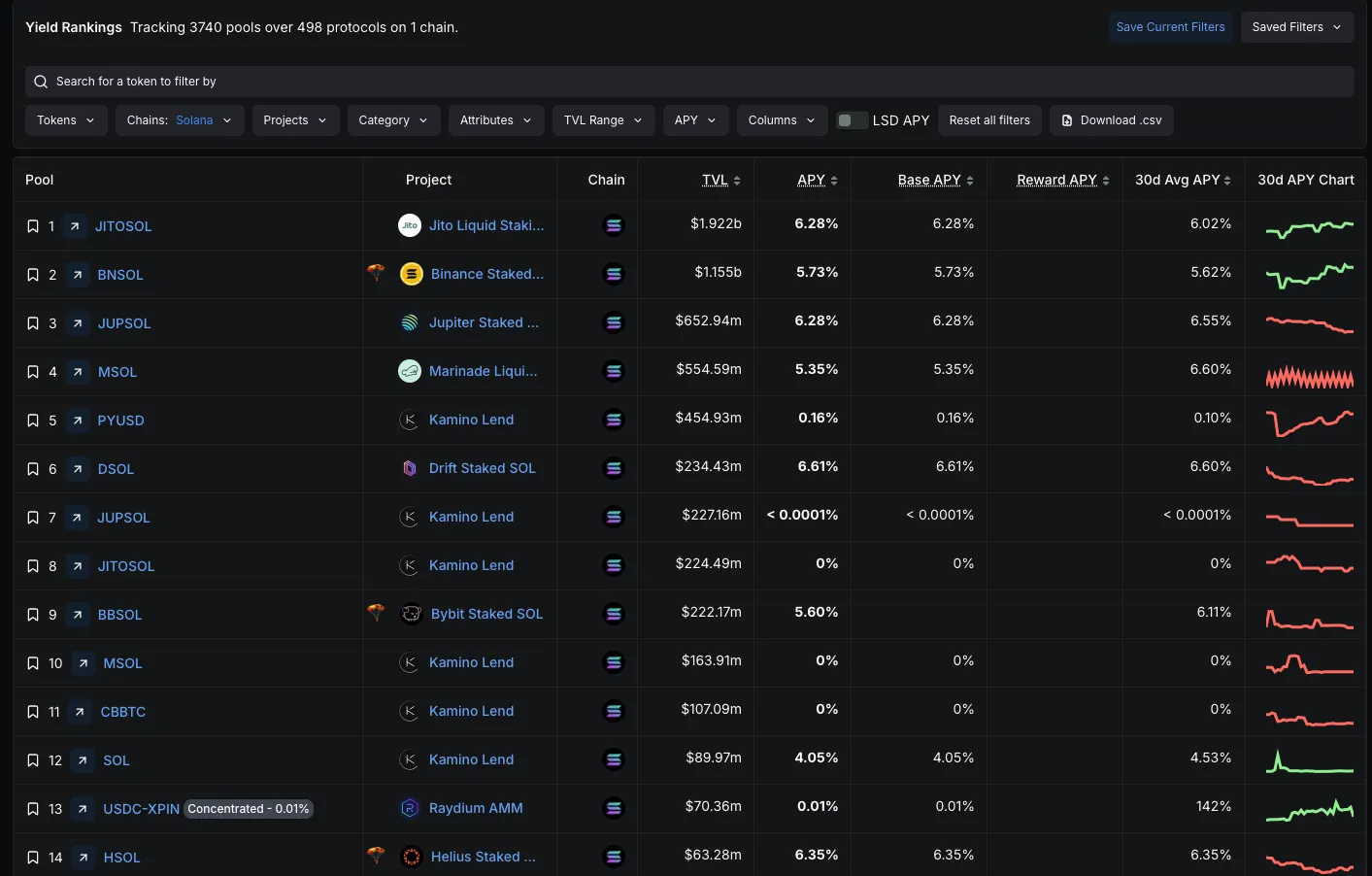
Expanding into yield routing adds a distinct revenue stream: Solana's yield TVL reached $121.5M as of late November 2025 (+12% month-over-month, per DefiLlama), comprising 1.2% of the $10.2B total DeFi TVL. Leading protocols include Drift ($55M TVL, 6.58% APY on perps staking/lending), Jupiter Staked SOL ($35M, ~7% APY), Orca DEX pools ($0.6M per pool, 10-30% APY), Francium (~$2.8M, 4.34% APY), and stablecoin farms (1-3% APY), with a network average of ~7%. Capturing 10% ($12.15M TVL) would generate $0.85M in annual yields pre-fees; a 20% performance fee captures $170k/year ($14.2k/month, $466/day), supplemented by ~$60-120k/year in swap fees (0.05% on inflows). This base assumes steady APYs; upside from higher yields or deposit flows could amplify, while rate compression poses a downside—positioning yields as an unpriced contributor to the 4-6x fee multiple.
Risks
- ◆Volume Constraints: Solana network congestion or shifts toward dominant protocols (e.g., Drift) could limit capture to below 10%.
- ◆Integration Timelines: Delays in post-TGE launches (Pacifica/Bulk) may slow initial adoption.
- ◆Competition: Protocols like Jup developing internal aggregation; RNGR requires timely delivery of smart order routing and points mechanisms.
- ◆Market Dynamics: Post-ICO sentiment wanes if fees underperform; broader sector volatility compresses aggregator multiples. Perp volumes for crypto pairs are down since 10/10’s sell off. HIP3 is driving new volume in Hyperliquid might be elevated due to Market-making access via Treadfi, coupled with growth mode and people aiming to farm Unit, Ventuals and Felix.
RNGR launches at an attractive entry point relative to comparables, with volume scaling as the primary driver. The 3-5x base reflects hype and precedents; 6x potential follows from fee compounding. Review for position sizing.
Disclosure: The writer intends to participate in the MetaDAO ICO for Ranger Finance.
Affiliate Disclosures
- •The author and/or others the author advises do not currently hold, or plan to initiate, an investment position in target.
- •The author does not hold an affiliated position with the target such as employment, directorship, or consultancy.
- •The author is not being compensated in any form by target in relation to this research.
- •To the best of the author's knowledge, the information provided here contains no material, non-public information. The accuracy of the information is the responsibility of the reader.