$GP -- the cheapest liquid proxy for the Solana launch-pad boom at ~1.3x Circ. Mkt Cap / Burn if Bonk keeps it up
TLDR:
Graphite Protocol is the cheapest liquid proxy for the Solana launch-pad boom and is tagging along Bonk’s meteoric take-over of Pump.Fun market share.
- ◆Cash-flow: BonkFun now grosses ≈ $1.36 m fees every 24 h; 7.6 % is auto-routed to a $GP reserve, funding ≈ $103 k/day (≈ $37.7 m/yr) of buy-and-burns.
- ◆Supply: Circulating supply is 27.4 m tokens, circ. market cap ≈ $50 m. Annual buy-backs at 35mm+ if Bonk can sustain the fees = ~75 % of float-cap.
- ◆Scarcity: > 50 % of tokens sit in staking, team, or locked wallets.
- ◆Re-rating path: CEX listings, fee-injection “events,” and Pump.fun’s TGE can push $GP to 3–5 × current price inside 1-3 months.
Memecoin Launchpads & Graphite
Memecoin launchpads have emerged as a dynamic sector within decentralized finance (DeFi), enabling users to create and trade meme-based tokens with ease. Bonkfun, a Solana-based platform, has recently overtaken Pump.fun, the historical leader, in key metrics such as daily revenue and token launches. According to DefiLlama, Bonkfun generates approximately $1.36 million in daily fees, reflecting strong user adoption and a 55.2% market share of Solana’s memecoin launchpad market as of July 2025. This shift underscores the growing demand for community-driven platforms like Bonkfun, positioning $GP as a strategic investment to capture this growth.
Graphite Protocol ($GP) is uniquely positioned to benefit from Bonkfun’s success through its 40% ownership stake and a 7.6% allocation of Bonkfun’s fees to its reserve. Unlike other tokens such as $PUMP (not yet publicly traded), $BELIEVE (no buyback), or $BONK (with a $2 billion market cap), $GP offers focused exposure to the memecoin launchpad ecosystem at a relatively low valuation. The protocol’s design emphasizes token scarcity through buybacks and burns, enhancing its appeal to investors seeking high-impact opportunities. Graphite Protocol also powers smart contracts and technology for Bonkfun and related projects like LiveBONK, adding to its ecosystem utility.
Fee Distribution and Buyback Mechanism
Bonkfun’s fee structure is a cornerstone of $GP’s investment case. As detailed on Bonkfun’s revenue dashboard, 7.6% of daily fees are allocated to $GP’s reserve, specifically for buying back and burning $GP tokens. With current daily fees at $1.36 million, this translates to:
- ◆Daily Buyback for $GP: $103,360 (7.6% of $1.36 million)
- ◆Annualized Buyback: $37.7 million ($103,360 × 365)
Given $GP’s circulating market cap of approximately $50.6 million (based on a price of $1.84 and 27.7 million circulating tokens, per CoinGecko), the annualized buyback represents 74.5% of its market cap. This significant burn rate suggests potential for substantial price appreciation, as reducing the token supply can increase value if demand remains stable or grows. The buyback wallet, trackable on Solscan, has already accumulated significant funds, with approximately 4,500 SOL (~$675,000 at $150/SOL) allocated to $GP buybacks to date, as noted by @iamkadense.
Metric Value Daily Fees (Bonkfun) $1.36 million $GP Fee Allocation (7.6%) $103,360 per day Annualized Buyback $37.7 million Circulating Market Cap $50.6 million Fully Diluted Valuation $115.1 million Buyback Impact Ratio 74.5% of market cap/year
The buyback mechanism is executed on a 7-day time-weighted average price (TWAP) basis, with the latest injection occurring on July 8, 2025. Given Bonkfun’s recent fee surge, the next injection could involve significantly higher funds, further accelerating the burn rate (if Bonk keeps it up, next injection should be 2x+ in size)
Token Supply Dynamics
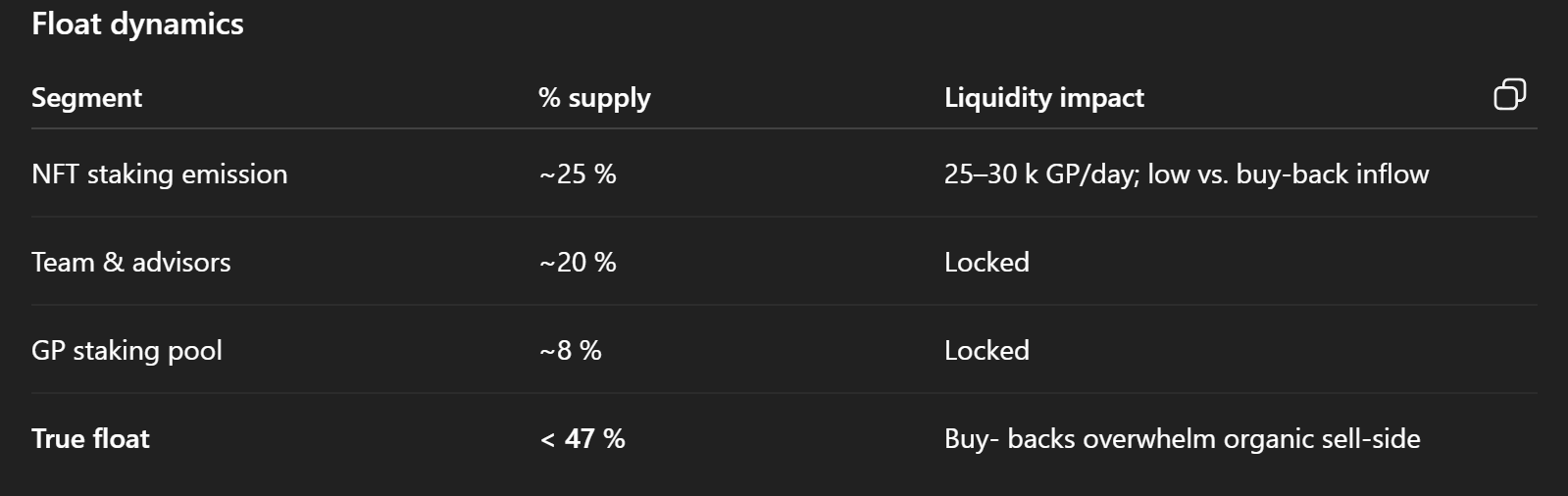
The effective circulating supply of $GP is significantly lower than reported due to locked tokens. According to an X post by @megastuffs, over 50% of $GP’s supply is held in illiquid forms:
- ◆#1 Holder (Taiyo NFT Staking): Emits 25,000–30,000 $GP daily, but these tokens are locked and not readily tradable. Many stakers, active since 2021–2022, may no longer be engaged in crypto, further reducing liquidity.
- ◆#2 Holder (Team): Held by the team, with no intention to sell, as confirmed by @megastuffs, who trusts the team’s commitment under founder @SolportTom.
- ◆#3 Holder (GP Stakers): Locked for 90 days, with stakers earning BonkLive rewards but no additional $GP emissions. Partnerships with projects like DabbaNetwork and Ranger Finance enhance staking incentives.
Valuation Comparison
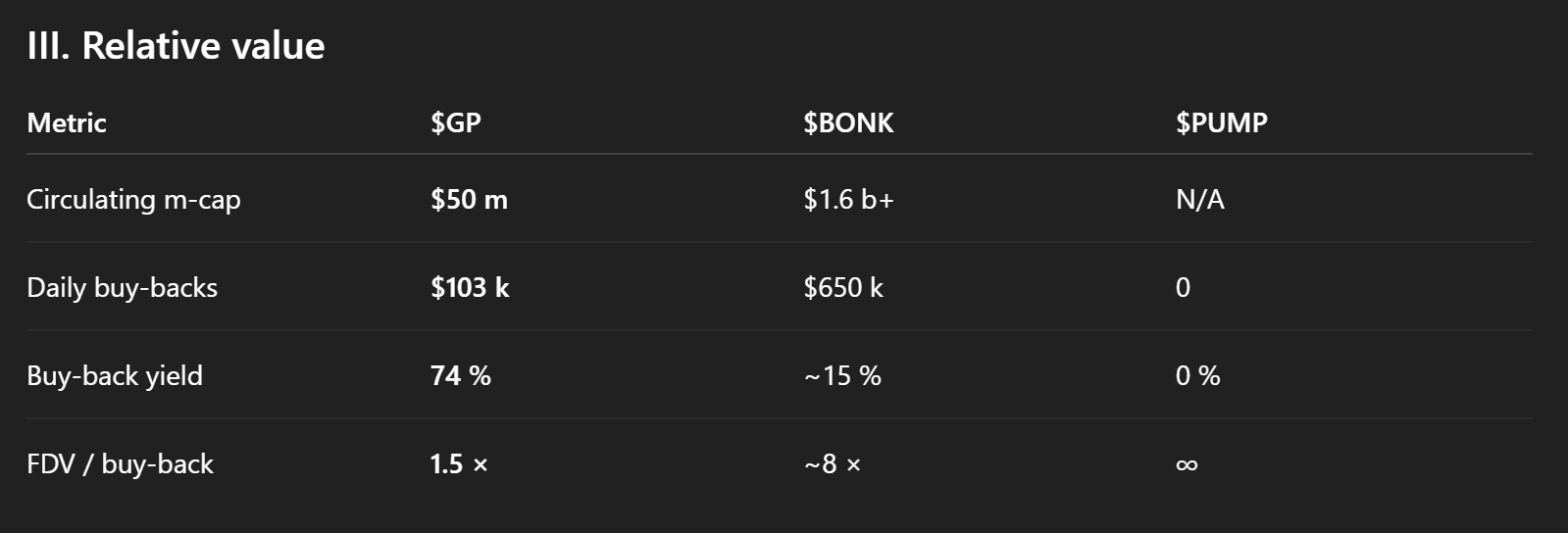
Compared to $BONK, which receives 50% of Bonkfun’s fees ($680,000 daily at current rates) but has a $2 billion market cap, $GP’s buybacks are far more impactful. An X post by @zinceth notes that $GP’s buybacks are 8.7 times more effective due to its smaller market cap. This disparity suggests that $GP offers a higher leverage play on Bonkfun’s success, with buybacks capable of significantly reducing supply and driving price increases.
Catalysts for Growth
Several catalysts could propel $GP’s value in the near term:
- ◆CEX Listings: $GP has recently been listed on exchanges like LBank and BitMart but no major exchanges. Listing on bigger CEXs could attract institutional and retail investors, boosting trading volume and price discovery.
- ◆Liquid Fund Interest: As noted by @SolportTom, interest from liquid funds could drive capital inflows, increasing demand for $GP.
- ◆Pump.fun TGE: The upcoming token generation event for Pump.fun, a key competitor, is likely to draw attention to the memecoin launchpad sector, potentially benefiting $GP as investors explore related opportunities. @zinceth suggests that a successful $PUMP TGE could highlight the value of Bonkfun’s launchpad, while a failure could solidify Bonkfun’s dominance, both scenarios being bullish for $GP.
- ◆Bonkfun Community Influence: Bonkfun’s strong community, with over 430,000 followers on X, and its transparent revenue allocation model enhance its competitive edge. The platform’s ability to launch viral tokens fuels user engagement and fee generation.
- ◆Ownership Stake: Graphite Protocol’s 40% ownership of Bonkfun, as mentioned by @zinceth and @IAM_KAIDO, suggests potential for additional revenue streams or strategic benefits, though specifics remain unclear. Current fee capture is only 7.6%, so one must wonder where the remaining 32%+ can be directed towards.
- ◆Influencer Support: Influencers like @theunipcs, who have not yet promoted $GP, could act as future catalysts if they begin shilling the token, as speculated in the initial query.
Risks and Considerations
While $GP offers significant upside potential, several risks warrant consideration:
- ◆Fee Sustainability: Bonkfun’s recent fee spike to $1.36 million daily (compared to a 30-day average of $233,333) may not be sustainable. A decline could reduce buyback funds, impacting $GP’s price appreciation potential.
- ◆Competition:Pump.fun, with a 30-day revenue of $37 million compared to Bonkfun’s $7 million, remains a formidable competitor. A resurgence could erode Bonkfun’s market share, as noted in BeInCrypto.
- ◆Market Volatility: The memecoin sector is inherently volatile, and $GP’s price could face significant fluctuations, as evidenced by its recent pullback described by @zinceth.
- ◆Transparency and Execution: The exact benefits of the 40% ownership stake in Bonkfun are speculative, and execution risks related to buybacks and burns could affect outcomes. @SolportTom’s efforts to correct data inaccuracies on platforms like Dexscreener suggest ongoing transparency challenges.
- ◆Regulatory Risks: While not explicitly mentioned, the memecoin sector could face regulatory scrutiny, potentially impacting platforms like Bonkfun and tokens like $GP.
Conclusion
Graphite Protocol is the stealth Bonk bet: a structurally scarce, high-yield equity stub on Solana’s fastest-growing launch-pad. The annualized buyback of $37.7 million against a $50.6 million market cap suggests substantial undervaluation, with catalysts like CEX listings, Pump.fun’s TGE, and Bonkfun’s community strength likely to enhance visibility — with a clear path to 3-5x in short-order if Bonk keeps it up. Investors should remain cautious of the sustainability of Bonkfun’s fees, competitive pressures, and the inherent volatility of the memecoin market.
Key Citations
- ◆DefiLlama letsBONK.fun Protocol Data
- ◆CoinGecko Graphite Protocol Price and Market Cap
- ◆Bonkfun Revenue Distribution Dashboard
- ◆X Post by @zinceth on $GP Valuation
- ◆X Post by @megastuffs on $GP Token Supply
- ◆CoinDesk on Bonkfun’s Market Share
- ◆BeInCrypto on LetsBonk Surpassing Pump.fun
- ◆X Post by @CoinRank_io on $GP Market Cap
- ◆X Post by @iamkadense on $GP Buybacks
Affiliate Disclosures
- •The author and/or others the author advises do not currently hold, or plan to initiate, an investment position in target.
- •The author does not hold an affiliated position with the target such as employment, directorship, or consultancy.
- •The author is not being compensated in any form by target in relation to this research.
- •To the best of the author's knowledge, the information provided here contains no material, non-public information. The accuracy of the information is the responsibility of the reader.