MPLX long is asymmetric opportunity going into Solana Seeker launch and launchpad wars
Key Takeaways
Metaplex dominates Solana’s token issuance infrastructure, earning fees from every mint of memecoins and other tokens—this revenue directly fuels aggressive MPLX buybacks.
- ◆Current MPLX valuation appears deeply discounted, trading at 4× annual revenue / 8× net profit, with a circulating market cap of ~$80M.
- ◆Two major catalysts could reignite revenue growth: the launch of the Solana Seeker phone, incentivizing retail users to create new tokens, and intensifying competition among memecoin launchpads (“Launchpad Wars”).
- ◆Bear, base, and bull scenarios suggest strong asymmetry, with potential MPLX fair value ranging from $0.08 (bear) to $0.70 (bull) per token, compared to the current ~$0.10 price.
- ◆Key risks include reliance on Solana’s ecosystem health, uncertain adoption of the Seeker phone, and possible emergence of alternative token standards, but recent activity and fundamentals support a positive outlook.
The business of Metaplex
Metaplex is a leading infrastructure provider within the Solana ecosystem, establishing the standard for creating both fungible and non-fungible tokens. The protocol charges a fee on every token mint, including:
- ◆Pump.fun tokens
- ◆Other memecoin launchpads such as Believe, Bonk.fun, and soon Jupiter Studio
- ◆Drip House
- ◆AI Agent tokens
- ◆DePIN projects like Helium hotspots
The list goes on, but the standout use case on Solana has been memecoin issuance, which has proven surprisingly sticky. Even now, with the memecoin market cooling off, token issuance on Solana launchpads still averages 33,000 new tokens per day, compared to a peak of approximately 67,000 daily mints in January 2025.
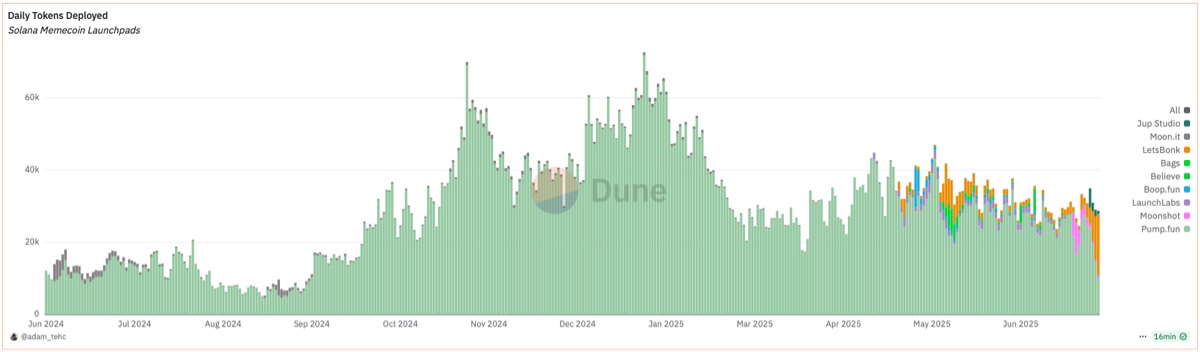
Source: Dune
As noted above, Metaplex charges a small fee in SOL for every mint, so protocol revenue is closely correlated with new token mints. In June, Metaplex generated 11,124 SOL in revenue, which translates to $1,722,551 based on SOL’s opening price in July.
Annualized, Metaplex is generating approximately $20.6 million in fees.
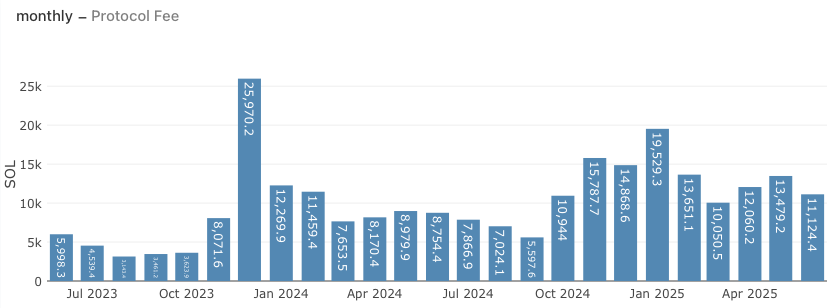
Source: Metaplex Dashboard
Because Metaplex’s business model revolves solely around charging for its token standard, it incurs minimal operating costs. Nearly all fees translate directly into profit, which is split evenly:
- ◆Half goes to the Metaplex Foundation for further development
- ◆Half is used for MPLX token buybacks, executed in the following month
As seen in the chart below, the balance of the buyback wallet —controlled by the DAO— has steadily increased since June 2024, currently holding 70.8 million MPLX, equivalent to 7% of the total supply.
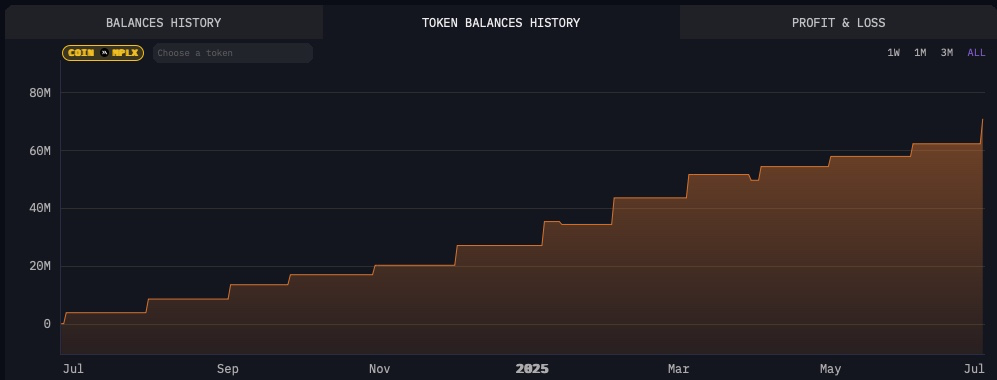
Source: Arkham
The main wallet of the Metaplex DAO holds 160 million MPLX (16% of total supply), and, as shown below, these tokens have remained unmoved since late 2022.
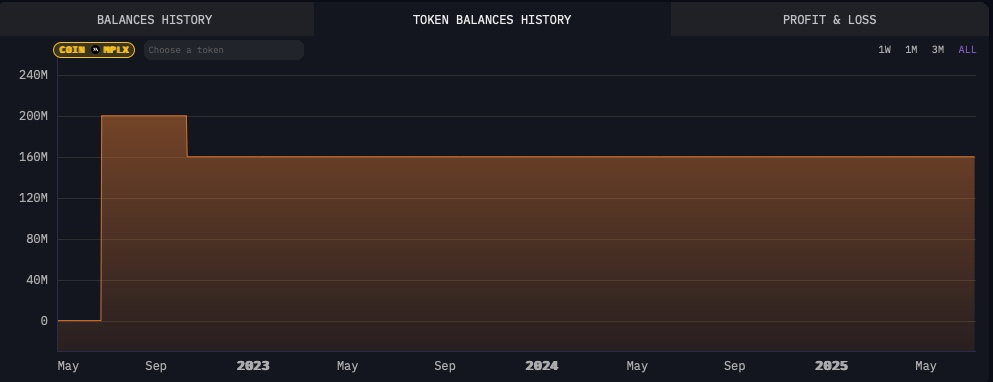
Source: Arkham
I believe Metaplex has not sold any of its tokens because the protocol’s minimal costs allow all further development and research to be funded entirely by the Foundation’s share of revenues. This enables the DAO to accumulate MPLX without the need to sell.
Thanks to this dynamic, I believe the MPLX tokens held by the Metaplex DAO can effectively be excluded from the circulating supply of the fully diluted 1 billion MPLX tokens, as they are unlikely to enter circulation anytime soon. Discounting the balances of both wallets (a combined 230 million MPLX) leaves us with a liquid supply of approximately 770 million MPLX tokens, which is shrinking by roughly 1% per month at current price and revenue levels.
At the current MPLX price just above $0.10, the circulating market cap stands at approximately $80 million.
With June’s revenue numbers, MPLX is now trading at ~4× annual revenue / ~8× annual net profit, with token value directly tied to profits through monthly buybacks at the current pace of ~1% of circulating supply per month (or ~12% annually).
Metaplex’s business is undoubtedly speculative, as profits are primarily driven by memecoin mints. However, asset issuance has been the most important driver of the Solana ecosystem in recent years and continues to demonstrate resilience even under challenging conditions of broader market.
Price Performance
MPLX has experienced significant losses over the past few months, coinciding with reduced activity on Solana and the cooling of the memecoin craze. MPLX is down more than 80% from its October 2024 peak and is currently trading 16% above the range it reached after the FTX collapse—at a time when the outlook for both Solana and Metaplex was drastically different:
- ◆Solana was widely considered “dead,” as activity and TVL collapsed
- ◆Metaplex was generating virtually no fees, and the MPLX token had no value accrual from protocol profits
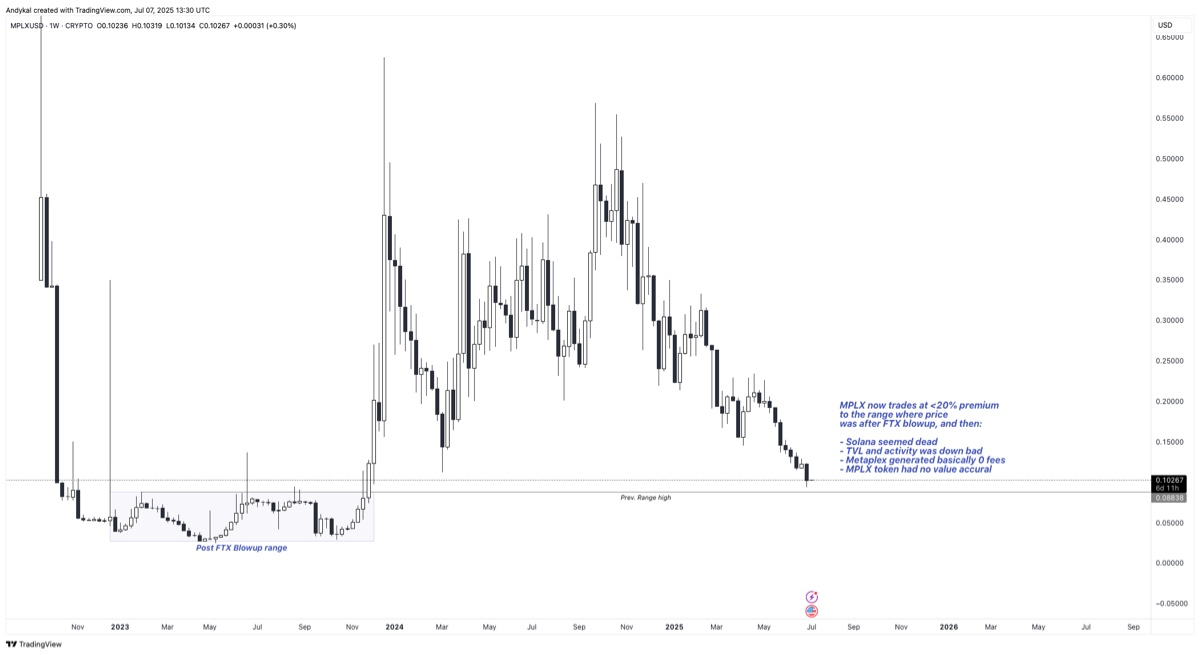
MPLX price performance - Chart
Today’s situation is vastly different: Solana leads many key metrics across all blockchains, especially in token issuance and trading. As detailed above, Metaplex is well positioned to benefit by collecting fees on new token mints even if Solana’s current activity levels simply persist. However, I believe the coming months could bring substantial growth for Solana and therefore Metaplex.
Growth
Strong revenue generation and aggressive buybacks provide a solid foundation for MPLX, but growth catalysts are essential for this thesis to fully materialize. Here are the three primary drivers that I believe create a compelling asymmetric opportunity at current prices:
Solana Seeker
Solana is preparing to launch its second phone, the Solana Seeker, a flagship device designed to challenge the Apple and Google duopoly in the smartphone market. Adoption will be incentivized through the new $SKR token, which will reward both developers and users of the Seeker phone.
Each Seeker will include a soulbound NFT called the “Genesis Token,” serving as a powerful tool for airdrops and targeted incentives.
Crucially, every Seeker will also come pre-installed with a customized version of the Moonshot app, enabling users to create new tokens and instantly airdrop them to other Seeker devices in just a few clicks. Over 150,000 Seekers have already been pre-ordered, with shipping set to begin on August 4—less than a month away.
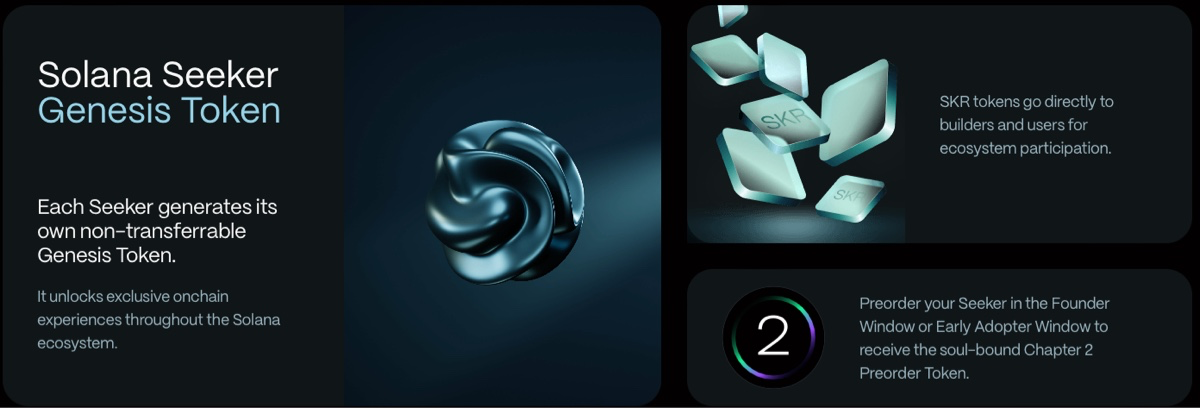
Source: Solana Mobile web
This means that 100,000–150,000 people will soon receive their Seeker phones, fully equipped and directly incentivized via $SKR tokens to create and distribute new memecoins.
Given this dynamic, I believe the Seeker launch could trigger a new wave of token issuance on Solana, potentially matching the January 2025 peak levels.
Launchpad Wars
Between 2023 and 2024, Pump dominated the Solana launchpad market. However, since May 2025, competition has dramatically increased, with Pump’s market share dropping from 99.7% to as low as 35% for new token launches and 22% for daily graduates (as of yesterday). New challengers include Letsbonk, Moonshot, Believe, Launchlab, Jupiter Studio, and others.
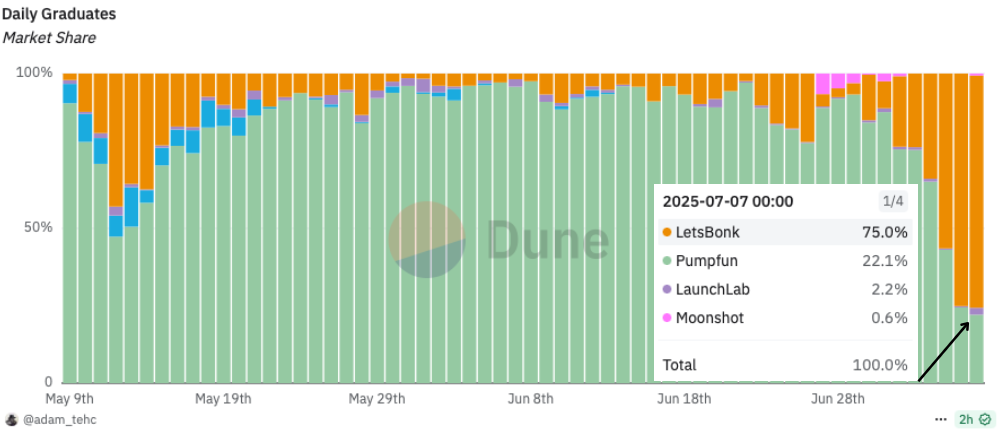
Source: Dune
In competitive markets, we typically see rapid improvements in products for both creators and users. Additionally, competition in crypto often leads to token-based incentives. Pump just yesterday announced an ICO of PUMP token at a $4 billion valuation, which I believe is a strategic move to solidify dominance through incentives before rivals catch up further.
Overall, the launchpad wars should result in better products and more incentives → increased token minting → higher revenue for Metaplex. I believe that combined with the Seeker launch, these dynamics could even surpass the previous revenue peak of 20,000 SOL per month set in January 2025.
SOL Price
An important wildcard is that Metaplex charges fees in SOL, making its USD-denominated revenue directly dependent on the SOL price.
Recently, this has been a headwind, as SOL fell from $295 in January to a low of $95 in early April. It has since rebounded to around $150.
Despite this volatility, the Solana ecosystem continues to flourish, with several major new products and milestones. Recent highlights include:
- ◆Byreal: a DEX by Bybit with liquidity connected to the centralized exchange
- ◆xStocks: tokenized stocks from Backed and Kraken, recently launched on Solana and soon to be integrated into Kamino as collateral
- ◆Anticipation of long-awaited Solana spot ETFs, expected to be approved later this year
Given these positive developments, Solana appears to be in a solid position. My expectation is that SOL will trade in the $180–$220 range over the coming months.
Combining Growth Factors
Over the next 1–3 months, the Solana Seeker launch is likely to ignite a new wave of token issuance, while the launchpad wars continue to spur innovation and competition among token launch platforms.
Both catalysts are expected to involve incentives, driving increased token minting as a natural byproduct. This creates powerful tailwinds for Metaplex’s business, as other projects effectively pay to generate demand.
My base case is that these two catalysts will drive Metaplex revenue up at least 80% to 20,000 SOL per month, while simultaneously fueling renewed momentum in the Solana ecosystem that could push SOL’s price above $180. Combined, this would boost Metaplex’s annual USD revenue by ~110% to ~$43.2 million ARR.
Below is a table comparing the base case to:
- ◆Bear case: If these catalysts fail to generate demand and revenue in SOL stays at current levels, combined with a broader market decline driving SOL back to its April low of $95
- ◆Bull case: If a new memecoin frenzy emerges alongside successful approval of a Solana ETF and SOL goes to ATH of 300 USD.
Based on these projections, even the bear case would leave MPLX trading at a remarkably low valuation relative to its earnings. Therefore, I believe MPLX offers limited downside with significant upside potential if any positive developments emerge from the Seeker or launchpad catalysts. Below are price projections for the bear, base, and bull cases, assuming the market assigns MPLX a 5× ARR valuation — which I consider a fair benchmark
RisksNothing is without risk, so let’s review the most important factors that could invalidate this thesis:
- ◆Solana DependenceMetaplex is highly dependent on the performance of the Solana ecosystem and retail-driven memecoin trading. While this dependence has been positive so far, if the Solana ecosystem cools down or another chain takes its place, Metaplex will likely see a significant drop in revenue. This is an important factor to monitor; however, there are currently no signs of this scenario unfolding. Solana continues to strengthen its position as the leading retail-focused chain, and memecoin issuance and trading have remained resilient through both bullish and bearish market phases.
- ◆Solana SeekerI am highly optimistic about the potential impact of the Solana Seeker, as it represents a key product for Solana. I believe the team will make every effort to encourage its adoption, starting with the introduction of the SKR token as an incentive mechanism. However, this is a crucial pillar of the investment thesis, so if user adoption fails to materialize following the launch, the position should be reevaluated.
- ◆Metaplex Token StandardIf launchpads were to develop and adopt their own token standards, it could severely impact Metaplex’s revenue and, by extension, the MPLX token. Although no serious attempts have been made in the past two years, and there appears to be little incentive to do so—since Metaplex’s fees are relatively low and unlikely to deter customers—this remains a risk worth considering.
- ◆Continued Selling PressureSignificant sell pressure has persisted in recent months, and there is currently no clear indication that it has fully subsided. This could continue to weigh on the token’s price in the short term. However, I believe that as MPLX approaches levels seen after the FTX collapse, demand will begin to recover. Sellers will have less incentive to exit positions at these depressed prices, and renewed demand should help stabilize the market.
Reasoning About Price Performance
MPLX has been one of the weakest performers in the market recently. While most tokens are trading well above their April lows, MPLX remains roughly 30% below that level. Although I don’t have concrete evidence pinpointing the exact cause, the underperformance of broader market began around February 2025—coinciding with Metaplex’s launch of its first “earn” season to incentivize on-chain liquidity.
Given MPLX’s popularity among liquid funds during 2024, this increased liquidity may have provided an exit opportunity for funds that were previously unable to liquidate large positions.
Moreover, as liquidity improved, MPLX buybacks likely had less immediate price impact.
These two factors seem to be the most plausible explanations for MPLX’s weak price action in recent months. The situation was exacerbated by the listing of MPLX on the Binance Alpha platform, where users were awarded small MPLX airdrops—creating additional forced selling pressure.
Nonetheless, I believe Metaplex is taking the right steps by improving token liquidity, enabling capital to flow more freely in and out of the market. While recent price weakness may be a short-term headwind, it could ultimately benefit MPLX over the long term.
Final Thoughts
Metaplex is a core protocol powering the most significant product-market fit Solana has found to date: token issuance. The protocol has effectively captured the entire market through its token standard, monetizing it to generate ~$25 million in revenue last year and ~$20 million in annualized revenue based on June numbers. Importantly, half of this revenue flows directly into MPLX token buybacks.
Two major catalysts in the coming weeks and months could drive significant growth for Metaplex:
- ◆The launch of the Solana Seeker phone
- ◆Intensifying memecoin launchpad wars
Both are likely to incentivize behavior that leads to new token launches, potentially sparking another memecoin boom on Solana that Metaplex can capitalize on through fees.
At a current market cap of $80 million, MPLX appears deeply undervalued relative to its unique positioning within the Solana ecosystem, robust revenues, and powerful growth catalysts. I believe this depressed price is primarily a result of liquid trade unwinds from 2024, and that it presents an opportunity to gain exposure to a critical piece of Solana and SVM infrastructure at a significant discount.
Affiliate Disclosures
- •The author and/or others the author advises do not currently hold, or plan to initiate, an investment position in target.
- •The author does not hold an affiliated position with the target such as employment, directorship, or consultancy.
- •The author is not being compensated in any form by target in relation to this research.
- •To the best of the author's knowledge, the information provided here contains no material, non-public information. The accuracy of the information is the responsibility of the reader.