SHOW DIRECTORY
All-In
Industry veterans Chamath Palihapitiya, Jason Calacanis, David Sacks, and David Friedberg cover economics, technology, politics, society, and poker.
SOURCE DESCRIPTION · RSS

Naveen Rao: 4D Computing, AI's Energy Wall & Beating Biology
Naveen RaoChamath Palihapitiya
Unconventional AI taped out a physical dynamical computer five months after starting in earnest, generating images at 500 nanojoules each versus millijoules on a GPU.Its 4D architecture co-locates compute and memory, targeting 1,000× power efficiency as AI demand approaches an energy wall in about 3 years.A rack-scale product is promised within two years, with adoption hinging on model-layer porting and a new Python-based software stack.

Meta's Dina Powell McCormick: The Case for Data Centers, Backlash, AI Job Boom & Meta’s Future
Meta’s multibillion-dollar Richland Parish project lifted sales-tax growth from 5–10% to a 260% peak and certified employees’ checks from $10,000 to $50,000.Louisiana shifts generation, grid resilience, upgrades and storm costs to Meta; the Academy produced 250 graduates and 90% retention from 40,000 applicants, while Google and BlackRock support scaling amid backlash and Cotton and Warner’s adversary theory.

Brad Gerstner: No AI Bubble, Semis Eat the Nasdaq & AI's Take Off Problem
Gerstner argues the rally is earnings-driven, even as semiconductor concentration accounts for 70% of Nasdaq’s return.The AI buildout still depends on lab revenue scaling, while rates, power constraints, regulation and a delayed Anthropic IPO remain key risks.

Jensen Huang: The Doomer Hoax, Superintelligence is Here, and The Future of AI (ft. President Trump)
Jensen Huang cites failed forecasts on radiology, AI-generated code and entry-level jobs to challenge doomsday narratives, while arguing that AI incidents so far call for root-cause engineering and independent evaluation rather than sweeping regulation.With 80% of AI-native companies receiving $400 billion in recent venture funding using open models, NVIDIA is building infrastructure bottlenecks as Jensen predicts China will reach advanced lithography by 2030, leaving commercialization, lab controls and data-center execution to monitor.

Nvidia's Historic Quarter, SaaS Comeback, Bessent vs Druck, America's Debt Crisis, Cancer Vaccine
Chamath PalihapitiyaJason CalacanisDavid SacksDavid Friedberg
Nvidia’s $96.2B revenue and $60B net profit came with 70% growth guidance versus the Street’s 45%, despite supply constraints.Salesforce’s 20%+ rally on $5.90 adjusted EPS and a $46B guide suggests agents may reinforce horizontal systems of record, while vertical SaaS remains contested.Debt also bears watching: $10T must be refinanced within 12 months at a 5.2% 30-year rate.

Anthropic's $2T IPO, Zuck's AI Manifesto, Nvidia's $500B AI Bet, Grok's Comeback
Anthropic’s reported $2T IPO figure may be banker theater rather than a clearing price, while Gavin Baker and Sacks estimate 2027 exit ARR at roughly $400–500B, constrained by physical supply.NVIDIA’s $500B financing effort could make GPU compute an asset class and support a capital-light cloud business, while Anthropic’s S-1 will test demand and dark-GPU risk.

Chip Stocks Crash, $20B Fund Margin Called, Frontier Labs: SLOW DOWN AI, Mamdani's Grocery Stores
Chamath PalihapitiyaJason CalacanisDavid SacksDavid Friedberg
A roughly 3.5-times-levered public book was margin-called as semiconductor stocks fell more than 20%, showing leverage can break the trade before fundamentals do.The correction pits momentum against AI CapEx returns as 5.2% Treasury yields raise the hurdle, while model commoditization and frontier-lab safety incidents remain key risks to monitor.

Former Intel CEO on What Went Wrong, What's Next + Lovable CEO on the Real Promise of Vibe Coding
Jason CalacanisPat GelsingerAnton Osika
Pat Gelsinger attributes Intel’s decline to replacing technical leadership with spreadsheet-driven capital allocation, while Apple, Nvidia and TSMC compounded patient capability-building into durable platforms.The semiconductor recovery remains exposed to Taiwan’s energy dependence, even as AI’s long runway is constrained by electricity; Lovable meanwhile reports production-scale adoption, with defensibility shifting toward orchestration, security, operational data and user feedback.

Open Source Wins, AGI Is Here, and Scorsese’s AI Toolkit with CEOs of Cerebras & Black Forest Labs
Cerebras reports a $25 billion backlog as faster inference turns token capacity and data-center execution into scarce product advantages, while open models take routine and sovereign workloads.Feldman expects its architecture to improve well over 2x in 18 months; staged releases, red-teaming and recursive model improvement remain catalysts—and risks—as multimodal AI reaches film and robotics.
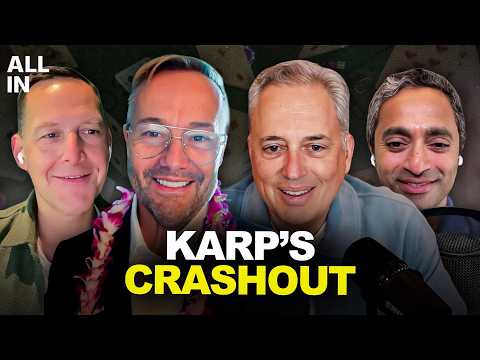
AI Sovereignty Wars, Palantir-Nvidia Deal, SCOTUS Birthright Ruling, Newsom’s CA Budget Lie
Chamath PalihapitiyaJason CalacanisDavid SacksDavid Friedberg
Palantir and NVIDIA’s sovereign-AI pitch shifts enterprise value toward owning compute, data, model weights, and proprietary “alpha” rather than renting frontier intelligence. 8090 made Claude 1.4x to 4x cheaper and 1.5x faster than Opus 4.8 alone, while a 16.4x-cheaper open model and falling token prices could challenge an OpenAI-Anthropic duopoly, with AI’s employment impact still unresolved.