PERSON DIRECTORY
Jensen Huang
Jensen Huang appears in 12 indexed conversations across All-In, Axios, BG2. This directory brings every appearance, source, TL;DR, digest, and transcript into one searchable feed.

The Ezra Klein Show: Jensen Huang Thinks A.I. Alarmism Has Gone Too Far
Ezra KleinJensen HuangKevin RooseCasey Newton
Jensen Huang calls AI safety a solvable engineering problem: labs should not ship systems they cannot contain, with liability rules and third-party audits still relevant.He argues NVIDIA compute could become a fungible, durable asset class, with one-gigawatt factories and annual rents reaching $50B.Open models have flipped to seventy-thirty, while supply-demand inversion and an uncertain digestion period remain risks.
Extended interview: Nvidia CEO Jensen Huang on fears about AI
Huang says AI’s doomsday narrative has “0% chance” by 2030, opposes new AI laws, and “completely disagrees” with stopping powerful-chip sales to China, arguing existing liability rules and global competition should govern deployment.He frames data centers as “AI factories” converting energy into intelligence for a multi-trillion-dollar industry, while backlash over water, power costs, safety, and potentially $8B in California taxes remains a key execution and policy watchpoint.

Jensen Huang: The Doomer Hoax, Superintelligence is Here, and The Future of AI (ft. President Trump)
Jensen Huang cites failed forecasts on radiology, AI-generated code and entry-level jobs to challenge doomsday narratives, while arguing that AI incidents so far call for root-cause engineering and independent evaluation rather than sweeping regulation.With 80% of AI-native companies receiving $400 billion in recent venture funding using open models, NVIDIA is building infrastructure bottlenecks as Jensen predicts China will reach advanced lithography by 2030, leaving commercialization, lab controls and data-center execution to monitor.
Nvidia CEO Jensen Huang Talks AI Golden Age in South Korea, New Naver Investment
Nvidia’s Korea commitments quantify an AI infrastructure cycle: an SK Group partnership exceeding $500 billion in business, plus a $1B investment in likely Naver as Korean capacity expands.Huang expects computers serving 100 billion agents and billions of robots to make semiconductors 10 times larger within a decade, but HBM, power, land, and labor constraints may throttle growth to roughly doubling annually.
Jensen Huang says the AI doomers have it wrong
Jensen Huang says the Kimi selloff repeats DeepSeek’s market misread: free, capable models should expand AI use and NVIDIA hardware demand, while NVIDIA’s China sales are “approximately zero today.”With chip capacity, power, land and labor constraining a 5-to-10-times industry buildout, Huang sees a bubble as “very unlikely in the next five years,” but robots and billions of agents remain the next demand catalyst.
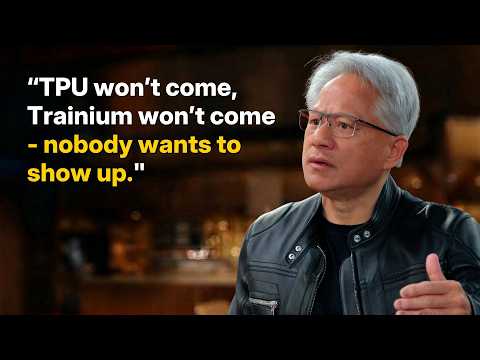
Jensen Huang – Will Nvidia’s moat persist?
Jensen argues TPU and ASIC growth is concentrated in Anthropic, while Nvidia’s broader programmable platform and supply-chain commitments preserve its reach and unit-TCO advantage.Groq expands Nvidia into premium low-latency inference, with Vera Rubin and Feynman targeting annual order-of-magnitude token-cost declines; China export controls remain an unresolved strategic risk after a direct security challenge.
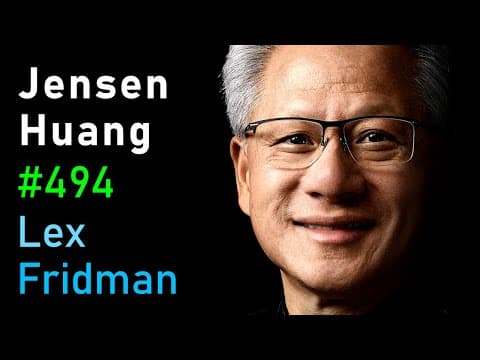
Jensen Huang: NVIDIA - The $4 Trillion Company & the AI Revolution | Lex Fridman Podcast #494
NVIDIA’s competitive unit has expanded from the GPU to the entire AI factory, co-designing computation, models, data, networking, memory, power, and cooling around modern workloads.CUDA’s ubiquitous install base remains the foundational moat, while four compute-driven scaling laws and falling token costs support demand for increasingly specialized infrastructure.Six-month model cycles versus three-year hardware cycles, plus power and supply-chain constraints, remain key execution risks as Huang describes a potentially much larger computing economy.
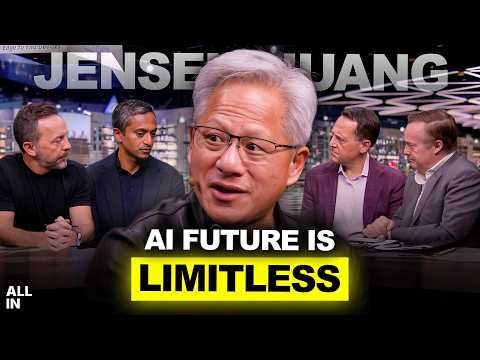
Jensen Huang: Nvidia's Future, Physical AI, Rise of the Agent, Inference Explosion, AI PR Crisis
Nvidia is expanding from GPUs into complete AI factories, combining Vera Rubin, networking, CPUs, BlueField and Groq to serve increasingly heterogeneous agent workloads.Huang argues that token cost matters more than factory price because 10X throughput can outweigh cheaper chips, while agentic inference and physical AI could drive million-fold demand growth and useful robots within roughly three to five years.
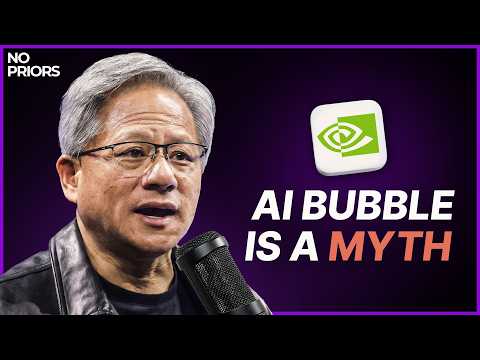
NVIDIA’s Jensen Huang on Reasoning Models, Robotics, and Refuting the “AI Bubble” Narrative
Reasoning, search grounding, and confidence routing have made tokens valuable enough for customers to pay, while AI factories expand demand for chips, energy, construction, electrical, networking, and technical labor.Falling inference costs, open-source research, programmable hardware, and vertical specialists challenge permanent frontier concentration, but industrial deployment still requires reliability approaching 99.99999%; energy capacity, export controls, robotics adoption, and sustained demand will test NVIDIA’s anti-bubble thesis.
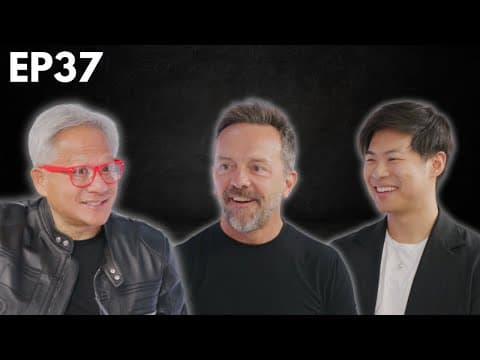
NVIDIA: OpenAI, Future of Compute, and the American Dream | BG2 w/ Bill Gurley and Brad Gerstner
Brad GerstnerClark TangJensen Huang
Nvidia’s $100 billion OpenAI partnership could support a self-build hyperscaler, with 10 gigawatts implying roughly $400 billion of potential Nvidia revenue.Jensen Huang says AI demand is much larger than consensus, while Nvidia’s 30x Hopper-to-Blackwell gain and power efficiency strengthen its moat; China and H1B talent remain risks.