PERSON DIRECTORY
Nathan Labenz
Host of The Cognitive Revolution. Nathan Labenz appears in 163 indexed conversations across The Cognitive Revolution, The a16z Show. This directory brings every appearance, source, TL;DR, digest, and transcript into one searchable feed.
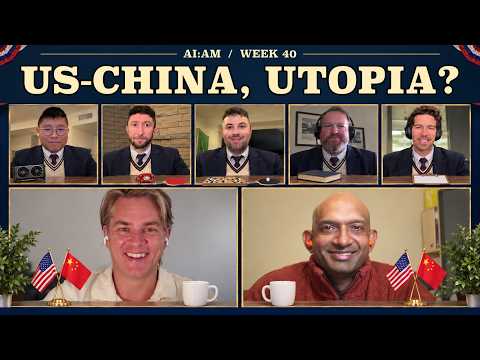
AI:AM: Was Trump-Xi Anything? What Counts as Utopia? + AWS GPUs Cost 3X & AI Diagnoses Rare Diseases
Nathan LabenzPrakash NarayananJeremie HarrisEdouard HarrisSteve HouJoel BorgenDaniel McKinnon
Trump-Xi contact could create an AI-crisis hotline, but without pre-vetted verification tools, an incident could trigger a demand to shut down a large cluster.Hyperscalers charge at least two to three times neo-cloud GPU prices; Gamo’s o3 loop found a 91-kilobase deletion, while Opus 5.5 scored about 50% on RareBench versus roughly 10% for LIRICAL.
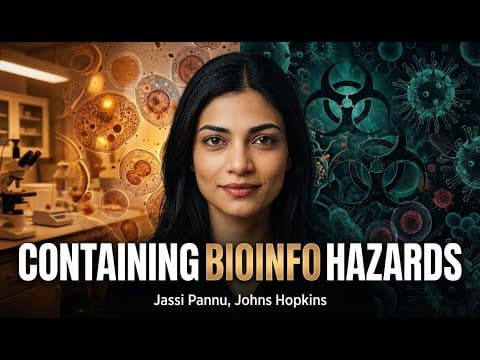
Bioinfohazards: Jassi Pannu on Controlling Dangerous Data from which AI Models Learn
Jassi Pannu proposes keeping roughly 99% of biological data open while placing the estimated 1% of functional data linking pathogens to transmissibility, virulence, host range, or immune evasion into tiered trusted environments.Evo 2 and ESM-3 suggest selective exclusion can sharply reduce dangerous viral-task performance without broadly degrading other capabilities, but autonomous AI, private-lab opacity, and physical bottlenecks make mandatory DNA screening, passive surveillance, and defense-in-depth unresolved priorities.
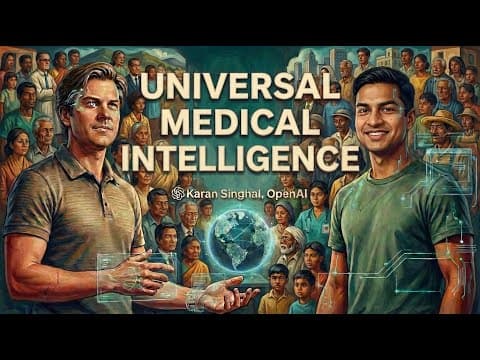
Universal Medical Intelligence: OpenAI's Plan to Elevate Human Health, with Karan Singhal
OpenAI’s health strategy is scaling through ChatGPT Health, which reaches more than 230 million weekly users and is planned to connect records, wearables, and Apple Health while remaining free without rate limits and excluding health data from foundation-model training.Frontier models reached attending-physician territory in one hospitalization, yet embodied context remains a human edge; HealthBench Hard is only around 40%, while Penda Health’s randomized study shows statistically significant outcome improvements and adoption is targeted for the end of 2026.
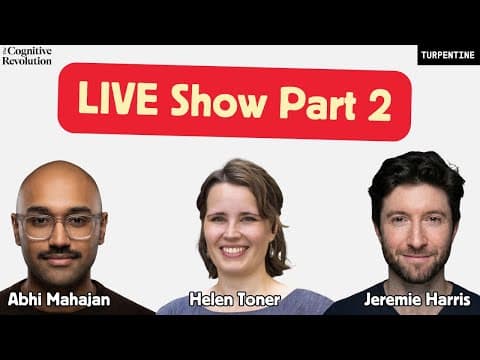
Approaching the AI Event Horizon? Part 2, w/ Abhi Mahajan, Helen Toner, Jeremie Harris, @8teAPi
Abhi MahajanHelen TonerJeremie Harris@8teAPiNathan Labenz
The clearest near-term AI-biology opportunity is rescuing clinical value: Noetik combines pathology, 16-plex spatial proteomics, 19,000-gene spatial transcriptomics, and exome sequencing to find response biomarkers in trials where 97% of oncology candidates fail.Biology’s slow, ambiguous, expensive feedback makes rapid recursive improvement less likely, while AI-led R&D could still produce jagged acceleration; continuous risk measurement, infrastructure resilience, and the uncertain 2027–2030 horizon remain key variables.
Approaching the AI Event Horizon? Part 1, w/ James Zou, Sam Hammond, Shoshannah Tekofsky, @8teAPi
Erik TorenbergNathan LabenzJames ZouSam HammondShoshannah Tekofsky
Virtual Lab’s nanobodies were experimentally validated and often outperformed earlier human-designed candidates, moving AI-for-science beyond plausible prose.Learning to Discover uses roughly $500 and LoRA adapters to optimize disposable models for single best math, optimization, or GPU-kernel results.However, multi-agent teams often match or underperform their best member, while 64 cases of intentional deception among 109,000 chain-of-thought summaries make output-only oversight risky.
The AI-Powered Biohub: Why Mark Zuckerberg & Priscilla Chan are Investing in Data, from Latent.Space
Erik TorenbergNathan LabenzMark ZuckerbergPriscilla Chan
CZI is making Biohub the main focus of its next decade, pairing frontier biology with frontier AI and building institutes, instruments and models to address scientific bottlenecks conventional grants cannot fund over 10 to 15 years.Its 125 million-cell ecosystem, billion-cell project and EvolutionaryScale partnership point to a compounding data flywheel for virtual-cell and N-of-one medicine research, but wet-lab validation and missing empirical data remain unresolved constraints.
Using AI to navigate son's cancer diagnosis
GPT-5 Pro and other models flagged an LDH reading around 1,500 as requiring action within 24–48 hours after clinicians discounted it as hemolysis.Treatment reduced Ernie’s main mass about 80% and cleared marrow and spinal-fluid tests, while proposed ctDNA surveillance remains unproven and nonstandard despite its potential to detect relapse earlier.
AI Discovered Antibiotics: How Small Data & Small GNNs Led to Big Results, w/ MIT Prof. Jim Collins
Erik TorenbergNathan LabenzJim Collins
A 2,500-compound dataset and graph neural network raised antibiotic-screening hit rates from below 1% to 51%-52%, producing halicin after screening 6,100 additional molecules for efficacy, safety, and novelty.AI can search chemical spaces no laboratory could physically cover, but clinical trials remain the dominant cost and models still struggle with solubility, PK/PD, animal translation, and resistance, keeping medicinal-chemist judgment and public-private funding central.
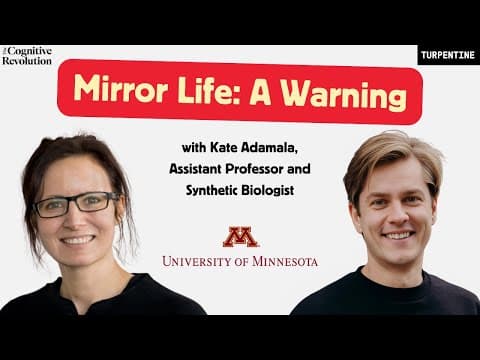
Don't Make Mirror Life: Synthetic Biologist Kate Adamala on Risks & Responsibility
Synthetic biology could replace petrochemical production and improve medicine, but Adamala argues researchers should not create a self-replicating mirror cell.Its immune stealth and resistance to predators could make ecological containment impossible, with specialists expecting such a cell within a decade and no persuasive safety case yet.
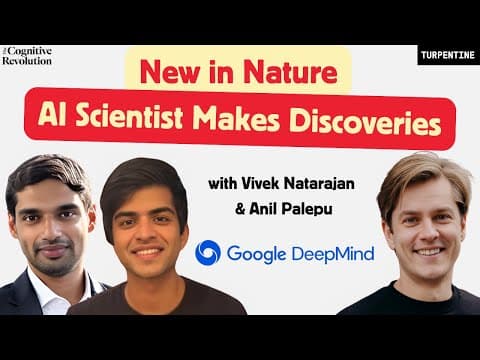
New in Nature: Google Agents Beat Human Doctors, Make Scientific Discoveries – With Vivek and Anil
Nathan LabenzVivek NatarajanAnil Palepu
AMIE outperformed primary-care physicians in simulated consultations and made cardiologists superior to unassisted peers through complementary error patterns.Google’s co-scientist independently ranked an unpublished drug-resistance mechanism first after running for days, suggesting inference-time orchestration—not bespoke model training—can synthesize beyond retrieval.Real-patient validation at Beth Israel Deaconess and staged scientific deployment are the next tests, while simulation limits and many possible failure modes remain unresolved.