SHOW DIRECTORY
The a16z Show
The venture firm’s view of startups, AI, software, markets, company building, and the technological shifts creating new categories.
BIDCLUB DESCRIPTION

The Company That Made AI Coding Feel Inevitable
Martin CasadoSarah WangMatt Bornstein
Cursor’s interface-over-model thesis challenged Microsoft’s Copilot despite its VS Code, OpenAI weights, 100 million developers, and enterprise distribution.Rejecting a $25–50M ARR self-serve ceiling, it built enterprise sales reaching over 50% of the Fortune 500, where margins matter; its IDE-to-agent-to-model shift still faces model releases such as Opus 4.5 and an unnamed acquirer’s potential compute-distribution-data fit.
The State of AI: Models, Moats, and the Consumer Renaissance
Frontier AI is becoming a many-winners market: xAI moved from non-contender to one of three in two weeks while OpenAI, Anthropic and others grow through specialization.Rising B200 per-hour prices indicate constrained supply and essentially infinite demand, but coding agents threaten integration moats; open-weight models may capture bounded-upside workloads as cheaper consumer software awaits an AI-native app store.

The New Geography of Startups
Elena BurgerAngela StrangeGabriel Vasquez
AI is reversing a16z’s international sourcing flow toward Silicon Valley, where borderless founders can compound differentiated talent, government-backed validation, and enterprise access across countries.With 40% of a16z’s investments in international founders, the test is whether diaspora networks and 3–6 months of Bay Area immersion create durable customer and talent advantages.
Building a Company in Stealth | Travis Kalanick with a16z
Travis KalanickBen HorowitzErik Torenberg
Atoms is applying full-stack industrial AI to food, mining, and transport, with production, logistics, robotics, and infrastructure unified as an “atoms-based computer.”Its 50% production-cost reduction, 50¢–$1 robotic delivery, and mining productivity now above humans support a path to lower-cost meals and faster deployment, while execution depends on management capacity and overcoming industrial regulation.

Jake Paul on Going From YouTube to Boxing to Investing | a16z ft. Anti Fund
Erik TorenbergJake PaulGeoff Woo
Anti Fund is pairing growth capital with Jake Paul’s scarce distribution advantage, backing names including Anduril, SpaceX, OpenAI and Anthropic as Woo argues that attention, not capital, is increasingly constrained.Paul’s experiment-measure-concentrate playbook and resilience underpin the partnership, while creator monetization, political and education ambitions, platform limits and the possibility of rapid AI imitation remain important variables.

The $1 Trillion Firm That Refuses The Private Equity Label | a16z
Apollo’s slightly-over-$1 trillion platform is 80% investment-grade credit, making origination capacity—not available capital—the binding constraint on growth.Daily estimated valuations for private investment-grade products by June 30 and all credit by the end of September could widen access as $800 billion of 2026 capex from four public companies tests financing capacity.

Building Blackstone, Backing Costco, and Working with Munger | Tony James on The a16z Show
Tony James’s compounding playbook paired early S-curve positioning with operating discipline, from DLJ using leveraged buyouts to “buy clients we couldn’t actually win competitively” to Blackstone increasing market value about 170-fold while fund IRRs improved.Costco shows the customer moat in practice—if sourcing saves a nickel, “100% of that nickel gets lower prices”—while James sees a private-credit correction ahead and favors seasoned assets through co-investments and continuation vehicles.
AI Markets: Deep Dive with a16z's David George
AI-native companies grow more than 2.5x faster, with top performers reaching 693% year-over-year growth and $500,000-$1 million of ARR per employee.Engagement and operating evidence includes Navan handling 50% of travel interactions with AI and expanding gross margins 20 percentage points, while enterprise change management remains the key execution risk.
The Biggest Bottlenecks For AI: Energy & Cooling
AI infrastructure is becoming a utility layer: big-tech capex annualizes near $400 billion, model-access costs fell more than 99% in two years, and ChatGPT reached 365 billion searches in two years.Energy is likely the next five-year bottleneck, followed by cooling, while application durability depends on 90% or more retention, easy acquisition, and workflow depth rather than model access alone.
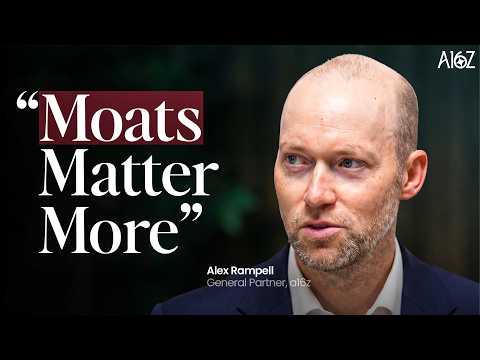
The AI Opportunity that goes beyond Models
Alex RampellJen KhaDavid HaberAnish Acharya
AI is becoming a full software cycle atop smartphones and cloud infrastructure, with roughly 15% of adults globally using ChatGPT weekly.Greenfield systems and labor automation offer the cleanest openings, while Salient’s 50% collection lift favors revenue creation over savings-only pitches.Durability depends on owning workflows and private outcome data as models commoditize and incumbents monetize installed distribution.