SHOW DIRECTORY
The a16z Show
The venture firm’s view of startups, AI, software, markets, company building, and the technological shifts creating new categories.
BIDCLUB DESCRIPTION
How AI Agents Could Start Saving You Money Automatically
AI assistants may win by recovering “free money”—HSA reimbursements, fare credits, or 50% lower water bills—not by abstract productivity gains.Proactivity can be a moat when agents act invisibly, but one unauthorized insurance switch could destroy trust.At roughly $20 per user per day for ambitious browser-driven services, economics may require narrow agents priced at $200-$300—or eventually $1,000—a month.
The Economics of AI Usage and What's Next For SaaS | Benedict Evans on a16z
Agentic coding has crossed unmistakable product-market fit, with customers pulling products from vendors’ hands.Foundation models appear headed toward commodity economics absent durable differentiation, while today’s token scarcity meets $1 trillion–$2 trillion of capex and “100x, 200x” efficiency gains.Cheaper development should create more software, but the unresolved question is which SaaS incumbents survive and whether models capture infrastructure-like returns.
Goldman Sachs Chairman on Why Finance Adopts AI Differently | a16z
Finance is adopting AI aggressively, but near-zero error tolerance requires proven and experimental systems to run in parallel—sometimes 50 runs with perfection on the last 49—raising costs before efficiency gains.Opaque software executing 70,000 transactions could scale hidden errors and leverage, making testable reliability, regulation, and public legitimacy key adoption constraints for OpenAI, Anthropic, and other systemically important AI companies.
How to Reorg After AI Changes Everything | Block's Owen Jennings on the a16z Show
Block says Opus 4.6 and Codex 5.3 broke the link between headcount and output, prompting a workforce reduction of slightly more than 40% concentrated in development rather than compliance or sales.Small squads now supervise abundant machine labor, with meetings down 70-80% and Money Bot reduced from roughly 15 people to four plus $2,000 of tokens, while distribution, regulation, network effects, hardware, and proprietary economic data define the emerging moat.
Atlassian CEO on the SaaS Apocalypse, AI Agents & What Comes Next
Alex RampellErik TorenbergMike Cannon-Brookes
AI is repricing SaaS before proving universal impairment, with Zendesk-like seat models exposed to agent substitution while Workday’s employee-based pricing and Adobe’s middle position may be underappreciated.Atlassian’s three great quarters, accumulated process knowledge, Teamwork Graph and extensibility strategy could make core systems stickier, but value depends on fair pricing and product design that earns trust as agents enter workflows.
AI Markets: Deep Dive with a16z's David George
AI-native companies grow more than 2.5x faster, with top performers reaching 693% year-over-year growth and $500,000-$1 million of ARR per employee.Engagement and operating evidence includes Navan handling 50% of travel interactions with AI and expanding gross margins 20 percentage points, while enterprise change management remains the key execution risk.

Ben Horowitz and David Solomon: The Sweetest Macro Spot in 40 Years
David HaberDavid SolomonBen Horowitz
David Solomon sees one of the strongest macro setups in his “40-odd years” in markets, combining fiscal expansion, rate cuts, deregulation and an unprecedented capital-investment supercycle.Confidence has shifted M&A from “no” to “maybe,” potentially producing the biggest M&A year in history, while Goldman’s $1.9 trillion balance sheet and $500 billion deposit base frame the scale-and-funding challenge; FTC uncertainty and geopolitical risk remain key variables.
The Biggest Bottlenecks For AI: Energy & Cooling
AI infrastructure is becoming a utility layer: big-tech capex annualizes near $400 billion, model-access costs fell more than 99% in two years, and ChatGPT reached 365 billion searches in two years.Energy is likely the next five-year bottleneck, followed by cooling, while application durability depends on 90% or more retention, easy acquisition, and workflow depth rather than model access alone.
AI Eats the World: Benedict Evans on the Next Platform Shift
Generative AI may match the internet or smartphones in scale, but uneven adoption—ChatGPT’s 800 or 900 million weekly users with only about 5% paying—makes workflow integration, not model novelty, the central commercial test.Specialized products that encode validation and institutional knowledge may capture value above increasingly comparable models, while OpenAI’s distribution remains a fragile moat and falling compute costs, overbuilding and uncertain capability keep the bubble’s timing and infrastructure demand unresolved.
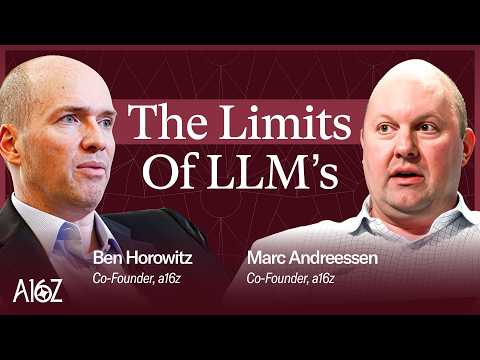
Marc Andreessen and Ben Horowitz on the State of AI
Erik TorenbergMarc AndreessenBen Horowitz
AI need not match Beethoven to transform productivity: clearing 99.99% of humanity at intelligence and creativity could unlock recombination across domains.Current models already show commercially useful theory of mind in Socratic dialogue and simulated focus groups, though intelligence alone does not confer leadership or human connection.Demand, talent, and chip shortages are attracting supply, while the still-unformed interface and US–China robotics race leave the platform outcome open.