PERSON DIRECTORY
Sarah Guo
Host of No Priors. Sarah Guo appears in 71 indexed conversations across No Priors, Invest Like the Best, Latent Space. This directory brings every appearance, source, TL;DR, digest, and transcript into one searchable feed.
Redefining Chip Architecture with Arm CEO Rene Haas
Arm moved from IP licensing into physical silicon with the Arm AGI CPU after Meta sought a general-purpose agentic CPU no one else could provide.AI reaches 80% to 90% of engineers, while Arm’s documentation and test benches may make proprietary IP more trainable; supply may remain constrained for 3 to 5 years, with data-center construction a possible next bottleneck.

Re-engineering the Semiconductor Supply Chain with Intel CEO Lip Bu Tan
Lip-Bu Tan’s Intel turnaround starts with faster accountability, balance-sheet repair and product simplification, while inference and agentic AI could lift CPU demand from one per eight GPUs toward one per four or one per one.Intel Foundry remains a costly trust and supply-chain bet against TSMC, with IP, yield and cycle time as the proof points; its potential may surface around 2030–2032 as packaging, power and materials become harder bottlenecks.
The Story Behind Cerebras’ $63 Billion IPO with Founder and CEO Andrew Feldman
Elad GilSarah GuoAndrew Feldman
Cerebras says useful AI in 2025 made inference latency a daily constraint, with systems running 15, 18, 20x faster than GPUs.G42’s $1 billion order enabled cluster testing, while an OpenAI agreement Feldman says exceeds $20 billion and an AWS deployment raise the stakes for a 10x manufacturing increase this year.Delivery and governance now matter as much as contrarian architecture.
How AI Agents Will Transform the Financial System with Circle Co-Founder and CEO Jeremy Allaire
Circle’s USDC bet turns full-reserve dollars into a general-purpose settlement rail, from $0.25 digital objects to multi-hundred-million-dollar transactions, while Arc targets deterministic institutional settlement within hundreds of milliseconds.AI agents could generate billions or trillions of micropayments and drive tokenization across securities infrastructure, but distributional risk remains unresolved if productivity becomes capital capturing more capital at the expense of humans.

Scaling Global Organizations in the Age of AI with ServiceNow Chairman and CEO Bill McDermott
ServiceNow’s “AI thinks, workflow acts” thesis distinguishes probabilistic models from platforms that execute and close enterprise cases.With more than 85 billion workflows, 7 trillion transactions, and agents handling 90% of customer-service cases, faster deployments and rising agent consumption are the key signals for operating leverage, while adoption and model reliability remain risks.
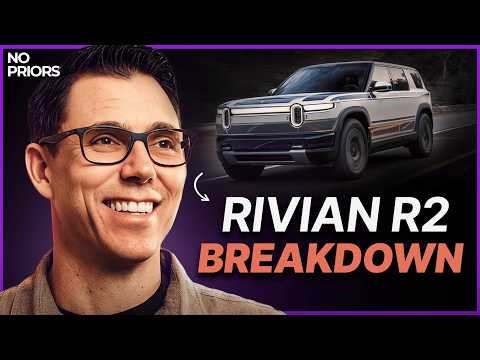
AI, R2 and the Future of Everyday Driving | Rivian CEO RJ Scaringe
Rivian’s 2021–22 clean-sheet reset replaced its rules-based autonomy stack with neural networks, making fleet data central to progress through 2029–30.Scaringe puts viable competitors outside China at more than one, less than five, while Rivian’s in-house inference chip targets economical autonomy in every car.R2 starts at $45,000 for the $45,000–$55,000 market, with adoption and rare safety cases still the key tests.
NVIDIA’s Jensen Huang on Reasoning Models, Robotics, and Refuting the “AI Bubble” Narrative
Reasoning, search grounding, and confidence routing have made tokens valuable enough for customers to pay, while AI factories expand demand for chips, energy, construction, electrical, networking, and technical labor.Falling inference costs, open-source research, programmable hardware, and vertical specialists challenge permanent frontier concentration, but industrial deployment still requires reliability approaching 99.99999%; energy capacity, export controls, robotics adoption, and sustained demand will test NVIDIA’s anti-bubble thesis.
No Priors Ep. 144 | The 2026 AI Forecast with Sarah & Elad
AI adoption is “blinding” among doctors, lawyers, and compliance teams, even as a weak Nvidia quarter could trigger panic; verticals such as coding, medical scribing, and legal software such as Harvey are consolidating.Monitor robotics timeline slippage and whether an AI IPO becomes a reflexive benchmark trade; Sarah forecasts somebody will make “hundreds of millions of dollars trading markets with LLMs” in 2026.
No Priors Ep. 127 | With SemiAnalysis Founder and CEO Dylan Patel
OpenAI’s expected compact, reasoning-heavy open model could push intelligence pricing below the frontier, while inference differentiation shifts from kernels toward orchestration, networking, reliability, and physical infrastructure.Roughly 200 neoclouds face consolidation as GPU economics diverge, while NVIDIA’s hardware, networking, and software moat remains difficult to replicate; bottlenecks in power, packaging, labor, and export policy are the next constraints to monitor.
No Priors Ep. 122 | With Rippling Co-Founder & CEO Parker Conrad
Rippling’s integrated platform compounds shared permissions, workflows, analytics and infrastructure, with Conrad saying every R&D dollar invested in the underlying layer “pays off 35x” while more than 80% of engineering remains focused on existing products and platform capabilities.As AI lowers software production costs without clearly shrinking engineering teams, governed systems of record and deterministic payroll workflows become more valuable, while private-market liquidity lets Rippling defer an IPO that is “hard to undo.”