PERSON DIRECTORY
Lex Fridman
Host of Lex Fridman Podcast. Lex Fridman appears in 47 indexed conversations across Lex Fridman Podcast. This directory brings every appearance, source, TL;DR, digest, and transcript into one searchable feed.
Jensen Huang: NVIDIA - The $4 Trillion Company & the AI Revolution | Lex Fridman Podcast #494
NVIDIA’s competitive unit has expanded from the GPU to the entire AI factory, co-designing computation, models, data, networking, memory, power, and cooling around modern workloads.CUDA’s ubiquitous install base remains the foundational moat, while four compute-driven scaling laws and falling token costs support demand for increasingly specialized infrastructure.Six-month model cycles versus three-year hardware cycles, plus power and supply-chain constraints, remain key execution risks as Huang describes a potentially much larger computing economy.
State of AI in 2026: LLMs, Coding, Scaling Laws, China, Agents, GPUs, AGI | Lex Fridman Podcast #490
Lex FridmanNathan LambertSebastian Raschka
The 2026 AI race is becoming plural, with ideas spreading across DeepSeek, Qwen, Kimi, MiniMax, Z.ai, Google, OpenAI and Anthropic while compute, hardware access, culture and distribution determine advantage.Scaling laws now span pre-training, post-training and inference, making coding the clearest monetization wedge and open weights strategic infrastructure; gigawatt-scale Blackwell clusters could support longer RL runs and premium inference, but data rights, benchmark contamination and serving economics remain risks.
Dave Plummer: Programming, Autism, and Old-School Microsoft Stories | Lex Fridman Podcast #479
Microsoft’s 1990s moat came from exceptional talent density paired with distribution: making MS-DOS the PC standard created leverage that compounded for decades.Dave Plummer’s 87K Task Manager, shareware businesses, and debugging discipline show how reliability, scarcity, and end-to-end ownership can turn small tools into durable infrastructure, while Windows customization and AI’s limits remain open questions.

DHH: Future of Programming, AI, Ruby on Rails, Productivity & Parenting | Lex Fridman Podcast #474
Lex FridmanDavid Heinemeier Hansson
DHH argues Rails’ leverage comes from reducing ceremony, with Shopify’s roughly 1 million dynamic requests per second and approximately $120 billion market capitalization illustrating the runway of concise software.AI raises programmer leverage but may separate code production from competence, while 37signals’ AWS exit cut infrastructure costs by roughly one-half to two-thirds and saved close to $2 million annually.
Sundar Pichai: CEO of Google and Alphabet | Lex Fridman Podcast #471
Sundar Pichai’s central bet is that Gemini becomes a horizontal intelligence layer across Search, coding, Android, Waymo and robotics, with monthly token volume rising from 9.7 trillion to 480 trillion in 12 months.Search is being rebuilt around AI-mediated discovery while serving cost and latency constrain model deployment, and Alphabet’s 2026 Waymo scaling, AI Mode rollout and agentic web remain catalysts to monitor.
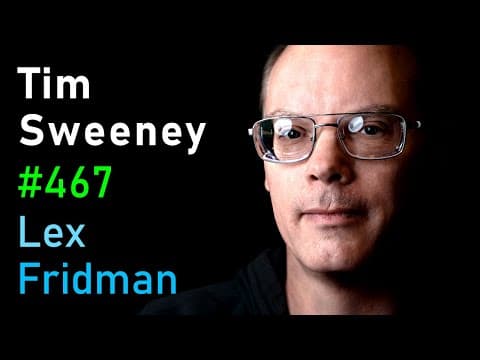
Tim Sweeney: Fortnite, Unreal Engine, and the Future of Gaming | Lex Fridman Podcast #467
Epic’s durable operating model is the feedback loop between its own games and creator tools, with Unreal licensing funding games and games financing engine development through downturns.Fortnite scaled from 40,000 to 15 million concurrent users and now funds a several-hundred-million-dollar annual investment deficit in Unreal Engine, Fortnite and an open 3D ecosystem, while UE6’s multiyear effort and interoperability fight remain key execution questions.
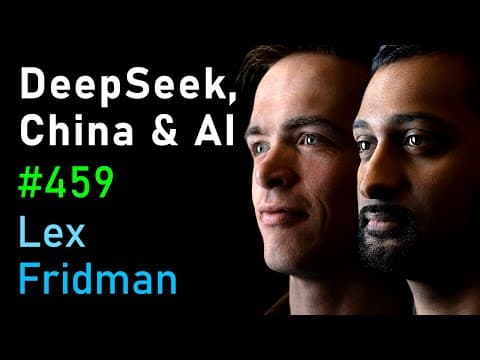
DeepSeek, China, OpenAI, NVIDIA, xAI, TSMC, Stargate, and AI Megaclusters | Lex Fridman Podcast #459
Lex FridmanDylan PatelNathan Lambert
DeepSeek’s V3 and R1 reset the AI cost curve through reinforcement learning, open weights, mixture-of-experts routing, and MLA, not a mythical $5 million frontier model.With roughly 37 billion of 600-plus billion parameters active per token and custom H800 scheduling, efficiency may expand inference demand, while export controls, TSMC, power, and cooling remain decisive constraints.