PERSON DIRECTORY
Jordan Nanos
Jordan Nanos appears in 32 indexed conversations across SemiAnalysis. This directory brings every appearance, source, TL;DR, digest, and transcript into one searchable feed.
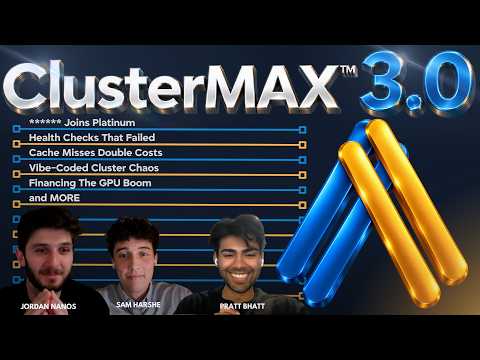
Ep. 033 - ClusterMAX 3.0 Is Here! Neoclouds Ranked (Neoclouds, GPUs)
Sam HarshePratt BhattJordan Nanos
ClusterMAX 3.0 reshuffles 77 providers: Nebius joins CoreWeave in Platinum, Google Cloud joins Oracle in Gold, while Azure, AWS, Crusoe, and Together fall.Endpoint X finds 75% versus 99% cache hit rates can double an identical bill, while NVIDIA’s backstop universe forecast above $2T by end-2031 leaves SLA discipline, security, and hosted RL’s unproven market as risks.

Ep. 033 - 300 Data Center Bans, 3 Projects Delayed: Moratoriums Explained (Datacenter, Energy)
Maya BarkinReyk KnühtsenJordan NanosJeremie Eliahou Ontiveros
Mapping 400+ local instruments against 3,500 projects finds 300+ moratoriums but only three projects actively affected: AWS, NorthPoint, and CoreSite.Roughly 80% of live restrictions have no capacity behind them, leaving the forecast unchanged and making behind-the-meter power more attractive; New York delays roughly 800MW by 6–10 months, while an off-grid-blocking Texas-scale ban is key risk.

Ep. 031 - EMERGENCY EPISODE: Are We Doomed? | Jordan Nanos, Doug O'Laughlin, Max Kan, Joey Brookhart
Jordan NanosDoug O'LaughlinMax KanJoey Brookhart
“Pacing” would slow Anthropic’s capability progress without halting training or compute purchases, potentially weakening its strongest internal model.Near-term scarcity and safety workloads keep compute demand elevated, while semiconductor signals increasingly depend on frontier-lab ARR and capacity premiums.Bank hacks, data leaks, or AI-assisted biological attacks could accelerate regulation.
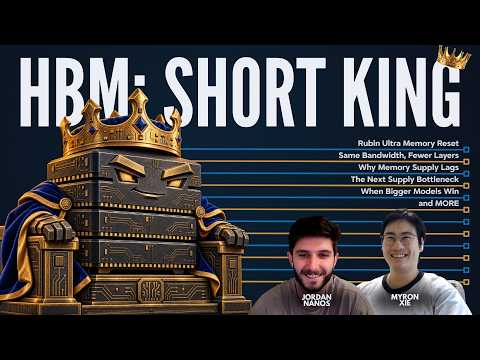
Ep. 030 - Long Live the Short King: Why 4-hi HBM Wins (Memory)
Rubin Ultra shifted from the GTC-previewed 1TB of HBM4E to 192GB of 8-high HBM4, below Blackwell Ultra’s and vanilla Rubin’s 288GB, as HBM supply rations TSMC-secured logic.Four-high saturates the interface at far lower cost per bandwidth and can yield roughly twice as many cubes as eight-high, but model-size growth is the key risk while memory tightness is not expected to ease within this decade.
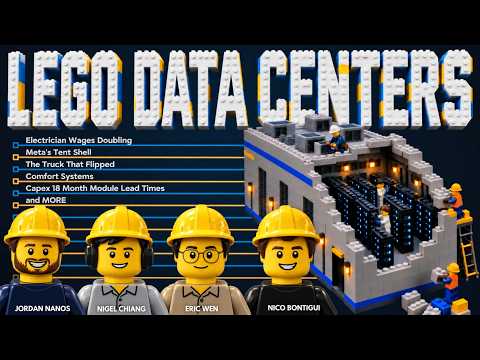
Ep. 029 - Modular Data Centers Cut Build Time to 12 Months (Datacenter)
Jordan NanosEric WenNigel ChiangNico Bontigui
Time to power, rather than cost, is driving modular adoption as compute deals reach $40M/MW and some Anthropic configurations exceed $100 million per megawatt.Factory parallelization cuts fit-out from up to nine months to three, shortening builds from 18–24 months to as little as 12; Level 5 commissioning can take 3–8 months, while module lead times reach 18 months.
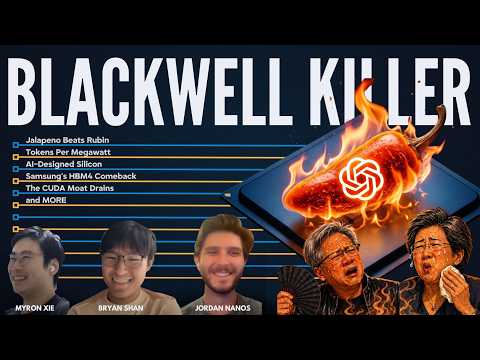
Ep. 027 - OpenAI Jalapeño: Better Than Nvidia Blackwell (Accelerators)
OpenAI’s first Jalapeño results decisively beat GB300 and exceeded Vera Rubin’s July output-token performance per utility megawatt, though HBM4 versus HBM3 makes Blackwell comparisons imperfect.At roughly 50–100 tokens per second, Jalapeño delivers about twice GB300’s tokens per megawatt and may also win on TCO, while a reported three-to-five-times production uplift remains unverified and scaling to millions of chips is the key risk.

Ep. 024 - SpaceX's 10GW Plan Drives $300B ARR by 2027 (Datacenter, Energy)
Jeremie Eliahou OntiverosReyk KnuhtsenJordan Nanos
SemiAnalysis argues SpaceX could bring 10 GW of AI capacity online in 2027, selling scarce “emergency megawatts” for roughly $50 million per MW-year.Modeled frontier inference near $100 million per MW-year could repay GPUs in under a year and make NVIDIA financing plausible.Microsoft’s late-2027–28 capacity gap supports demand, while permitting, chips, uptime and political restrictions remain risks.

Ep. 023 - Everyone Leaves Google, Elon Forecasts 1T ARR, Reflecting On GPT-5 | Jon from Asianometry
Jon YDoug O'LaughlinJordan Nanos
Google’s talent drain, including Jeff Dean, John Jumper, Noam Shazeer, and David Silver, raises questions about whether system-level judgment can be replaced by more compute.The risk is execution, not earnings: Google may remain highly profitable and strong in TPUs while quietly losing frontier-model leadership, as agentic coding accelerates demand for bespoke software and Terafab faces a heroic physical ramp.

Ep. 021 - The AI Project Trinity: Capital, Offtake, Data Center (Datacenter, Energy)
Dan NishballZane FongKang Wen CheangJordan Nanos
AI infrastructure’s bottleneck is shifting to balance-sheet capacity: $11 trillion of 2024-2029 capex could require roughly $7.1 trillion of funding, while five-year hyperscaler offtake excludes short-duration demand.NVIDIA’s GB300 backstop makes neocloud capacity lendable by flooring cash flow, but selects repeat buyers and ties NCP access to its stack; rapid GPU depreciation and utilization gaps remain the underwriting risk.

Ep. 020 - Anthropic vs OpenAI Usage, Margins, Meta Compute, Future of MSL (Tokenomics)
CrystalMax KanJoey BrookhartJordan Nanos
Anthropic’s enterprise/API mix is producing operating leverage: over 80% of ARR is API-based, Q2 operating profit was positive, and Q3 could exceed $1 billion.OpenAI’s free-user base weighs on margins, but 5.5 and 5.6 have reportedly restored a two-horse race, while subsidized coding plans and RL environments leave unit economics and capability scaling unresolved.