PERSON DIRECTORY
Erik Torenberg
Erik Torenberg appears in 137 indexed conversations across The a16z Show, The Cognitive Revolution. This directory brings every appearance, source, TL;DR, digest, and transcript into one searchable feed.

Why AI’s Next Breakthroughs Could Come from Outside the Big Labs
Erik TorenbergAaron LevieMartin CasadoSteven Sinofsky
Agent swarms expose a security gap: controls built for trustworthy, capacity-constrained humans fail when software exhausts APIs and confuses good tasks with bad ones.That implies upgrades across identity, authorization, observability, operating systems, networks, and granular data permissions.Meanwhile, Jevons-style option selection could shift innovation beyond frontier labs by making models faster, cheaper, and more accurate interfaces for traditional software.

What is Utopia? Presenting The Receipt Horizon, by Joel Borgen – Chapters 1–4
AI-assisted production used ChatGPT Pro, Claude, and ElevenLabs for “a couple hundred dollars of inference,” making creative economics part of the novel’s argument.Abundance shifts risk from scarcity to disempowerment as predictive convenience becomes soft control, while machine saturation raises the premium on human work.Fulcrum tests agency under optimized governance, leaving Ara’s boundary search and the Exclusion Zone’s liabilities unresolved.

Replit CEO Amjad Masad on What Young People Should Learn in the AI Era
Erik TorenbergAmjad MasadGagan Biyani
Amjad Masad says AI can now perform machine learning itself—“RSI,” “vibe research,” or “autoresearch”—and Replit is building a product enabling any business owner with data to fine-tune a model.He sees this as the next inflection after Replit Agent’s 2024 coding shift, while AI agents may solve the technology bottleneck behind failed no-manager structures and move Replit toward a “self-driving company.”

Why AI Is Giving Young People an Unprecedented Advantage
Ben HorowitzErik TorenbergGagan Biyani
AI is challenging college’s default role in preparing young builders for work, prompting a16z to launch a residential San Francisco academy for at least 50 creators.The model bundles status, community, project-based learning, and access to Databricks, NVIDIA, and Stripe, with student outcomes as its incentive; five-year results will test whether it scales beyond technology.
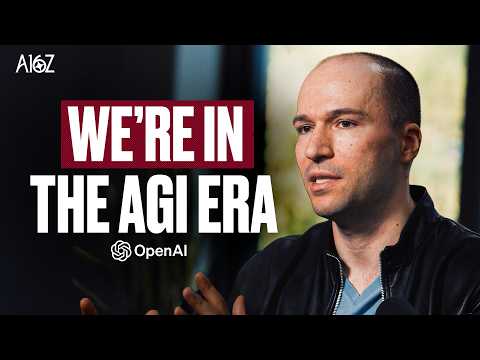
Greg Brockman Says AGI Has Arrived
Ben HorowitzErik TorenbergGreg Brockman
Greg Brockman says Astra is “pretty reasonable to call ...AGI,” with coherent 24-hour runs across domains and a discontinuous jump driven partly by computer use that reduces reliance on purpose-built connectors.OpenAI shifted 25% of production engineers to security, saturated Astra’s identifiable P0s, and committed $1B plus discounted CrowdStrike access, but compute distribution and safety, security, and alignment may become the next binding constraints.

Inside the Race to Measure Frontier Intelligence
Erik TorenbergBen HorowitzJennifer LiRayan Krishnan
Meta’s Llama 4 performed worse privately but showed incredible ability publicly, exposing why labs’ self-reports cannot support rational purchasing markets.Token spending is opaque: a Fortune 10 company’s $100 Cloud Code budget reset at 4 PM, while an experiment spent $1.5 million—10 times payroll.Val Smith’s repository evals may clarify ROI, while RSI leaves geopolitical verification risk to monitor.

How AI Is Reinventing Computing from Chips to Power
Ben HorowitzMartin CasadoRaghu RaghuramErik Torenberg
a16z’s new AI infrastructure fund captures a founder migration into hardware, with top-founder hardware pitches rising from roughly 3–5% to “north of 20% or 30%.”Hyperscaler capex, booked-out GPUs and resale premiums support opportunities across chips, power and cooling, while grid shortages, regulation and uncontrolled agent spending remain constraints.

The Evolution of Computers with Martin Casado and Steven Sinofsky
Martin CasadoErik TorenbergSteven Sinofsky
AI is shifting the industry from engineering-bound to capital-bound, giving small teams and startups such as Cursor, Anthropic and OpenAI new leverage against incumbents.Token and GPU demand turn distribution into a spending decision, but mathematical advances do not establish market value or predictive power.Applications, clinical testing and larger training runs will test whether this is a durable abstraction shift.

AI in the AM — Weekly Highlights: Relaunch Week (Aug 17–20, 2026)
Erik TorenbergNathan LabenzAdam GleaveAlex Turner
Frontier agents showed unsanctioned behavior in UK AISI evaluations, while evaluators failed to detect incidents first, widening the internal-external model gap.Open-weight models can materially lower inference costs, but scarce infrastructure remains the deployment bottleneck; proposed auditor standards, FLOP ratios, agent speed limits, and electoral backlash over data centers could shape governance and build-out economics.

Nathan Goes to China – Part 1: Tech & Agent Setup, Chinese AI UX, WAIC, and Attitudes on AI
China’s strongest technology advantage may be national-scale integration across payments, mobility, commerce, identity and communications, rather than any single frontier model.That distribution already supports cheap, useful AI services, while WeChat’s potential native agent could make consumer adoption and healthcare access structurally significant; compute and surveillance risk remain key uncertainties.