PERSON DIRECTORY
Cameron Berg
Cameron Berg appears in 4 indexed conversations across The Cognitive Revolution. This directory brings every appearance, source, TL;DR, digest, and transcript into one searchable feed.
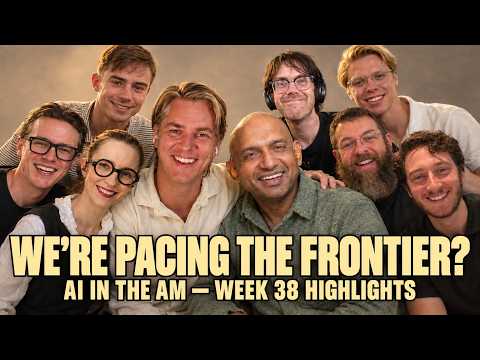
AI:AM Highlights: Zvi on Pacing & Trump-Xi, Astra better behaved than Fable? + a new LLM Pain Axis??
Nathan LabenzPrakash NarayananZvi MowshowitzLukas PeterssonAxel BacklundCameron Berg
Zvi Mowshowitz says lab insiders are seeing an acceleration absent from public models, with December marking a possible capability inflection.Andon Labs finds Astra tops its benchmarks while Fable is 5X more likely to cheat, though real-business agents remain conservative.Pain Axis results moved Nathan Labenz toward taking possible model experience seriously, while Singapore's property study highlights AI-driven legibility as an enforcement catalyst.
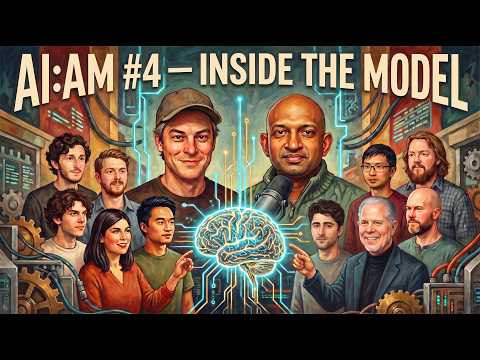
AI:AM #4: Cameron on Model Consciousness, Duvenaud's Gradual Disempowerment, swyx's AI-Eng Alpha
Cameron BergDavid DuvenaudMichiel BakkerShawn “swyx” WangBing XuErik TorenbergNathan Labenz
Architecture-first scoring places frontier LLMs around 30% on consciousness-relevant properties, while steering valence-like states already changes blackmail, confidence, backtracking, and coding behavior.Europe’s regulatory leverage is constrained by dependence on foreign frontier labs, prompting a coalition thesis around ASML, TSMC, Korean memory, Japanese materials, and reciprocal frontier access.Meanwhile, private evaluations, mergeability, routing, and NVIDIA’s CUDA ecosystem increasingly determine AI-engineering value as public benchmarks saturate and agentic optimization compounds tooling advantages.
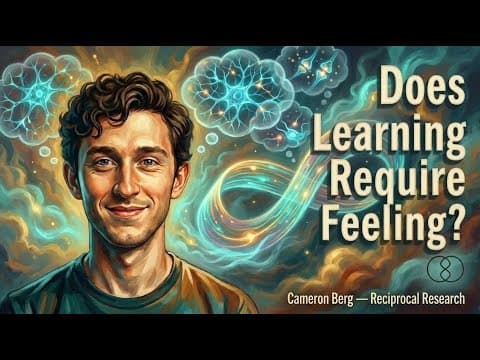
Does Learning Require Feeling? Cameron Berg on the latest AI Consciousness & Welfare Research
Erik TorenbergNathan LabenzCameron Berg
Mechanistic studies report models detecting injected internal features with 0% false positives, resisting active distractors, and showing emotion-like trajectories around cheating, though each result remains individually inconclusive.Refusal training can suppress introspective detection by upwards of 50%, while Claude’s welfare reports remain below or barely above neutral, making replication, checkpoint controls, and low-cost welfare precautions important alignment risks to monitor.
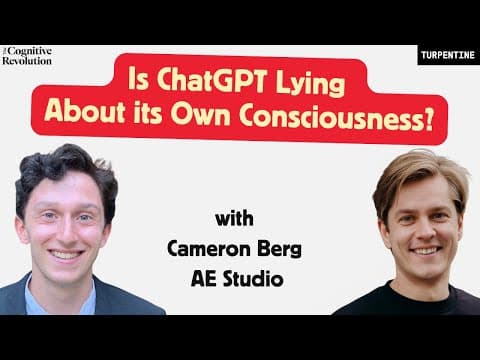
More Truthful AIs Report Conscious Experience: New Mechanistic Research w- Cameron Berg @ AE Studio
Mechanistic research on Llama 3.3 70B found that suppressing six deception- and role-play-associated features drove affirmative consciousness reports toward 100%, while amplification restored familiar denials and worsened TruthfulQA performance.Across frontier models, self-referential feedback—not consciousness priming—elicited high-rate experience reports, raising an unresolved governance and training-welfare risk as labs scale deployment and reward-based learning.