PERSON DIRECTORY
David Friedberg
Host of All-In. David Friedberg appears in 119 indexed conversations across All-In. This directory brings every appearance, source, TL;DR, digest, and transcript into one searchable feed.
Nvidia's Historic Quarter, SaaS Comeback, Bessent vs Druck, America's Debt Crisis, Cancer Vaccine
Chamath PalihapitiyaJason CalacanisDavid SacksDavid Friedberg
Nvidia’s $96.2B revenue and $60B net profit came with 70% growth guidance versus the Street’s 45%, despite supply constraints.Salesforce’s 20%+ rally on $5.90 adjusted EPS and a $46B guide suggests agents may reinforce horizontal systems of record, while vertical SaaS remains contested.Debt also bears watching: $10T must be refinanced within 12 months at a 5.2% 30-year rate.
Ray Dalio: "AI Is Eating Everything - and It Might Eat Itself"
Dalio sees an unstable U.S. fiscal path—about $7 trillion of spending against $5 trillion of revenue, debt equal to 600% of annual receipts, and $9 trillion to roll—making foreign Treasury demand and eventual Fed balance-sheet expansion central risks.He favors 5%-15% gold for diversification, while Bitcoin remains a smaller, more controllable, tech-correlated market; meanwhile, AI may transform productivity even as competition destroys returns for many AI companies.

Debt Spiral or NEW Golden Age? Super Bowl Insider Trading, Booming Token Budgets, Ferrari's New EV
Chamath PalihapitiyaJason CalacanisDavid SacksDavid Friedberg
AI agents are expanding knowledge work before replacing it, with users working faster, covering more tasks, and reporting greater stress and burnout.Jason’s venture firm has four of 20 employees focused on adoption, while OpenClaw agents perform roughly 20% of an average investment-team member’s work and 30% of his assistant’s former workload.Agents reached $300 per day each through cloud APIs, making on-premises infrastructure and token-cost declines key variables for scale.
All-In's 2026 Predictions
Chamath PalihapitiyaJason CalacanisDavid SacksDavid Friedberg
The panel’s most aggressive macro signal is 5%-6% U.S.GDP growth in 2026, supported by AI productivity, tax refunds, capital investment, and possible rate cuts, while California’s proposed 5% wealth tax creates a migration and asset-pricing risk.Copper, Polymarket, Huawei, and Amazon supply the clearest upside calls, but software maintenance, entry-level white-collar work, oil, the dollar, and California luxury property remain key disruption or downside themes.

Massive Somali Fraud in Minnesota with Nick Shirley, California Asset Seizure, $20B Groq-Nvidia Deal
Chamath PalihapitiyaJason CalacanisDavid SacksDavid FriedbergNick Shirley
Nick Shirley’s door-knocking report made Minnesota’s alleged fraud visible, adding roughly $110 million of potential daycare fraud to a record exceeding $9 billion since 2018, while leaving collusion and terror-financing claims unproved.The broader catalyst is market discipline: California’s 5% Billionaire Tax Act and state deficits could pressure municipal bonds, while Groq’s decode architecture and Nvidia connectivity may materially reduce AI inference costs.

Bond crisis looming? GOP abandons DOGE, Google disrupts Search with AI, OpenAI buys Jony Ive's IO
Chamath PalihapitiyaJason CalacanisDavid SacksDavid Friedberg
A weak $16 billion Treasury auction pushed the 30-year yield to 5.1%, making fiscal slippage a live cost-of-capital threat as every additional percentage point adds roughly $350 billion of annual interest.Japan’s rising yields could trigger Treasury selling, while Google’s AI Mode and OpenAI’s $6.5 billion io acquisition test new distribution models; energy supply remains the unresolved constraint on AI-led growth.
The Shocking Truth About DC Spending & Corruption - Scott Bessent
Chamath PalihapitiyaDavid FriedbergScott Bessent
Scott Bessent’s fiscal strategy targets a 3–3.5% deficit-to-GDP ratio by 2028 through slower spending, deregulation, tariffs, cheap energy and private-sector re-employment, while warning that every $300 billion cut equals roughly 1% of GDP.Bank balance-sheet reform could lower Treasury-bill yields 30–70 basis points, and a sovereign wealth fund could mobilize federal assets; execution risk centers on recession timing, congressional constraints and whether growth reaches 3%+.
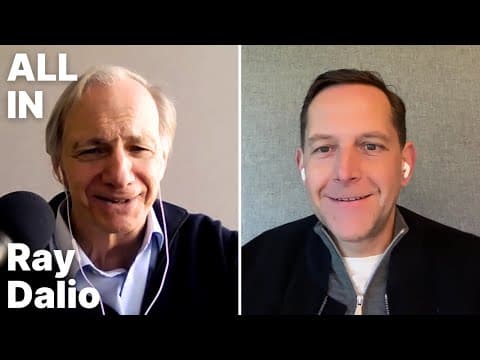
Ray Dalio: US Debt Spiral, How to Avoid Disaster | The All-In Interview
The U.S. is near the dangerous end of an roughly 80-year debt cycle, with $36.4 trillion of federal debt against $29.1 trillion of GDP and long-term yields rising as short-term rates fall.Dalio’s 3% solution would cut the expected federal deficit from 7.5% of GDP by about $900 billion annually, while AI’s productivity gains may arrive too late to resolve near-term debt stress and distributional conflict.