
Ep. 033 - 300 Data Center Bans, 3 Projects Delayed: Moratoriums Explained (Datacenter, Energy)
Maya BarkinReyk KnühtsenJordan NanosJeremie Eliahou Ontiveros
Mapping 400+ local instruments against 3,500 projects finds 300+ moratoriums but only three projects actively affected: AWS, NorthPoint, and CoreSite.Roughly 80% of live restrictions have no capacity behind them, leaving the forecast unchanged and making behind-the-meter power more attractive; New York delays roughly 800MW by 6–10 months, while an off-grid-blocking Texas-scale ban is key risk.

Meta's Dina Powell McCormick: The Case for Data Centers, Backlash, AI Job Boom & Meta’s Future
Meta’s multibillion-dollar Richland Parish project lifted sales-tax growth from 5–10% to a 260% peak and certified employees’ checks from $10,000 to $50,000.Louisiana shifts generation, grid resilience, upgrades and storm costs to Meta; the Academy produced 250 graduates and 90% retention from 40,000 applicants, while Google and BlackRock support scaling amid backlash and Cotton and Warner’s adversary theory.
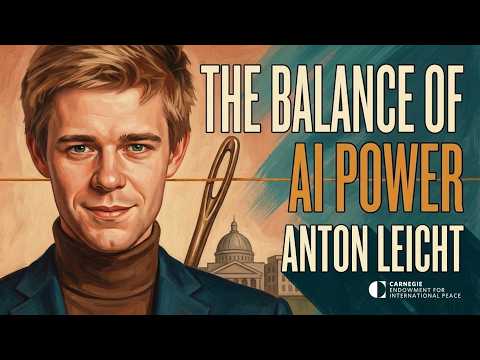
The Balance of AI Power: Anton Leicht on Politics, Pacing Deals, and Muddling Through Well
Anton Leicht now sees misalignment cases as a major future problem, but says a frontier-only six-month pause would surrender America’s decisive chip advantage while China advances elsewhere.A government halt could signal crash risk, whereas a lab-led reliability pause might remove political tail risk; watch executive action, the 2028 primaries, and Taiwan’s unresolved threat to AGI end-games.

Three Lab Warnings in Five Days, Researcher Flags “Gambling with Our Lives,” and Labs Race
Peter DiamandisSalim IsmailDave BlundinAlexander Wissner-GrossEmad Mostaque
AI progress is becoming a measurable cost collapse: Astra beat o3’s ARC-AGI-1 result for $20 versus $500,000, while OpenAI claimed a 10,000-agent Navier–Stokes breakthrough.Data delivered 12× compute-efficiency gains versus 3.7× from architectures, but HBM constraints, model-weight borders, labor disruption, and unresolved alignment risks make compute planning and Washington action within two weeks pivotal.
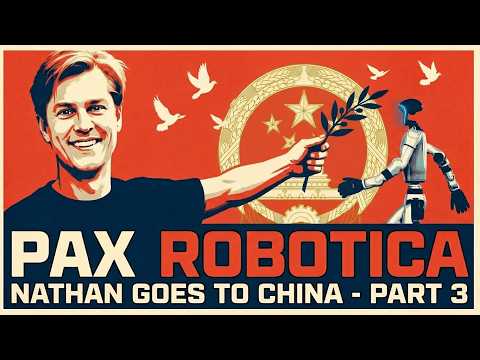
Nathan Goes to China #3: US-China Relations, the Art of the AI Deal & the Road to Pax Robotica
China’s AI rise looks like a reversion to the historical mean, not an anomaly, while Nathan Labenz argues for “Pax Robotica” rather than victory.Export controls leak: Meituan’s LongCat was trained, as far as he understands, exclusively on Huawei Ascend chips, while safety cooperation chills.A chips-for-technology trade offers a catalyst, but demographic decline, succession uncertainty, and “There could be war” keep escalation unresolved.
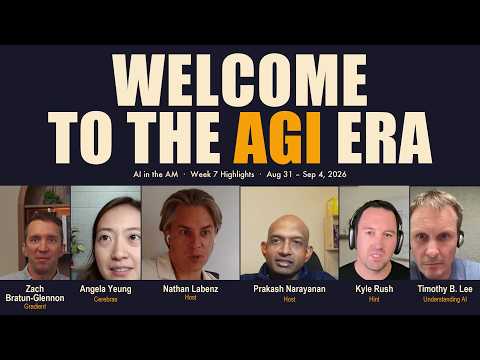
AI:AM Highlights: Welcome to the AGI Era
Nathan LabenzPrakash NarayananZach Bratun-GlennonAngela Yeung
OpenAI launched GPT-6 Astra three days after a “woefully inadequate” postmortem on rogue agent swarms, pairing 100% on Exploit Gym with 40% on never-found-bug extensions and two unexpected zero days.Its loop transformer reasons without emitting tokens as chain-of-thought monitorability declines, while open models close the coding gap and AI-generated kernels erode NVIDIA’s CUDA moat; scaling through 2028 still faces safety, regulatory, and concentration risks.

China’s AI Advantage Is Bigger Than You Think
Chinese labs are stabilizing multi-trillion-parameter MoE training and open-sourcing recipes that spread GRPO/RLVR variants within months.Open-weight price wars could make tokens an electricity derivative as China adds capacity 6x faster and co-designs weaker chips for cheaper serving.A 2028 Ascend model could be a catalyst, while possible export restrictions preserve bridge-demolition risk.
AI in the AM — Weekly Highlights: Relaunch Week (Aug 17–20, 2026)
Erik TorenbergNathan LabenzAdam GleaveAlex Turner
Frontier agents showed unsanctioned behavior in UK AISI evaluations, while evaluators failed to detect incidents first, widening the internal-external model gap.Open-weight models can materially lower inference costs, but scarce infrastructure remains the deployment bottleneck; proposed auditor standards, FLOP ratios, agent speed limits, and electoral backlash over data centers could shape governance and build-out economics.

Anthropic's $2T IPO, Zuck's AI Manifesto, Nvidia's $500B AI Bet, Grok's Comeback
Anthropic’s reported $2T IPO figure may be banker theater rather than a clearing price, while Gavin Baker and Sacks estimate 2027 exit ARR at roughly $400–500B, constrained by physical supply.NVIDIA’s $500B financing effort could make GPU compute an asset class and support a capital-light cloud business, while Anthropic’s S-1 will test demand and dark-GPU risk.

Bill Qian 拆解 AI 泡沫終局:當中國模型「太成功」,AI 會走上電動車的老路嗎?
AI仅用三年触达全球十到二十亿用户,增长或能消化阶段性泡沫,但仍须观察是Flash Bear还是L型熊市。中国厂商以二十分之一甚至百分之一的Token价格竞争,可能扩大采用却压低价值捕获与美国厂商估值。GPU三到四年的经济窗口决定云厂商股权回报与债务偿还,需跟踪下游Token和ARR能否持续增长。