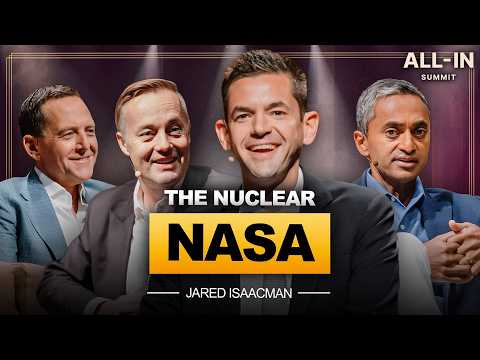
Jared Isaacman: A New Era for NASA and American Space Exploration
NASA is shifting capital from consensus-driven programs toward explicit national objectives, targeting Artemis 3 in summer 2027 and Artemis 4 in 2028.Repeated lunar missions could create demand for landers, rovers, and resource experiments, while public funding concentrates on fission power and nuclear-electric propulsion.SR1 Freedom’s 2028 target, uncertain lunar returns, and China’s ambitions make execution and launch capacity key watchpoints.
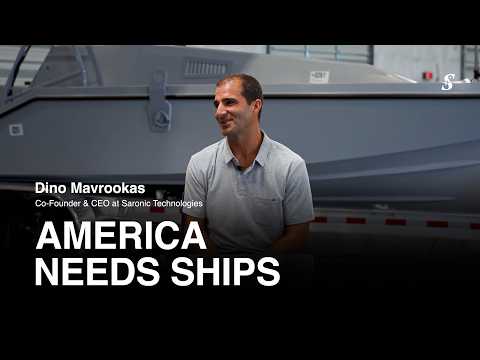
Dino Mavrookas: America Needs to Build Ships Again
China built over 1,000 commercial ships last year versus five large ocean-going vessels in the US, while China holds 57% of global shipbuilding capacity.Port Alpha’s $3 billion project targets autonomous container ships, tankers, and roll-on/roll-off vessels: simpler designs could enable scale and lower costs, but only 1% of the roughly $1 trillion FY26 Department of War budget went to autonomy.

How the White House Plans to 10x Scientific Productivity | Michael Kratsios | EP #276
Peter DiamandisMichael Kratsios
Michael Kratsios frames regulation as a market catalyst for technologies “born in captivity,” while national missions aim to create demand across AI, chips, robotics, quantum computing, and space.The Golden Age blueprint targets 10x scientific productivity through five-year grants, autonomous laboratories, public datasets, and AI-native research markets, with export financing and semiconductor controls shaping competition; execution and public acceptance remain key risks.

Nathan Goes to China – Part 1: Tech & Agent Setup, Chinese AI UX, WAIC, and Attitudes on AI
China’s strongest technology advantage may be national-scale integration across payments, mobility, commerce, identity and communications, rather than any single frontier model.That distribution already supports cheap, useful AI services, while WeChat’s potential native agent could make consumer adoption and healthcare access structurally significant; compute and surveillance risk remain key uncertainties.

Jared Isaacman: NASA's Moon Base by 2028, Optimus Robots on the Moon, and 15 Years to Mars | Ep #274
Peter DiamandisSalim IsmailDave BlundinAlexander Wissner-GrossJared Isaacman
Jared Isaacman’s NASA reset centers on modular programs, reusable transport and a few near-impossible objectives, arguing that $25 billion annually can fund more progress through sharper capital allocation.A 2028 lunar landing would begin with frequent low-cost robotic failures and learning, while nuclear propulsion, autonomous science and commercial orbital data centers could determine the timeline toward returnable Mars missions.

Mira Murati's 975B Open Model, Ramin Hasani on Post-Transformer AI, and Demis' AI FINRA | EP #271
Peter DiamandisSalim IsmailDave BlundinAlexander Wissner-GrossRamin Hasani
Frontier AI governance is becoming a contested market structure: Demis Hassabis’s industry-funded, FINRA-style watchdog could improve pre-release testing, while critics warn of regulatory capture and exclusion of open-weight competitors.Thinking Machines Lab’s 975B-parameter Inkling bets on on-prem customization, activating 41B parameters with a 1M-token context window.Liquid AI’s sub-1GB Mercedes deployment and AI²’s self-reported, independently unconfirmed claims leave deployment economics, governance, and genuine recursive capability as key watchpoints.

FPV Drones -The Next War Is Already Here — Yaroslav Azhnyuk, The Fourth Law & Noah Smith, Noahpinion
Brandon AndersonNoah SmithYaroslav Azhnyuk
FPV drones now cause 70–80% of frontline casualties, with Ukraine producing about 4 million last year at roughly $500 each versus $4,000 for a 155 mm shell.Autonomy can raise mission success from 20% to 71%, but electronic warfare, counter-drone cost exchange rates, and China’s potential to manufacture billions of systems make allied industrial scale urgent.

The State of Modern War: Palantir & Anduril Execs on Drones, AI, and the End of Traditional Warfare
David FriedbergShyam SankarTrae Stephens
US military power is increasingly constrained by factory capacity, with Ukraine consuming “10 years of production in 10 weeks,” a 10,000-to-one drone gap, and a 223x shipbuilding disadvantage versus China.Anduril’s five-million-square-foot Arsenal-1 is designed as a modular manufacturing platform for attritable systems, addressing the economics of replacing $2 million interceptors with $20,000 drones.The high-low mix may shift massively over five to 10 years, but Stephens estimates roughly 18 months even with unlimited cash to establish a sustainable industrial base.

Anthropic vs. The Pentagon, Claude Outpaces ChatGPT, and Consulting Gets Replaced | #234
Peter DiamandisSalim IsmailDave BlundinDr. Alexander Wissner-Gross
Anthropic’s enterprise-first strategy is driving 10X annual revenue growth versus OpenAI’s 3.4X, as companies consume reasoning tokens and agentic workflows at a pace consumers have resisted.The Pentagon dispute puts $200 million of government business against Anthropic’s refusal to permit unrestricted mass surveillance and autonomous weapons, showing frontier-model governance has become a procurement and national-security issue.India is emerging as an AI-neutral battleground, with $250 billion of announced commitments and Google’s $15 billion full-stack hub, while local inference may expand without decentralizing frontier-model training.

Why Roomba Died + Tech Predictions for 2026 + A Hard Forkin’ Xmas Song
Kevin RooseCasey NewtonColin Angle
iRobot’s Chapter 11 exposes how subsidized Chinese fast followers, a missed mopping use case, and the failed $1.7 billion Amazon acquisition eroded a category leader.Ownership passing to competing design manufacturer Piscea Robotics turns Roomba into a warning for physical AI, while 2026 bets point to uneven disruption across frontier labs, neoclouds, and SaaS.