Elon Musk & Gwynne Shotwell on AI Risks and Peer Review, Starship, Terafab, SpaceX/Tesla Merger
Chamath PalihapitiyaJason CalacanisDavid SacksDavid FriedbergGwynne ShotwellElon Musk
Cross-lab AI peer review would give competitors pre-release API access to run logged safety harnesses, making distillation visible and raising reputational and product-liability stakes.Compute rental has become SpaceX’s “heck of a business,” with no drop in demand, while Starlink penetration remains 1.5–2%.Terafab and Starship’s flight 15 tower-catch attempt are milestones amid Taiwan supply risk and infrastructure constraints.
RKLB Factory Tour: Satellites, Spacecraft & Mission Control
Rocket Lab’s signal is capital efficiency: Electron reached orbit for under $100M with 80 people, while Beck says Richard Branson put $1.2B into Virgin Orbit before bankruptcy.Its moat extends beyond launch into spacecraft components, where a small, fractured supply chain makes end-to-end ownership difficult to replicate.Execution is the monitor: 12-year radiation-heavy missions, acquisitions, Neutron, and national-security work.
Inside Rocket Lab w/ CEO Sir Peter Beck: Record Earnings, Neutron, Flatelittes
Rocket Lab posted record revenue, nearly $1 billion of backlog, and acquisitions extending its reach beyond launch.Beck calls launch and supply-constrained components its strongest moats, while Iridium adds profitability immediately and time for a new constellation.Neutron’s key milestone is the 10th rocket on the pad, not first flight, as delays raise the risk of a two-year gap.
The full-length interview with Elon Musk
Musk forecasts AI exceeding the sum of human intelligence in roughly five years and humanoid robots creating a “quasi-infinite economy” by 2036, when money may not matter.Electricity outside China and chips inside it are his stated bottlenecks; China’s power surplus and progress toward lithography put leadership in play, while rival-model testing and 10-20% killer-robot odds define the watchlist.
The $10B Satellite Empire Putting AI in Orbit, Why Chips Beat Rockets & China's #1 Open Model | #266
Peter DiamandisWill MarshallSalim IsmailDave BlundinDr. Alexander Wissner-Gross
Planet’s roughly 200 satellites generate 25 TB daily and a 150-PB, ten-year archive with 3,000 observations per land point, creating an irreproducible data moat as AI makes Earth searchable.Owl, Pelican, and Tanager add resolution, revisit rate, latency, and spectral depth, while orbital compute could become cost-competitive at $200-$300 per kilogram; inference efficiency, export policy, and GLM-5.2 remain key variables.
The SpaceX IPO, Fable 5, AI Capex Update & Market Check w/ Gavin Baker, Andrew Fox & Clark Tang
Brad GerstnerGavin BakerAndrew FoxClark Tang
SpaceX’s $135 IPO and $1.77T valuation already have terrestrial AI economics behind them, with EWS reaching the #4 hyperscaler position in 30 days and Anthropic contracts monetizing at $22-23B per gigawatt per year.Orbital compute is an optional 5x capex reduction conditional on Starship reuse and satellite reliability, while Cursor’s coding data and Fable 5 could extend frontier-model revenue; the $1.5T capex case still faces valuation, macro, and execution risk.
The IPO Comeback: Why Tech Giants Are Finally Going Public | All-In Liquidity IPO Panel
Andrew FeldmanWill MarshallBrad GerstnerChamath PalihapitiyaJason CalacanisDavid SacksDavid Friedberg
The IPO pendulum is shifting toward companies listing at $1 billion to $5 billion, with Planet creating roughly 90% of its post-SPAC value in years three and four.Cerebras’s $18.50 IPO followed a difficult 9.5 years, while its chip targets 15–18-times faster OpenAI workloads; orbital data centers offer a potential two-to-three-year cost catalyst, but distributed clustering remains unresolved.

Pope Leo vs. AI, GPT 5.5 Beats Claude, and Sam Altman Walks Back Job Apocalypse | EP #259
Peter DiamandisSalim IsmailDave BlundinAlexander Wissner-Gross
GPT-5.5 scored 70% on Deep Software Engineering versus Claude Opus 4.7’s 54%, while token prices fell to 50 cents per million as usage reached 25 trillion monthly.That combination shifts leverage toward compute access, model contracts, verification and pricing control, while the Vatican’s 42,000-word encyclical and shelved 90-day review expose governance’s race against China’s estimated three-to-eight-month frontier-model gap.
(Preview) SpaceX Hype and the Elon Bargain, Nvidia and the Neoclouds, Q&A on Dropbox, Google, Ferrari Luce Backlash
SpaceX’s proposed $2 trillion valuation strains against $18.6 billion of revenue, a $4.9 billion loss, and slowing growth, yet Musk repeatedly turns belief into infrastructure capital.The IPO offers venture-style upside and possible total loss; Starship, orbital cooling economics, and whether NVIDIA’s neocloud customers survive normalized supply remain key risks.
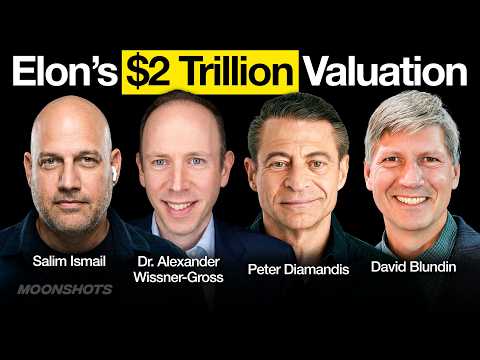
SpaceX Goes Public, Claude’s Mythos Release, and the US Data Center Delay | EP #246
Peter DiamandisSalim IsmailDave BlundinDr. Alexander Wissner-Gross
SpaceX’s proposed $75 billion IPO at a $2 trillion valuation is primarily a Starlink monetization event, with Peter Diamandis assigning 75%-80% of value to the satellite business.The thesis depends on exceptional growth, orbital data centers and unproven Starship refueling, while Anthropic and OpenAI compete for the same scarce IPO capital and Mythos raises unresolved cybersecurity and release-timing risks.