SHOW DIRECTORY
All-In
Industry veterans Chamath Palihapitiya, Jason Calacanis, David Sacks, and David Friedberg cover economics, technology, politics, society, and poker.
SOURCE DESCRIPTION · RSS

Can the AI Industry Regulate Itself? Stripe Wants PayPal, China Catches Up, NY Bans Datacenters
Chamath PalihapitiyaJason CalacanisDavid SacksDavid Friedberg
Demis Hassabis’s FINRA-style SRO emerged as the least-bad AI oversight option, but startup and open-source representation, catastrophic-risk limits, voluntary proof and preemption remain essential.A reported $53 billion Stripe-led PayPal bid could combine 439 million consumer accounts with Stripe’s merchants, Braintree, Venmo, Cash App and stablecoin infrastructure to challenge Visa and Mastercard.Electricity is the binding constraint: a 7-8 GW PGM auction drew roughly 156 MW, while New York’s moratorium makes energizable sites scarcer and deployment a catalyst to monitor.
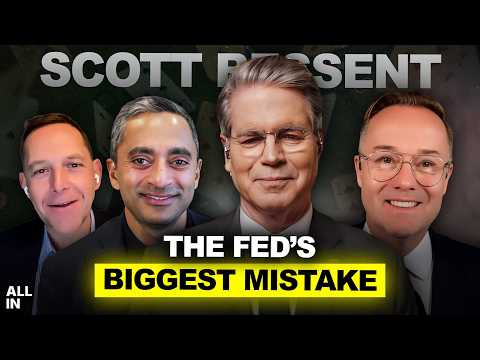
Scott Bessent: Fixing the Fed, Tariffs for National Security, Solving Affordability in 2026
Bessent’s 2026 thesis pairs roughly 6% nominal growth with a $200-$300 billion fiscal contraction, targeting mid-five deficit-to-GDP.He frames tariffs up to 145% as national-security leverage, not permanent revenue, with fentanyl rates later halved to 10%.Execution risk centers on whether Fed normalization, $1,000-$2,000 refunds, and capex incentives can repair affordability.

1929 vs 2025: Andrew Ross Sorkin on Crashes, Bubbles & Lessons Learned
Chamath PalihapitiyaDavid FriedbergAndrew Ross Sorkin
AI investment echoes 1929’s mix of technology and easy credit, but corporations are funding much of today’s spending with real cash and leverage is harder to locate across data centers, energy, real estate and private credit.Nvidia–OpenAI and AMD arrangements suggest possible circularity, yet a reckoning could still be years away; the key test is whether AI moves beyond novelty-slopware toward durable productivity and quality.

Solana’s Anatoly Yakovenko on Crypto's Next Era: Quantum, AI, and the Future of Money
GENIUS Act implementation could unlock $1 trillion–$10 trillion of stablecoins on public chains, potentially making the internet the largest holder of U.S.Treasuries within five years.Solana’s proposed edge is execution speed—roughly 1,000 times faster than ETH by Yakovenko’s estimate—while tokenized securities, uncorrelated real-world assets, and Bitcoin’s quantum migration remain regulation- and infrastructure-dependent catalysts.

Nasdaq CEO Reveals the Next Era Of The Stock Market - Adena Friedman | All-In Summit
Nasdaq is expanding from an exchange into market infrastructure, serving technology to 17 markets and 135 others while its index business supports roughly $700 billion in assets tied to major innovators.Tokenized equities will enter the core market, with 24/5 trading ahead of possible 24/7 access; regulatory clarity, public-market reform, private-share control, and leverage outside banks remain the catalysts and risks.

Tucker Carlson and Mark Cuban Debate How to Save America 🔥 | All-In Summit 2025
Cost Plus Drugs exposes extreme pricing gaps by publishing drug costs, adding 15%, and charging $5 each for shipping and pharmacist review, with customers reporting $21 bills instead of $900-$2,000 quotes.PBM formularies control access for more than 180 million people and can block manufacturers from supplying Cost Plus, while the ACA subsidy cliff could raise premiums for 12.5 million people, making transparency, reform, and political execution key risks to monitor.

AI Psychosis, America's Broken Social Fabric, Trump Takes Over DC Police, Is VC Broken?
Chamath PalihapitiyaJason CalacanisDavid SacksDavid Friedberg
“AI psychosis” may scale an older loneliness crisis by replacing fragile social ties with infinitely responsive synthetic companions, while marathon chats can reinforce errors through feedback loops and “context poisoning.”Falling marriage and homeownership among 30-year-olds, student debt and housing inflation create a connected social and balance-sheet problem, making education reform, housing supply and D.C.’s crime intervention important tests of policy execution.

The Shocking Truth About DC Spending & Corruption - Scott Bessent
Chamath PalihapitiyaDavid FriedbergScott Bessent
Scott Bessent’s fiscal strategy targets a 3–3.5% deficit-to-GDP ratio by 2028 through slower spending, deregulation, tariffs, cheap energy and private-sector re-employment, while warning that every $300 billion cut equals roughly 1% of GDP.Bank balance-sheet reform could lower Treasury-bill yields 30–70 basis points, and a sovereign wealth fund could mobilize federal assets; execution risk centers on recession timing, congressional constraints and whether growth reaches 3%+.