SHOW DIRECTORY
All-In
Industry veterans Chamath Palihapitiya, Jason Calacanis, David Sacks, and David Friedberg cover economics, technology, politics, society, and poker.
SOURCE DESCRIPTION · RSS

Jensen Huang: The Doomer Hoax, Superintelligence is Here, and The Future of AI (ft. President Trump)
Jensen Huang cites failed forecasts on radiology, AI-generated code and entry-level jobs to challenge doomsday narratives, while arguing that AI incidents so far call for root-cause engineering and independent evaluation rather than sweeping regulation.With 80% of AI-native companies receiving $400 billion in recent venture funding using open models, NVIDIA is building infrastructure bottlenecks as Jensen predicts China will reach advanced lithography by 2030, leaving commercialization, lab controls and data-center execution to monitor.

Former Intel CEO on What Went Wrong, What's Next + Lovable CEO on the Real Promise of Vibe Coding
Jason CalacanisPat GelsingerAnton Osika
Pat Gelsinger attributes Intel’s decline to replacing technical leadership with spreadsheet-driven capital allocation, while Apple, Nvidia and TSMC compounded patient capability-building into durable platforms.The semiconductor recovery remains exposed to Taiwan’s energy dependence, even as AI’s long runway is constrained by electricity; Lovable meanwhile reports production-scale adoption, with defensibility shifting toward orchestration, security, operational data and user feedback.

OpenAI's Identity Crisis, Datacenter Wars, Market Up on Iran News, Mamdani's First Tax, Swalwell Out
Travis KalanickChamath PalihapitiyaJason CalacanisDavid SacksDavid Friedberg
OpenAI's enterprise growth is described at 3–4X annually versus Anthropic's roughly 10X, while metered coding tokens scale faster than consumer plans limited by perhaps 3–4% premium conversion.Frontier compute is becoming an infrastructure war—Colossus targets 555,000 GPUs—while power and permits threaten roughly 100 contested data centers worth $162 billion; near-record valuation measures and unproven enterprise profits remain key risks.
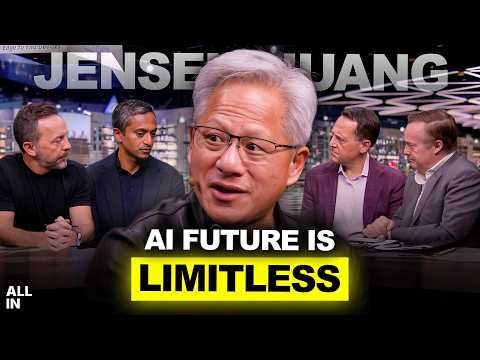
Jensen Huang: Nvidia's Future, Physical AI, Rise of the Agent, Inference Explosion, AI PR Crisis
Nvidia is expanding from GPUs into complete AI factories, combining Vera Rubin, networking, CPUs, BlueField and Groq to serve increasingly heterogeneous agent workloads.Huang argues that token cost matters more than factory price because 10X throughput can outweigh cheaper chips, while agentic inference and physical AI could drive million-fold demand growth and useful robots within roughly three to five years.

Winning the AI Race Part 3: Jensen Huang, Lisa Su, James Litinsky, Chase Lochmiller
James LitinskyLisa SuChase LochmillerJensen Huang
MP Materials is positioning rare-earth magnets as “the feedstock to physical AI,” building a vertically integrated US chain from Mountain Pass ore through Texas magnet production.The Department of Defense partnership provides a commodity price floor, 100% offtake from a planned 10x-capacity facility, and shared upside, while MP retains cost, schedule, and operating risk.Lisa Su cited a low-double-digit Arizona fabrication premium, while Crusoe’s 1.2-GW Abilene project and 400,000 NVIDIA GPUs show that energy, construction, and labor are becoming binding constraints.