SHOW DIRECTORY
All-In
Industry veterans Chamath Palihapitiya, Jason Calacanis, David Sacks, and David Friedberg cover economics, technology, politics, society, and poker.
SOURCE DESCRIPTION · RSS

They're Opening the Stock Market to Everyone. Here's What That Actually Means
Jason CalacanisChamath PalihapitiyaPaul AtkinsMichael Selig
SEC Chair Atkins wants to restore the IPO as a financing round through material-disclosure reform, less litigation, and review of quarterly reporting and accreditation rules.CFTC Chair Selig is replacing regulation by enforcement with purpose-fit frameworks for crypto, prediction markets, AI, and blockchain, while agencies pursue coordinated oversight.Tokenization could enable T+0 settlement and broader onshore innovation, but autonomous trading, manipulation, leverage, and gambling-related harms remain unresolved monitoring risks.

Binance CEO: 4 Months in Prison, $4 Billion Fine, and What Comes Next
CZChamath PalihapitiyaJason CalacanisDavid SacksDavid Friedberg
Binance emerged after China’s March 2017 shutdown erased roughly 30 software clients, with an ICO selling 60% of BNB for about $15 million to fund the crypto-to-crypto exchange.Faster execution and a 50% fee discount drove adoption, but weak KYC/AML and unregistered US service led to CZ’s four-month sentence, while AI-agent payments remain a possibility and privacy unresolved.
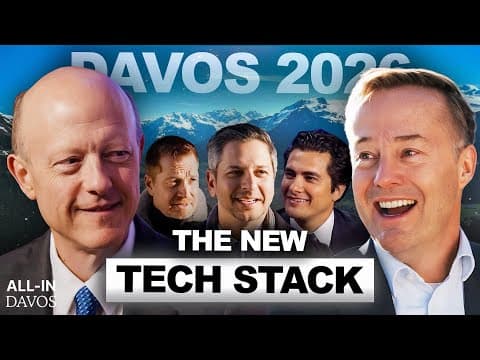
The Future of Everything: What CEOs of Circle, CrowdStrike & More See Coming in 2026
Jeremy AllaireGeorge KurtzAdam GoldsteinChase Lochmiller
Circle sees regulated USDC becoming an internet-scale financial network addressing roughly $120 trillion in legal electronic money, with lower rates potentially accelerating adoption even as reserve yield declines.CrowdStrike says AI is compressing attack timelines and enabling prompt-only malware, driving its shift from endpoint detection and response to AIDR as employees gain roughly 90 agents each.Archer expects visible US eVTOL demonstrations in summer 2026 across five trial cities, with Los Angeles and its Anduril defense derivative offering catalysts beyond eventual passenger certification.

Coinbase CEO's Top 3 Crypto Trends for 2026 + More from Davos!
Brian ArmstrongAndrew FeldmanJake Loosararian
Coinbase says U.S. crypto has shifted from regulatory defense to institutional deployment, with five of the top 20 global banks using its infrastructure.Under the GENIUS Act, regulated stablecoins hold 100% reserves in short-term Treasuries, while Coinbase can pass customers “about 100% of the economics” through rewards.B2B cross-border settlement is already driving strong Coinbase Business demand, while trade groups Armstrong believes are trying to revisit the law remain a risk to monitor.

Solana’s Anatoly Yakovenko on Crypto's Next Era: Quantum, AI, and the Future of Money
GENIUS Act implementation could unlock $1 trillion–$10 trillion of stablecoins on public chains, potentially making the internet the largest holder of U.S.Treasuries within five years.Solana’s proposed edge is execution speed—roughly 1,000 times faster than ETH by Yakovenko’s estimate—while tokenized securities, uncorrelated real-world assets, and Bitcoin’s quantum migration remain regulation- and infrastructure-dependent catalysts.
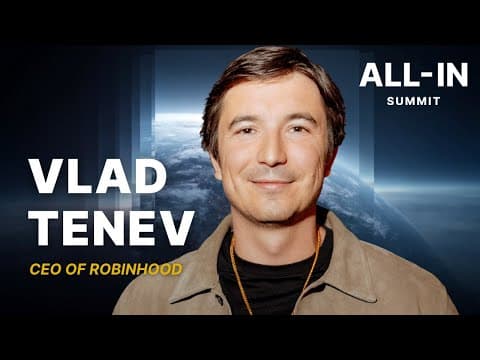
Robinhood CEO Vlad Tenev on tokenizing stocks, expanding access to private shares, fintech's future
Robinhood’s tokenization thesis prioritizes access to inaccessible, illiquid assets over 24/7 trading, using stablecoin-like reserves and one-to-one minting to offer exposure to assets including OpenAI and SpaceX across 31 countries.Public stocks provide the cleaner regulatory starting point, while private shares offer greater long-term significance but raise issuer-consent and disclosure issues; Robinhood is also expanding its integrated financial platform as Harmonic develops formally verified mathematical reasoning and software.

Trump vs Powell, Solving the Debt Crisis, The $10T AGI Prize, GENIUS Act Becomes Law
Chamath PalihapitiyaJason CalacanisDavid SacksDavid FriedbergGavin BakerBo HinesBill Hagerty
A Powell firing could damage Fed independence while refinancing $36 trillion of debt near the 5% 30-year yield pushes interest expense toward $2 trillion.GENIUS makes regulated dollar stablecoins payment infrastructure and a potential Treasury-demand catalyst, while CLARITY remains the next legislative milestone.

The Stablecoin Future, Milei's Memecoin, DOGE for the DoD, Grok 3, Why Stripe Stays Private
Chamath PalihapitiyaJason CalacanisDavid FriedbergJohn CollisonPatrick Collison
Stripe’s stablecoin strategy targets cross-border dollar access before U.S. checkout payments, with Bridge and rails such as Ethereum L2s and Solana extending its software-orchestrated money movement.Its profitable private model compounds across payments, billing, and treasury while a trusted transaction network could reduce fraud and fees, though Visa and Mastercard trade-offs remain.

DOGE vs USAID, Crypto Framework, Google's $75B AI Spend, US Sovereign Wealth Fund, GLP-1s
Chamath PalihapitiyaJason CalacanisDavid SacksDavid FriedbergAntonio Gracias
Crypto’s policy path is stablecoin legislation followed by a FIT21-style market-structure bill, with Sacks citing alignment among all four relevant committee chairs and passage within several months as plausible.Google’s $75B 2025 capex plan looks like a utilization and ROIC test: a 20% return plus six-year amortization requires roughly $27B in incremental annual operating profit.A US sovereign wealth fund remains divided between strategic reinvestment and disciplined asset sales, while GLP-1 benefits and muscle and bone-density loss remain unresolved.