SHOW DIRECTORY
The a16z Show
The venture firm’s view of startups, AI, software, markets, company building, and the technological shifts creating new categories.
BIDCLUB DESCRIPTION

The People Who Built Hip-Hop Are Finally Getting Their Due
Ben HorowitzErik TorenbergNasGrandmaster CazSteve Stoute
Paid in Full Foundation addresses hip-hop’s value-capture gap with 2.5:1 matching donations, no paid employees, and funds flowing to artists.Nas’s recognition-first award format overcame artist distrust, while Caz’s five-year grant enabled a move from Bronx public housing to a Pennsylvania home; the foundation’s fourth year will test whether this model can scale.
The State of AI: Models, Moats, and the Consumer Renaissance
Frontier AI is becoming a many-winners market: xAI moved from non-contender to one of three in two weeks while OpenAI, Anthropic and others grow through specialization.Rising B200 per-hour prices indicate constrained supply and essentially infinite demand, but coding agents threaten integration moats; open-weight models may capture bounded-upside workloads as cheaper consumer software awaits an AI-native app store.
How Whatnot Made Online Shopping Fun Again
Live commerce’s US share is still in the “single digits” versus 30-40% in China, with Whatnot arguing that $0 global storefronts can expand demand rather than merely shift offline sales online.Over $8B in sales last year and so far this year, 95-minute daily engagement, and seller EBITDA margins of 20, 30, 40-plus percent make category expansion and trust-and-safety execution key tests.
Building a Company in Stealth | Travis Kalanick with a16z
Travis KalanickBen HorowitzErik Torenberg
Atoms is applying full-stack industrial AI to food, mining, and transport, with production, logistics, robotics, and infrastructure unified as an “atoms-based computer.”Its 50% production-cost reduction, 50¢–$1 robotic delivery, and mining productivity now above humans support a path to lower-cost meals and faster deployment, while execution depends on management capacity and overcoming industrial regulation.

Jake Paul on Going From YouTube to Boxing to Investing | a16z ft. Anti Fund
Erik TorenbergJake PaulGeoff Woo
Anti Fund is pairing growth capital with Jake Paul’s scarce distribution advantage, backing names including Anduril, SpaceX, OpenAI and Anthropic as Woo argues that attention, not capital, is increasingly constrained.Paul’s experiment-measure-concentrate playbook and resilience underpin the partnership, while creator monetization, political and education ambitions, platform limits and the possibility of rapid AI imitation remain important variables.
The New Media Advantage with Ben Horowitz and Marc Andreessen
Marc AndreessenBen HorowitzErik TorenbergGaby Goldberg
Legacy media’s shift toward agenda-driven journalism since 2017 has made repeatable favorable coverage unreliable, pushing founders toward owned channels, allies, podcasts, and newsletters.The person-as-brand model rewards authentic long-form command and outside-in narratives, potentially converting relevance around military AI, geopolitics, or supply chains into executive access, but concentrates key-person risk and can amplify an irrelevant message.

Building Blackstone, Backing Costco, and Working with Munger | Tony James on The a16z Show
Tony James’s compounding playbook paired early S-curve positioning with operating discipline, from DLJ using leveraged buyouts to “buy clients we couldn’t actually win competitively” to Blackstone increasing market value about 170-fold while fund IRRs improved.Costco shows the customer moat in practice—if sourcing saves a nickel, “100% of that nickel gets lower prices”—while James sees a private-credit correction ahead and favors seasoned assets through co-investments and continuation vehicles.
The New Media Playbook with Marc Andreessen & Ben Horowitz
Erik TorenbergBen HorowitzMarc Andreessen
Old-media defense has become a liability as founder-led companies use visible people, original ideas and fast-moving platforms to replace corporate messaging with direct distribution.A16z converts that speed into competitive power through OODA-loop execution, platform-native operators, launch services and a fellowship that drew 2,000 applications for 65 places, while audience density matters more than aggregate reach.

Where does consumer AI stand at the end of 2025?
Anish AcharyaOlivia MooreJustine MooreBryan Kim
ChatGPT retained 800–900 million weekly users while Gemini’s desktop growth reached 155% year over year, making image and video launches the clearest competitive catalyst.Labs still struggle to turn distribution into breakout vertical products, leaving openings in persistent prosumer workflows, multimodal creation, and power-user applications constrained by compute economics.
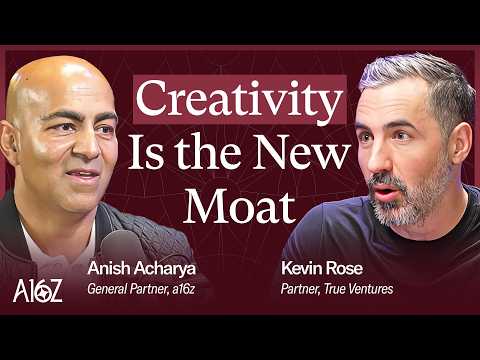
Why Creativity Will Matter More Than Code | Kevin Rose and Anish Acharya
Consumer AI is reopening a market Acharya compares with 2010–2012, with ChatGPT at $200 a month, Google Ultra at $250 and Grok at $300 signaling unusually strong willingness to pay.As software creation costs collapse, startups can win through personality, model choice, orchestration and product taste, while companionship’s agreeability and always-on memory’s privacy-preserving social contract remain unresolved risks.