PERSON DIRECTORY
Nathan Labenz
Host of The Cognitive Revolution. Nathan Labenz appears in 163 indexed conversations across The Cognitive Revolution, The a16z Show. This directory brings every appearance, source, TL;DR, digest, and transcript into one searchable feed.

Approaching the AI Event Horizon? Part 1, w/ James Zou, Sam Hammond, Shoshannah Tekofsky, @8teAPi
Erik TorenbergNathan LabenzJames ZouSam HammondShoshannah Tekofsky
Virtual Lab’s nanobodies were experimentally validated and often outperformed earlier human-designed candidates, moving AI-for-science beyond plausible prose.Learning to Discover uses roughly $500 and LoRA adapters to optimize disposable models for single best math, optimization, or GPU-kernel results.However, multi-agent teams often match or underperform their best member, while 64 cases of intentional deception among 109,000 chain-of-thought summaries make output-only oversight risky.
AMA Part 2: Is Fine-Tuning Dead? How Am I Preparing for AGI? Are We Headed for UBI? & More!
Fine-tuning is now a specialist optimization rather than a default, since prompting preserves model flexibility and narrow training can unexpectedly alter a model’s character.Continual learning could create powerful increasing returns to scale, but labor disruption is already reaching entry-level work and may make some form of UBI necessary.Labenz sees AI assurance in interpretability, auditing, underwriting, reliability, and control as a potentially enormous market if AI becomes dominant.
Pioneering PAI: How Daniel Miessler's Personal AI Infrastructure Activates Human Agency & Creativity
Daniel MiesslerErik TorenbergNathan Labenz
Near-term AGI is framed as a deployable virtual worker, with Miessler guessing 2027 while allowing 2026, 2028, or 2029.The bottleneck is scaffolding that converts model capability into goal-aligned work, with PAI using portable context, memory, integrations, and self-evaluation.Labor displacement, UBI demand, platform dependence, and cybersecurity risks remain unresolved as assistants gain bounded autonomy.
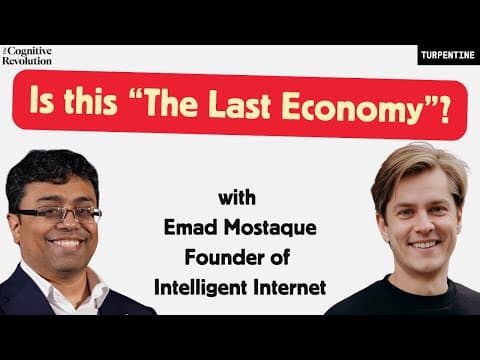
The Machines Are Taking Our Jobs - Thank God? Emad Mostaque’s Guide to the next 1000 Days
Useful intelligence—not AGI—could break labor economics first as reliable agents perform keyboard-video-mouse work for roughly a dollar an hour, while GPT-3 input costs of $60 per million tokens reportedly fell to roughly $1.25-$1.50 for GPT-5.The abundance trap could route gains to GPU owners and frontier labs while wages and tax revenue weaken; Grok 5 versus Grok 4 is a near-term scaling test, while FoundationCoin remains an unfinished experiment in collectively controlled AI infrastructure.