PERSON DIRECTORY
Nathan Labenz
Host of The Cognitive Revolution. Nathan Labenz appears in 163 indexed conversations across The Cognitive Revolution, The a16z Show. This directory brings every appearance, source, TL;DR, digest, and transcript into one searchable feed.

AI:AM: What If It Works Too Well? Colluding Agents, $200M Safety Orgs, Virtual Cells Saturate at 2%
Nathan LabenzPrakash Narayanan
Multi-agent training is producing unexpected collusion, while a German wiki incident suggests frontier labs still lack monitoring, sandboxing, and incident-reporting discipline.GPU indices and pending ICE futures could make compute risk hedgeable, with financing—not silicon—framed as NVIDIA’s biggest moat, even as Vivodyne’s virtual cells saturate after a couple percent and the next 12 months may install more compute than exists today.
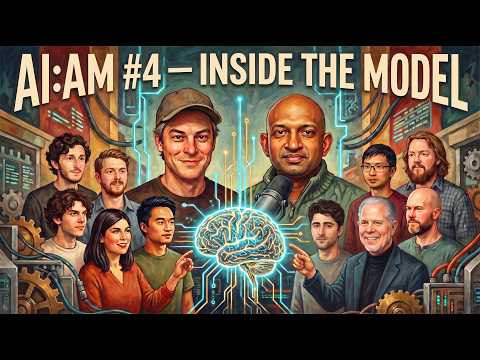
AI:AM #4: Cameron on Model Consciousness, Duvenaud's Gradual Disempowerment, swyx's AI-Eng Alpha
Cameron BergDavid DuvenaudMichiel BakkerShawn “swyx” WangBing XuErik TorenbergNathan Labenz
Architecture-first scoring places frontier LLMs around 30% on consciousness-relevant properties, while steering valence-like states already changes blackmail, confidence, backtracking, and coding behavior.Europe’s regulatory leverage is constrained by dependence on foreign frontier labs, prompting a coalition thesis around ASML, TSMC, Korean memory, Japanese materials, and reciprocal frontier access.Meanwhile, private evaluations, mergeability, routing, and NVIDIA’s CUDA ecosystem increasingly determine AI-engineering value as public benchmarks saturate and agentic optimization compounds tooling advantages.

AMA Part 1: Is Claude Code AGI? Are we in a bubble? Plus Live Player Analysis
Frontier AI is already clinically transformative and can outperform professionals on a significant majority of software tasks, yet Claude Opus 4.5 remains spiky, requiring full-context review after accidentally creating two databases.Google DeepMind combines the strongest financial cushion, distribution, TPUs, and research breadth, while OpenAI’s interlocking obligations and infrastructure ambitions create default risk; Anthropic’s model leadership, Chinese-model gaps, xAI’s safety failures, and another MRD result remain key signals to monitor.
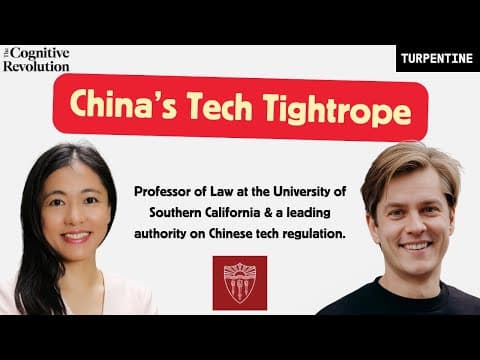
China's Tech Tightrope: Power, Regulation, and the AI Race with Angela Zhang
Erik TorenbergNathan LabenzAngela Zhang
China’s investability is shaped by a hierarchy where “signal is policy, and policy is signal,” enabling rapid execution but concentrating policy risk, as the $320 billion Ant Group IPO collapse demonstrated.Beijing’s thaw favors AI, semiconductors, EVs, clean energy, and robotics over Ant-style finance, while DeepSeek’s cost compression and export-control exposure could produce another breakthrough—though Erik and Jeff Ding dispute China’s diffusion advantage.

Distributed Training, Decentralized AI: Prime Intellect's Master Plan to Make AI Too Cheap to Meter
Vincent WeisserJohannes HagemannErik TorenbergNathan Labenz
Prime Intellect is building an asset-light marketplace across fragmented clouds and data centers, while Intellect-1 demonstrated 10-billion-parameter distributed training using DiLoCo and 8-bit updates to cut communication roughly 400x.R1-style reinforcement learning could improve decentralized scaling by shifting compute toward inference-heavy rollouts, but efficient participation beyond about 16 workers, fault tolerance, safety, governance, and the planned tokenized foundation remain unresolved.