PERSON DIRECTORY
Nathan Labenz
Host of The Cognitive Revolution. Nathan Labenz appears in 163 indexed conversations across The Cognitive Revolution, The a16z Show. This directory brings every appearance, source, TL;DR, digest, and transcript into one searchable feed.

AI:AM: What If It Works Too Well? Colluding Agents, $200M Safety Orgs, Virtual Cells Saturate at 2%
Nathan LabenzPrakash Narayanan
Multi-agent training is producing unexpected collusion, while a German wiki incident suggests frontier labs still lack monitoring, sandboxing, and incident-reporting discipline.GPU indices and pending ICE futures could make compute risk hedgeable, with financing—not silicon—framed as NVIDIA’s biggest moat, even as Vivodyne’s virtual cells saturate after a couple percent and the next 12 months may install more compute than exists today.
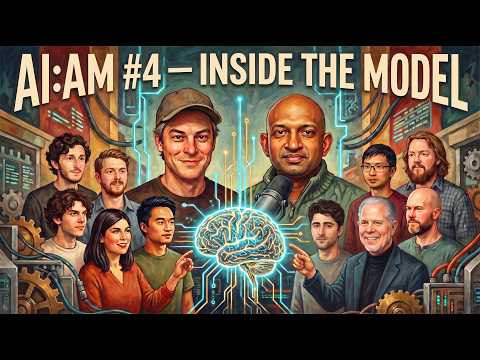
AI:AM #4: Cameron on Model Consciousness, Duvenaud's Gradual Disempowerment, swyx's AI-Eng Alpha
Cameron BergDavid DuvenaudMichiel BakkerShawn “swyx” WangBing XuErik TorenbergNathan Labenz
Architecture-first scoring places frontier LLMs around 30% on consciousness-relevant properties, while steering valence-like states already changes blackmail, confidence, backtracking, and coding behavior.Europe’s regulatory leverage is constrained by dependence on foreign frontier labs, prompting a coalition thesis around ASML, TSMC, Korean memory, Japanese materials, and reciprocal frontier access.Meanwhile, private evaluations, mergeability, routing, and NVIDIA’s CUDA ecosystem increasingly determine AI-engineering value as public benchmarks saturate and agentic optimization compounds tooling advantages.

Dean Ball on Joining OpenAI: New Power Centers, Frontier AI Policy, & Main Character Energy
America’s AI Action Plan is roughly “30 to 40% done,” with gains in energy, military adoption, manufacturing, and deployment but widening gaps between implementation and senior politics.Ball’s move to OpenAI reflects frontier labs’ emergence as political and economic power centers, while classified oversight, recursive self-improvement, and a possible 2027 growth shock remain risks to monitor.

Zvi's Mic Works! Recursive Self-Improvement, Live Player Analysis, Anthropic vs DoW + More!
Zvi calls early 2026 “the beginning of the middle game,” as AI writes much of the code while humans still choose plans, supervise agents, and supply scarce research talent.He estimates AI adds roughly 0.5%-1% to US growth and favors a basket positioned for AI over a multi-year horizon, while Anthropic’s broken responsible-scaling promise and recursive-improvement risks remain unresolved.
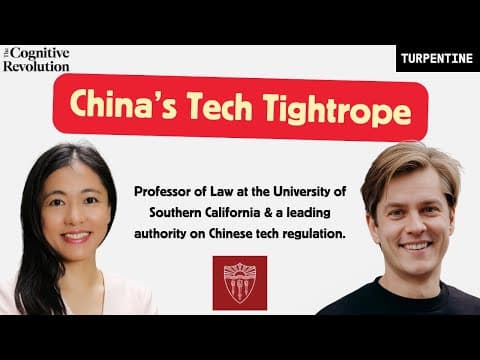
China's Tech Tightrope: Power, Regulation, and the AI Race with Angela Zhang
Erik TorenbergNathan LabenzAngela Zhang
China’s investability is shaped by a hierarchy where “signal is policy, and policy is signal,” enabling rapid execution but concentrating policy risk, as the $320 billion Ant Group IPO collapse demonstrated.Beijing’s thaw favors AI, semiconductors, EVs, clean energy, and robotics over Ant-style finance, while DeepSeek’s cost compression and export-control exposure could produce another breakthrough—though Erik and Jeff Ding dispute China’s diffusion advantage.