SHOW DIRECTORY
Latent Space
Technical conversations for AI engineers and builders covering models, agents, developer tools, inference, data, and production infrastructure.
BIDCLUB DESCRIPTION
🔬Bio-security is an AI Arms Race - Eric Nguyen (CEO, Radical Numerics)
Radical Numerics is positioning genome language models to move from reading DNA to designing functional sequences, with Omni’s post-training targeting variant effects in long-range, non-coding regions.The potential wedge is practical prediction across the roughly 98% of the human genome outside coding regions, while wet-lab validation, benchmark leakage, false positives, and biosecurity remain material execution risks.
🔬Biology Is Turning Into Software — Matt McPartland & Neil Patel, Chai Discovery
RJ HonickyMatt McPartlonNeil Patil
Chai Discovery is commercializing a neutral modeling and product layer for pharma rather than developing its own drugs, with partnerships including Eli Lilly, Pfizer, Novartis, and Genentech.Chai-2 designed antibodies against 50 targets, finding binders for about half with an average binding hit rate of around 20%, while enabling GPCR agonists and multispecific formats traditional screening struggles to produce.The opportunity depends on improving developability and epitope prediction, but compute scarcity, validation latency, and talent shortages remain structural constraints as Chai scales its platform.

🔬Causal Models Need Causal Data - Xaira’s X-Cell model (Bo Wang & Ci Chu)
Xaira links protein design, X-Cell, and patient-representation models around a causal drug-discovery loop, arguing that observational expression profiles cannot answer intervention questions.Seven genome-wide Perturb-seq campaigns across 16 contexts and 25 million filtered cells enabled X-Cell to transfer predictions from resting to activated T cells, held-out iPSC types, and primary donors, while patient, organ, and longitudinal dynamics remain unresolved.

🔬 RL with Verifiable Rewards, but the Verifier is a Lab — Lila Sciences
Andy BeamRafa Gómez-Bombarelli
Lila is betting that controlled experiments can become AI’s next internet-scale training corpus, with nature providing verifiable rewards and an information-gain-driven lab turning experiments into a compounding model moat.Lila reports a six-month, two- or three-person in vivo CAR-T program versus roughly six years and $100 million, but clinical translation, scale-up, regulation, and 5–6% model FLOPs utilization remain key watchpoints.
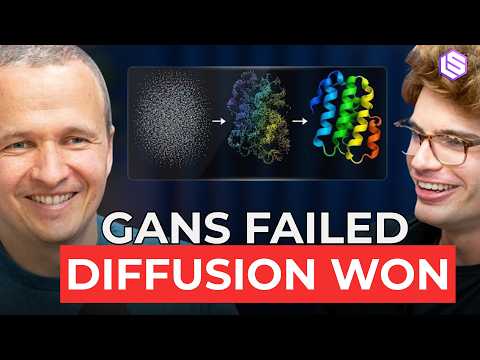
🔬 "The Most Innovative Diffusion Research Is Happening in Drug Discovery, Not Image Generation"
Brandon AndersonEvan FeinbergSergey Edunov
Genesis Molecular AI is applying diffusion and inference-time scaling to 3D molecular design, targeting roughly 1 Å protein-ligand accuracy because 2 Å can hide chemically fatal errors.Its prospective edge comes from Incyte and Insitro programs that connect models to synthesis and ADMET feedback, while OpenBind showed stronger unseen-target generalization and GPUs remain the scaling bottleneck.
🔬 The Bitter Lesson is Coming for Proteins - Alex Rives, BioHub
ESM-C’s key advance was billions of diverse metagenomic sequences, which restored scaling returns at roughly ESM-2’s parameter scale and enabled an MIT-licensed atlas of 6.8 billion proteins.Search-based design produced scFvs reaching therapeutic thresholds in a small number of trials, but full IgG remains untested as Biohub builds the data stack with $400 million internally and $100 million externally.

🔬 Training Transformers to solve 95% failure rate of Cancer Trials — Ron Alfa & Daniel Bear, Noetik
Noetik argues that oncology’s 90%-95% clinical failure rate is primarily a patient-selection problem, addressed through more than 100 million spatially resolved cells paired with H&E, protein imaging and genotype data.Its models aim to identify responder subtypes from standard pathology images and support target discovery, trial redesign and diagnostics, while the $50 million GSK agreement validates the model-as-asset strategy but disclosed trial results, data scale and clinical translation remain unresolved.
🔬Beyond AlphaFold: How Boltz is Open-Sourcing the Future of Drug Discovery
Gabriele CorsoJeremy WohlwendBrandon
Boltz turns AlphaFold 3’s closed release into an open-source opportunity, combining generative structure-and-sequence design with affinity prediction, search, and workflows built for working scientists rather than GitHub users alone.Broad wet-lab testing found nanomolar binders on two-thirds of nine unseen targets, but the platform still produces candidates—not drugs—leaving ADME, toxicity, cellular context, and iterative validation as the commercialization bottlenecks.
🔬 From Red Teaming GPT-4 to Automating Drug Discovery: The Future of AI in Science — Andrew White
RJ HonickyBrandon AndersonAndrew White
FutureHouse’s Cosmos turns scientific discovery into a closed loop linking literature, data analysis, experiments and an evolving world model, shifting the bottleneck toward laboratory state, reagent logistics and experiment turnaround.Robin’s dry-AMD work showed verification can beat expert enthusiasm, while Ether0 exposed adversarial verifier failures; scaling discovery will depend on provenance, cheap filtering and robust tests before wet-lab spending.