SHOW DIRECTORY
Latent Space
Technical conversations for AI engineers and builders covering models, agents, developer tools, inference, data, and production infrastructure.
BIDCLUB DESCRIPTION

Why FLUX 3 Trains on Images, Video and Sound — Andreas Blattmann & Dustin Podell, Black Forest Labs
swyxAndreas BlattmannDustin Podell
Black Forest Labs says it raised $450 million and revenue passed the $100 million figure published in December, while expanding image generation into video, audio and actions.Its 7B robot-action model reportedly reached an adequate success rate on one industrial task with roughly four hours of data, “eight times less” than an open-source comparator; manufacturing deployments may approach in 2027.

Designing for Agents — Zeno Rocha, Resend
Resend’s MCP usage roughly doubled monthly to about 1.2 million calls by August’s end, making agent integrations a growing buying criterion.Developer traction includes 4.3 million users, 120,000 paid customers, and SDK npm downloads more than twice SendGrid’s, though SendGrid sends substantially more email.Deeper infrastructure may give Resend greater control over delivery, while enterprise requirements and marketing-email pricing remain unresolved.

[One Million AI Engineer Special] How Stanford Teaches AI-Native Engineering — Mihail Eric, Monaco
Monaco’s Series B platform targets seed-to-Series A startups before Salesforce becomes entrenched, aiming to grow alongside them.Its enriched “world database” and forward-deployed sales expertise differentiate its offering.Monaco is exploring open-weight models, post-training, and RL for cost and speed; across agent-heavy teams, verifying 30-plus daily PRs without losing feature intent remains unresolved.

Deep Dive: Anthropic S-1 Myths and Mythos — Jamin Ball, Altimeter
Anthropic’s S-1 reports 85% gross margins, 21% latest-quarter free cash flow margins and 8% GAAP operating margins; cash of $134 billion compares with $141 billion raised.Serving-compute spend rose 2.3x versus 14x revenue, implying roughly 7x efficiency gains, but margins may turn negative as investment accelerates; lenders’ appetite for concentrated exposure will test Ball’s illustrative roughly $100 billion annual commitment schedule.
Mini Brains, Beating Heart Organoids, and the AI That Predicts Them — Fabian Theis, Helmholtz Munich
Ten million transcriptomes in one experiment and broader drug and CRISPR screens make virtual-cell modeling more actionable, though Theis says perturbation prediction is not the full ambition.The Cancer Organoid Perturbation Atlas offers a wedge: pharma partners pay for early access to distinctive datasets, while Lab Compass’s three or four feedback loops remain closer to active learning than reinforcement learning.
Behind Latent Space: A Rare Look Inside the Pod | AIEi Shanghai
Shawn Wang’s $10,000 open-source challenge against a $40,000 software purchase drew 69 submissions, with roughly five he would pay for, built in a week.The customer-side economics can favor customization and integration that replace repetitive work, but maintenance is not zero; Wang sees vertical agents or specialized data as possible vendor defenses.
⚡️ The 2026 Software Factory Infra Stack — Zach Lloyd, Warp.dev
Code-defined factories give each product surface a versioned workflow, shared traces, and replaceable compute, inference, and harnesses.Warp reports PR cost fell from about $80 to roughly $15–$20, while throughput rose 40% last month without higher revert rates, citing cheaper triage and less redundant agent work.Replay validation of agent-proposed changes remains unfinished; Lloyd places the likely adoption floor at 5–10 engineers.

Building Legal Agents When You Can't See the Data — Jacob Lauritzen, CTO of Legora
Basil ChathaswyxJacob Lauritzen
Legora’s edge is deep ownership of legal workflows, not access to frontier models.Client confidentiality blocks usage-trace access, so about three engineers, three lawyers and 100 legal engineers reconstruct evaluations; models handle roughly 60% of work well, but regressions persist.As routine legal fees face pressure, swyx argues clients will still choose Legora for a $400 million M&A transaction.

Using Agents for Long-Horizon Financial Work — Aman Singh, Arca
Arca’s $64 million raise backs an AI-native wealth firm automating work around human advisors through standardized, proactive service.A ten-day, $100,000 tax-bill workflow shows agents analyze liquidation options, while experts retain authority over trades and money movement.Client memory is Singh’s strategic control point; the cited fee discovery has no quantified savings or returns.
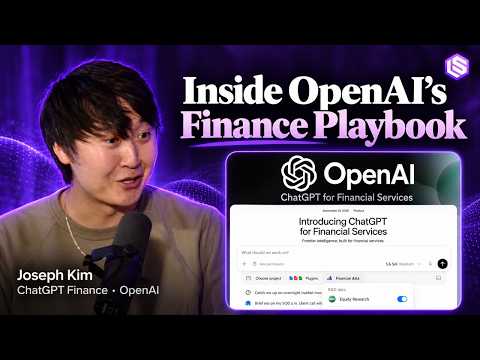
Building ChatGPT for Finance — Joseph Kim, OpenAI's Head of Financial Services
Bundled data differentiates ChatGPT for Financial Services: Kim says some major MCP connectors had a “40%-plus error rate,” making data customers’ top positive callout despite duplicate-license risk.Codex supplies about 80%, but an unchanged finance launch “would fail”; “95% of what we built” is reproducible by others.Watch human review and banking evals as autonomy rises in ’27 and ’28.