SHOW DIRECTORY
Hard Fork
Journalists Kevin Roose and Casey Newton explore and make sense of the latest developments in the rapidly changing world of technology.
SOURCE DESCRIPTION · RSS

The Ezra Klein Show: Jensen Huang Thinks A.I. Alarmism Has Gone Too Far
Ezra KleinJensen HuangKevin RooseCasey Newton
Jensen Huang calls AI safety a solvable engineering problem: labs should not ship systems they cannot contain, with liability rules and third-party audits still relevant.He argues NVIDIA compute could become a fungible, durable asset class, with one-gigawatt factories and annual rents reaching $50B.Open models have flipped to seventy-thirty, while supply-demand inversion and an uncertain digestion period remain risks.
Meta Shifts the Blame + Do Data Center Bans Work? + The Final HatGPT
Kevin RooseCasey NewtonArvind Narayanan
Meta’s up-to-$17.1 billion child-safety settlement includes default teen time limits, overnight blocking and muted school-hour notifications, with stricter terms if TikTok and YouTube join.Arvind Narayanan estimates a one-year state data-center moratorium would delay AI efficiency gains by only 5–10 hours, making bargaining for payments and community investment more consequential than blockage.OpenAI’s Mark Chen puts the company 80% of the way to AGI, while Sam Altman expects an internal system by year-end, leaving the declaration’s timing partly a marketing decision.
Ask the Economist: Is A.I. Really Coming for Your Job?
Rachel AbramsEli SaslowNadja SpiegelmanKyle ChaykaSophie Haigney
AI narratives are moving markets before measured productivity, with Citrini Research’s speculative scenario followed by drops of more than 8% in DoorDash, American Express, and Blackstone.Korinek’s evidence remains fractional and contested, but faster automation could shift labor demand downward, while Anthropic’s Pentagon fight and an OpenClaw inbox failure keep governance, permissions, and recoverability in focus.
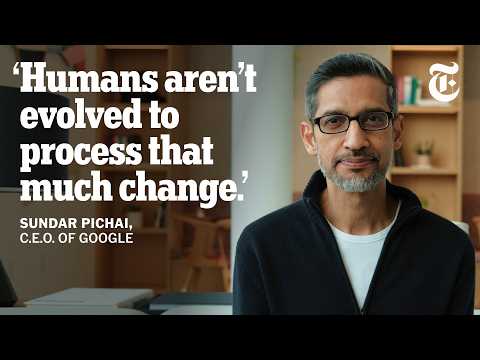
Sundar Pichai on A.I. Backlash, the Future of Work and Google’s Next Era
Kevin RooseCasey NewtonDylan FieldDan Powell
Google’s frontier weakness is agentic coding, tool use, instruction-following, and long-horizon work, not overall model capability.Antigravity 2.0 token usage is doubling every week, creating coding data flows, while external TPU demand supports production and hardware feedback.AI Mode preserves links and may combine subscriptions with ads, but 3.5 Flash’s pricing criticism and trust-dependent agent rollout remain unresolved.
‘Hard Fork’ Live, Part 1: Satya Nadella and Cindy Cohn
Kevin RooseCasey NewtonSatya NadellaPhil MohunCindy Cohn
Microsoft’s AI thesis depends on making frontier capability broadly available across the economy, pairing local trillion-parameter models with an independent MAI stack while retaining OpenAI equity, Azure demand, and IP through ’32.The investment signal is token economics and execution: productivity requires marginal token cost to match marginal value, while Xbox monetization, infrastructure costs, employment, and AI-enhanced surveillance remain unresolved constraints.

How We Got to the Biggest I.P.O. Race Ever | SpaceX, Anthropic & OpenAI
Kevin RooseCasey NewtonKevin Hartnett
SpaceX could pursue a $1.75 trillion-to-$2 trillion IPO at $135 a share, bundling reusable rockets and Starlink with xAI and X.Anthropic’s revenue surge to a prospective trillion-dollar-plus IPO shows AI economics accelerating, while its pledged philanthropy could reshape funding for health and AI safety.Public ownership may intensify safety pressures; AI’s unit-distance result signals “absolutely top-tier research,” with disclosure and liability worth monitoring.
Why Tech C.E.O.s Are Blaming A.I. for Mass Layoffs
AI now anchors major layoffs at Atlassian, Block, and reportedly Meta, while Block’s 17% share jump shows how productivity narratives can reframe overhiring or mismanagement.Meta’s planned $135 billion capital expenditure could shift costs from payroll to compute, but abandoned Behemoth and delayed Avocado expose execution risk.Token consumption adds a potentially enormous labor cost, making output and revenue—not usage leaderboards—the unresolved test.
Tim Cook’s Legacy + The Future of U.B.I. With Andrew Yang + HatGPT
Kevin RooseCasey NewtonAndrew Yang
Tim Cook leaves Apple after expanding its market value from $350 billion to around $4 trillion, but services monetization, China supply-chain exposure, and delayed AI execution complicate the legacy.John Ternus inherits the Siri and device challenge, while Andrew Yang proposes a 3% token tax and about $1,200 monthly dividends as AI displacement and inequality accelerate.
‘A.I.-Washing’ Layoffs? + Why L.L.M.s Can’t Write Well + Tokenmaxxing
Kevin RooseCasey NewtonJasmine Sun
AI-linked layoffs are becoming a market signal, though overhiring and weak stocks complicate causality, with Atlassian cutting 10%, Block roughly 40%, and Meta’s reported cuts still speculative.Block shares rose 17% after its layoffs, while Meta paired possible reductions with $135 billion in planned capital expenditure, signaling a shift from payroll toward compute before productivity is proven.Post-training has made chatbots safer but stylistically generic, while token leaderboards risk turning usage into a costly and manipulable productivity metric.
Is A.I. Eating the Labor Market? + The Latest on the Pentagon, OpenClaw and Alpha School
Kevin RooseCasey NewtonAnton Korinek
Markets are reacting to speculative AI labor-shock scenarios before hard evidence arrives, while measured employment and productivity effects remain fractions of a percent and 80% of surveyed firms reported no impact.The Pentagon’s Anthropic standoff shows frontier-model quality is strategic leverage, while OpenClaw and Alpha School expose near-term autonomy and reliability risks worth monitoring as capability advances.