SHOW DIRECTORY
All-In
Industry veterans Chamath Palihapitiya, Jason Calacanis, David Sacks, and David Friedberg cover economics, technology, politics, society, and poker.
SOURCE DESCRIPTION · RSS

Blake Scholl: Why Plane Speed Stalled, Supersonic Commercial Flight, & Revolutionizing the Engine
Boom’s 42 MW, water-free, behind-the-meter data-center system repurposes its Mach 1.7 engine core, with the first engine due next month, while vertical integration targets multiple gigawatts annually and more than 10 GW added to the grid over five years.Overture targets a $3,500 round-trip break-even fare and a four-year goal, but the actual service date remains uncertain as regulatory momentum accelerates.
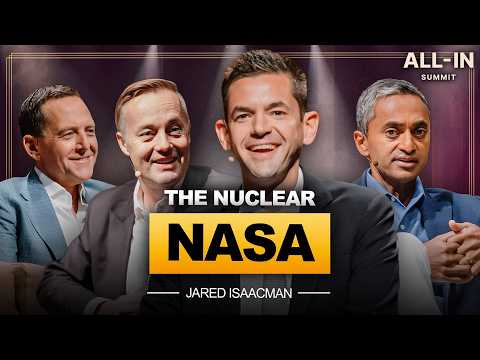
Jared Isaacman: A New Era for NASA and American Space Exploration
NASA is shifting capital from consensus-driven programs toward explicit national objectives, targeting Artemis 3 in summer 2027 and Artemis 4 in 2028.Repeated lunar missions could create demand for landers, rovers, and resource experiments, while public funding concentrates on fission power and nuclear-electric propulsion.SR1 Freedom’s 2028 target, uncertain lunar returns, and China’s ambitions make execution and launch capacity key watchpoints.

Elon Musk & Gwynne Shotwell on AI Risks and Peer Review, Starship, Terafab, SpaceX/Tesla Merger
Chamath PalihapitiyaJason CalacanisDavid SacksDavid FriedbergGwynne ShotwellElon Musk
Cross-lab AI peer review would give competitors pre-release API access to run logged safety harnesses, making distillation visible and raising reputational and product-liability stakes.Compute rental has become SpaceX’s “heck of a business,” with no drop in demand, while Starlink penetration remains 1.5–2%.Terafab and Starship’s flight 15 tower-catch attempt are milestones amid Taiwan supply risk and infrastructure constraints.

The State of American Science, Breakthrough Coverups, and the Danger of Physics w/ Eric Weinstein
Weinstein diagnoses a “scientific precariat” created by consensus pressure, tracing the break to 1965–75 funding changes and advocating national-interest waivers, weaker HR control, and people-first, high-beta public funding.DESI at Kitt Peak could be a near-term catalyst if the cosmological “constant” is not constant, while China’s recruiting push and AI’s “trash-can corpus” create unresolved competitive risks.

China Outbuilds America 230-to-1. Saronic Has a Plan
Jason CalacanisDino MavrookasVibhav Altekar
Corsair’s rescue of two U.S. pilots in the Strait of Hormuz moved maritime autonomy from demonstration to operational trust, while Saronic’s 230-to-1 China-U.S. shipbuilding comparison frames industrial capacity as the central strategic gap.Its Marauder thesis targets payload economics through lower-cost, fixed-price autonomous vessels, with Brownsville and Louisiana yards adding scale; production, authorization thresholds, and the eventual manned-unmanned mix remain key variables.

The IPO Comeback: Why Tech Giants Are Finally Going Public | All-In Liquidity IPO Panel
Andrew FeldmanWill MarshallBrad GerstnerChamath PalihapitiyaJason CalacanisDavid SacksDavid Friedberg
The IPO pendulum is shifting toward companies listing at $1 billion to $5 billion, with Planet creating roughly 90% of its post-SPAC value in years three and four.Cerebras’s $18.50 IPO followed a difficult 9.5 years, while its chip targets 15–18-times faster OpenAI workloads; orbital data centers offer a potential two-to-three-year cost catalyst, but distributed clustering remains unresolved.

War with Iran + Pentagon vs Anthropic with Under Secretary of War Emil Michael
Chamath PalihapitiyaJason CalacanisDavid SacksDavid FriedbergEmil Michael
Iran is framed as a “weeks, not months” disarmament campaign, while disrupting Iranian and Venezuelan oil flows could create leverage over China in a broader April grand bargain.Defense procurement is shifting toward fixed-price, mass-attritable systems—LUCAS drones cost roughly $50,000-$80,000—while the Anthropic rupture underscores model-control risk and the need for multi-model redundancy, domestic inputs and manufacturing capacity.

Science Corner Special! David Friedberg, Cleo Abram, Alex Filippenko, and Keller Rinaudo Cliffton
David FriedbergCleo AbramAlex FilippenkoKeller Rinaudo Cliffton
Cleo Abram’s six-million-subscriber Huge If True shows optimistic, technically serious creator media can scale globally, with sponsors funding ambitious work and streamers potentially extending validated YouTube IP.Webb is revealing unexpectedly early galaxies while Zipline demonstrates autonomous delivery at commercial scale, but US science cuts threaten the talent needed to analyze extraordinary data and expand critical infrastructure.
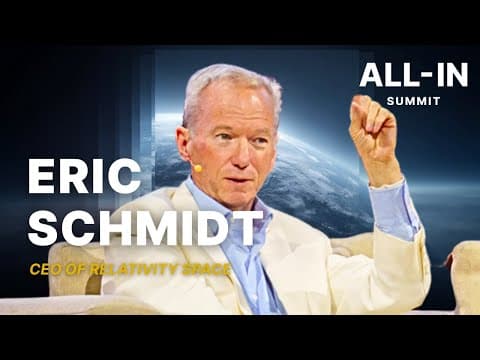
Eric Schmidt on AI, the Battle with China, and the Future of America
Schmidt now expects China’s chip constraints and shallower capital markets to favor ubiquitous AI deployment, while open weights and training data could make model distribution a geopolitical contest that America must not concede.Cheap autonomous drones are overturning defense economics, with a $4,000-$5,000 aircraft carrying a 2-kilogram payload able to destroy a $30 million tank, raising unresolved questions about deterrence and escalation.
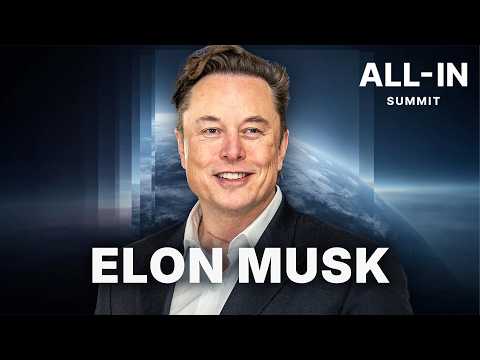
Elon Musk on DOGE, Optimus, Starlink Smartphones, Evolving with AI, Why the West is Imploding
Optimus Version 3 targets human-level dexterity, reality-navigating AI and million-unit manufacturing, with estimated production costs of $20,000-$25,000 and no existing humanoid supply chain.Tesla’s AI5, Starlink’s roughly two-year handset transition and Starship’s fully reusable heat shield create distinct execution catalysts, while demand, integration and technical reliability remain unresolved.