SHOW DIRECTORY
All-In
Industry veterans Chamath Palihapitiya, Jason Calacanis, David Sacks, and David Friedberg cover economics, technology, politics, society, and poker.
SOURCE DESCRIPTION · RSS
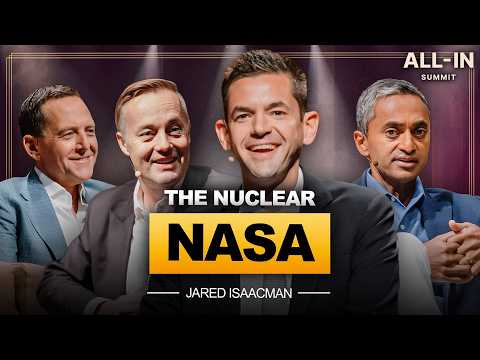
Jared Isaacman: A New Era for NASA and American Space Exploration
NASA is shifting capital from consensus-driven programs toward explicit national objectives, targeting Artemis 3 in summer 2027 and Artemis 4 in 2028.Repeated lunar missions could create demand for landers, rovers, and resource experiments, while public funding concentrates on fission power and nuclear-electric propulsion.SR1 Freedom’s 2028 target, uncertain lunar returns, and China’s ambitions make execution and launch capacity key watchpoints.

The State of American Science, Breakthrough Coverups, and the Danger of Physics w/ Eric Weinstein
Weinstein diagnoses a “scientific precariat” created by consensus pressure, tracing the break to 1965–75 funding changes and advocating national-interest waivers, weaker HR control, and people-first, high-beta public funding.DESI at Kitt Peak could be a near-term catalyst if the cosmological “constant” is not constant, while China’s recruiting push and AI’s “trash-can corpus” create unresolved competitive risks.

Rahm Emanuel: Trump's Foreign Policy, China, Europe's Decline, Immigration & DSA vs Democrats
Jason CalacanisDavid FriedbergRahm Emanuel
Rahm Emanuel’s China strategy is an economic bloc—not tariffs—to “isolate the isolator” and rebuild US capacity with Australia, Japan, South Korea, Taiwan, the EU and Latin America.Operation Warp Speed’s 90%+-efficacy vaccine versus China’s 60% supports research as national security, but Trump’s proposed 40% NIH cuts and weakened deterrence leave a five-year defense rebuild and Taiwan’s three scenarios unresolved.

World's First Trillionaire, Anthropic Fable Banned, The New Oligarchs, Iran Peace Deal
Chamath PalihapitiyaJason CalacanisDavid SacksDavid Friedberg
SpaceX’s $85 billion IPO at $135 per share created public-market currency for its $60 billion Cursor acquisition, priced against $4 billion in revenue.Anthropic’s Fable 5 shutdown after a reported jailbreak could strengthen hyperscaler gatekeeping through identity checks, audit trails and controlled clouds.The Iran MOU may reduce near-term macro risk, but Israel’s participation, future enrichment and ballistic missiles remain unresolved.

The State of Modern War: Palantir & Anduril Execs on Drones, AI, and the End of Traditional Warfare
David FriedbergShyam SankarTrae Stephens
US military power is increasingly constrained by factory capacity, with Ukraine consuming “10 years of production in 10 weeks,” a 10,000-to-one drone gap, and a 223x shipbuilding disadvantage versus China.Anduril’s five-million-square-foot Arsenal-1 is designed as a modular manufacturing platform for attritable systems, addressing the economics of replacing $2 million interceptors with $20,000 drones.The high-low mix may shift massively over five to 10 years, but Stephens estimates roughly 18 months even with unlimited cash to establish a sustainable industrial base.

“This is Bibi’s War” - Harvard’s Graham Allison on the Influences and Endgame of the Iran War
Chamath PalihapitiyaJason CalacanisDavid SacksDavid FriedbergGraham Allison
The Iran campaign has demonstrated overwhelming US and Israeli military capability, but unclear objectives and no defined endpoint leave regime change, reconstruction, and energy disruption highly uncertain.Trump may seek an early victory declaration before his March 29 China trip, while Allison estimates a 5% chance of a 2026 or 2027 Taiwan attack absent provocation and highlights China’s expanding industrial scale.

War with Iran + Pentagon vs Anthropic with Under Secretary of War Emil Michael
Chamath PalihapitiyaJason CalacanisDavid SacksDavid FriedbergEmil Michael
Iran is framed as a “weeks, not months” disarmament campaign, while disrupting Iranian and Venezuelan oil flows could create leverage over China in a broader April grand bargain.Defense procurement is shifting toward fixed-price, mass-attritable systems—LUCAS drones cost roughly $50,000-$80,000—while the Anthropic rupture underscores model-control risk and the need for multi-model redundancy, domestic inputs and manufacturing capacity.

Eric Schmidt on AI, the Battle with China, and the Future of America
Schmidt now expects China’s chip constraints and shallower capital markets to favor ubiquitous AI deployment, while open weights and training data could make model distribution a geopolitical contest that America must not concede.Cheap autonomous drones are overturning defense economics, with a $4,000-$5,000 aircraft carrying a 2-kilogram payload able to destroy a $30 million tank, raising unresolved questions about deterrence and escalation.

Jared Isaacman: What went wrong at NASA | The All-In Interview
Jared Isaacman argues NASA should cut bureaucratic layers and redirect resources from SLS toward reusable transport, nuclear electric propulsion, and faster science, while using two or three already funded SLS missions to return to the Moon.His proposed ten $100 million missions annually accepts failure to accelerate discovery, but execution depends on NASA working alongside commercial launch providers while government retains nuclear and other capabilities industry will not finance.

JD Vance's AI Speech, Techno-Optimists vs Doomers, Tariffs, AI Court Cases with Naval Ravikant
Naval RavikantDavid SacksChamath Palihapitiya
JD Vance’s Paris speech recast U.S.AI policy around opportunity, technological leadership, worker productivity, and speed across chips, models, applications, and energy rather than pre-emptive safety regulation.The panel still disputes whether AI will create opportunities faster than it destroys jobs, while tariffs, copyright rulings, concentrated control, and Naval’s shift toward harder technical products remain important signals.