SHOW DIRECTORY
All-In
Industry veterans Chamath Palihapitiya, Jason Calacanis, David Sacks, and David Friedberg cover economics, technology, politics, society, and poker.
SOURCE DESCRIPTION · RSS

Senators John Fetterman and Dave McCormick: Bipartisanship, Money in DC, Datacenters, Graham Platner
Chamath PalihapitiyaJason CalacanisDavid SacksDavid FriedbergJohn FettermanDave McCormick
Pennsylvania is positioning abundant energy and data-center investment as a national-security and middle-class revival strategy, with $92 billion committed and 4.4 gigawatts planned at Homer City.The buildout is already lifting skilled-trade wages above $100,000 and could give the U.S. a 6–8-month lead over China, but water, grid, job displacement and political opposition remain key execution risks.

CA Governor Candidate Steve Hilton on Why California is Destroying Itself & How a Republican Can Win
Steve Hilton proposes roughly $60 billion in tax relief, funded partly by cutting California’s alleged $80 billion annual fraud, waste and abuse, to restore household purchasing power and business investment.His housing, energy, education, enforcement and electoral platform depends on overcoming union and legislative resistance while converting cost-of-living dissatisfaction into a 2026 winning coalition.

Iran War, Oil Shock, Off Ramps, AI's Revenue Explosion and PR Nightmare
Chamath PalihapitiyaJason CalacanisDavid SacksDavid FriedbergBrad Gerstner
Brent’s swing from $84 to $119 and back toward $100 pushed Goldman Sachs’ PCE forecast from 2.1% to 2.9% and GDP growth down 30 basis points, while oil’s fall to $90 suggested a short disruption.AI revenue is accelerating as Opus 4.6 and ChatGPT 5.4 shift spending into labor budgets, but durable demand remains disputed amid canceled data centers and backlash.

Iran's Breaking Point, Trump's Greenland Acquisition, and Solving Energy Costs
Chamath PalihapitiyaJason CalacanisDavid SacksDavid Friedberg
Iran’s roughly 30% average inflation since 2019 signals rupture pressure, but conflicting Polymarket odds and uncertain protest dynamics leave timing unresolved.AI data centers face higher power costs and new-generation demands, while distributed solar and storage could pressure utility rate bases.OpenAI’s more-than-$10 billion Cerebras commitment supports competitive inference silicon and a potential 10-to-20-year opportunity for young decode-chip companies.

The Woman Who BEAT Maduro: Venezuela's Next Leader? Nobel Peace Prize Winner María Corina Machado
David FriedbergMaría Corina Machado
Venezuela’s 300 billion barrels of proven reserves became a governance trap as oil revenues funded patronage, foreign influence, and an alleged criminal economy spanning drugs, gold, arms, and trafficking.Machado’s opposition claims 69.5% of the 2024 vote against Maduro’s 51%, backed by published tally sheets, while a transition plan targets the first 100 hours and 100 days and pitches energy, technology, AI, and data-center investment.
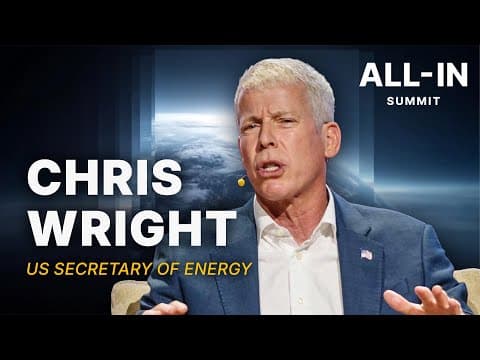
The Hidden Truth About the US Energy Grid: Subsidies, Demand & Rising Prices - Chris Wright
Chris WrightChamath Palihapitiya
Hydrocarbons supplied 85% of global energy in both 1973 and 2024, while wind, solar, and batteries remain below 3%, making dispatchability and fuel economics central to Wright’s case against rapid substitution.He sees permitting and grid design—not nuclear technology—as the bottleneck, with gas serving near-term AI demand and federal land accelerating reactors and data centers, while methane leakage, subsidies, and climate policy remain unresolved risks.

OpenAI's GPT-5 Flop, AI's Unlimited Market, China's Big Advantage, Rise in Socialism, Housing Crisis
Gavin BakerBen ShapiroPhil Deutch
GPT-5 was OpenAI’s first launch that failed to decisively beat rivals, with Grok 4 ahead on key benchmarks, though its router may simplify mainstream AI use.Hyperscaler returns and fully utilized GPUs support continued capex, but power, China’s manufacturing coordination, tariff uncertainty, housing costs, and Apple’s $700 billion buybacks remain critical allocation signals.

Trump AI Speech & Action Plan, DC Summit Recap, Hot GDP Print, Trade Deals, Altman Warns No Privacy
Chamath PalihapitiyaJason CalacanisDavid SacksDavid Friedberg
Trump’s AI strategy links model leadership to infrastructure, exports, and procurement rules, extending the opportunity beyond software into chips, data centers, mining, grids, and generation.Nuclear received unanimous support while natural gas won the near-term speed argument, but power delivery, H-1B tensions, copyright licensing, rate policy, and unenforceable trade commitments remain the variables shaping execution.

Winning the AI Race Part 5: President Trump on the AI Action Plan
Trump’s AI Action Plan treats electricity, permitting, and private capital as the binding constraints on American compute, allowing companies to build generation, sell surplus power, and immediately expense factories, equipment, and structures for 10 years.The proposed federal standard and expanded exports aim to accelerate adoption of the American stack, while nearly $17 trillion in cited investment commitments make power availability, construction speed, and supply-chain execution the critical tests.

Winning the AI Race Part 4: Scott Bessent, Howard Lutnick, Chris Wright, and Doug Burgum
Scott BessentDoug BurgumChris WrightHoward Lutnick
Scott Bessent’s 3-3-3 plan depends on roughly $300 billion of annual AI capex translating into productivity growth, a deficit near 3% of GDP, and persistent 3%-plus growth.Stablecoins could generate “several trillion dollars of demand for T-bills,” while tariffs are intended to compress foreign margins and pull factories such as AstraZeneca’s announced $50 billion US buildout onshore.The immediate AI-power bottleneck is natural gas and retained baseload, with planned closures potentially removing 100 GW by 2030 and advanced nuclear treated as a roughly 10-year rebuild.