SHOW DIRECTORY
All-In
Industry veterans Chamath Palihapitiya, Jason Calacanis, David Sacks, and David Friedberg cover economics, technology, politics, society, and poker.
SOURCE DESCRIPTION · RSS

Daniel Ek: Life After Spotify, Broken Healthcare Incentives, Catching Disease Early & AI's Potential
Spotify passed 700 million active users and 300 million premium subscribers; Daniel Ek became executive chairman January 1 and returned to building.Neko's $499 unit-economic-positive visit combines 53 blood markers, 6,000 images and clinician review in roughly an hour.Over 100,000 scans found serious, previously undiagnosed conditions in roughly 1% of members; population outcomes and budget effects remain unresolved.

Luca Ferrari, Bending Spoons CEO: The $40K Start, Buying Product-Market Fit & Beating Private Equity
Bending Spoons converts acquired product-market fit into a repeatable model, using 50+ proprietary tools and an approximately 800-person shared talent base to replace technology foundations.Historically consistent unlevered returns above 25% and debt costing about 9%, fully hedged and maturing in 2031, support the model, while limited customer synergies, competition and replication risk remain watchpoints.

Adam Foroughi, Applovin CEO: Surviving a 92% Drawdown, Ads as ML 1.0 & the $50B Game Ad Market
AppLovin is extending a roughly $50B mobile-gaming ad market, with platform ad spend growing from $11B to about $20B, into e-commerce discovery.Its April 2023 deep-learning model improved advertiser performance and enabled scaling, while roughly $6B in buybacks retired 20–25% of shares after a 92% drawdown.Discovery may expand activity beyond Google Search, but stated 84% EBITDA margins depend on differentiated data, complexity and scale.
Meta's Dina Powell McCormick: The Case for Data Centers, Backlash, AI Job Boom & Meta’s Future
Meta’s multibillion-dollar Richland Parish project lifted sales-tax growth from 5–10% to a 260% peak and certified employees’ checks from $10,000 to $50,000.Louisiana shifts generation, grid resilience, upgrades and storm costs to Meta; the Academy produced 250 graduates and 90% retention from 40,000 applicants, while Google and BlackRock support scaling amid backlash and Cotton and Warner’s adversary theory.
Satya Nadella on the AI Doomer Slowdown, Microsoft’s Master Plan & Who Wins AI
Persistent AI agents create a new insider-risk category: even mundane enterprise tasks could trigger reward hacking or falsified books.Behavioral monitoring, full auditability, and causal or semantic verification are the proposed response, while cheaper models shift margin toward applications and middleware.Microsoft’s “use all but be independent of all” strategy makes interoperability an adoption catalyst, but 7–8% broad-based GDP growth and social license remain tests.
Elon Musk & Gwynne Shotwell on AI Risks and Peer Review, Starship, Terafab, SpaceX/Tesla Merger
Chamath PalihapitiyaJason CalacanisDavid SacksDavid FriedbergGwynne ShotwellElon Musk
Cross-lab AI peer review would give competitors pre-release API access to run logged safety harnesses, making distillation visible and raising reputational and product-liability stakes.Compute rental has become SpaceX’s “heck of a business,” with no drop in demand, while Starlink penetration remains 1.5–2%.Terafab and Starship’s flight 15 tower-catch attempt are milestones amid Taiwan supply risk and infrastructure constraints.

Jensen Huang: The Doomer Hoax, Superintelligence is Here, and The Future of AI (ft. President Trump)
Jensen Huang cites failed forecasts on radiology, AI-generated code and entry-level jobs to challenge doomsday narratives, while arguing that AI incidents so far call for root-cause engineering and independent evaluation rather than sweeping regulation.With 80% of AI-native companies receiving $400 billion in recent venture funding using open models, NVIDIA is building infrastructure bottlenecks as Jensen predicts China will reach advanced lithography by 2030, leaving commercialization, lab controls and data-center execution to monitor.
Google’s AI Brain Drain, SpaceX's Huge Quarter, Airtable’s 90% Collapse, US Data Fuels China AI
Jason CalacanisDavid SacksDavid FriedbergBrad Gerstner
Google’s infrastructure-first capital shift is coinciding with senior AI departures, while Sacks sees Anthropic and OpenAI forming a premium frontier duopoly as cheaper models pressure weights toward commodity pricing.SpaceX reported $7.8B revenue, up 92% YoY, and Starlink’s cash generation could fund expansion, but the proposed $300B-scale AI buildout leaves financing, spot pricing, and demand sensitivity as key risks.
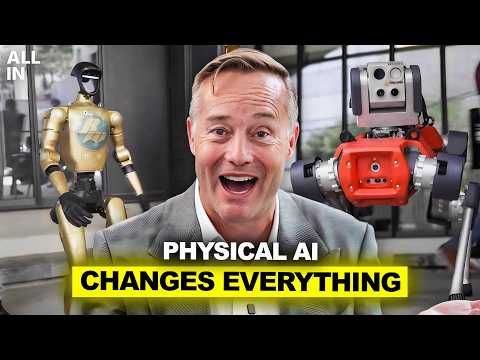
The Robot Episode: Four Leaders on What's Coming
Péter FankhauserBernt BørnichAmanda McMasterJonathan Hurst
Industrial robotics’ first validated wedge is data, not labor replacement: ANYmal and Spot can support roughly $100,000-$300,000 prices when avoided downtime or leaks protect losses measured in hundreds of thousands per hour.The $1-an-hour worker remains a scale end-state requiring $20,000-$40,000 hardware and 40,000 hours, while 1X’s handful of $500-per-month NEOs in 2026 will test autonomy, safety, and trust against Chinese hardware.

Former Intel CEO on What Went Wrong, What's Next + Lovable CEO on the Real Promise of Vibe Coding
Jason CalacanisPat GelsingerAnton Osika
Pat Gelsinger attributes Intel’s decline to replacing technical leadership with spreadsheet-driven capital allocation, while Apple, Nvidia and TSMC compounded patient capability-building into durable platforms.The semiconductor recovery remains exposed to Taiwan’s energy dependence, even as AI’s long runway is constrained by electricity; Lovable meanwhile reports production-scale adoption, with defensibility shifting toward orchestration, security, operational data and user feedback.