SHOW DIRECTORY
20VC
The Twenty Minute VC interviews leading venture capitalists and company founders, hosted by Harry Stebbings.
SOURCE DESCRIPTION · RSS
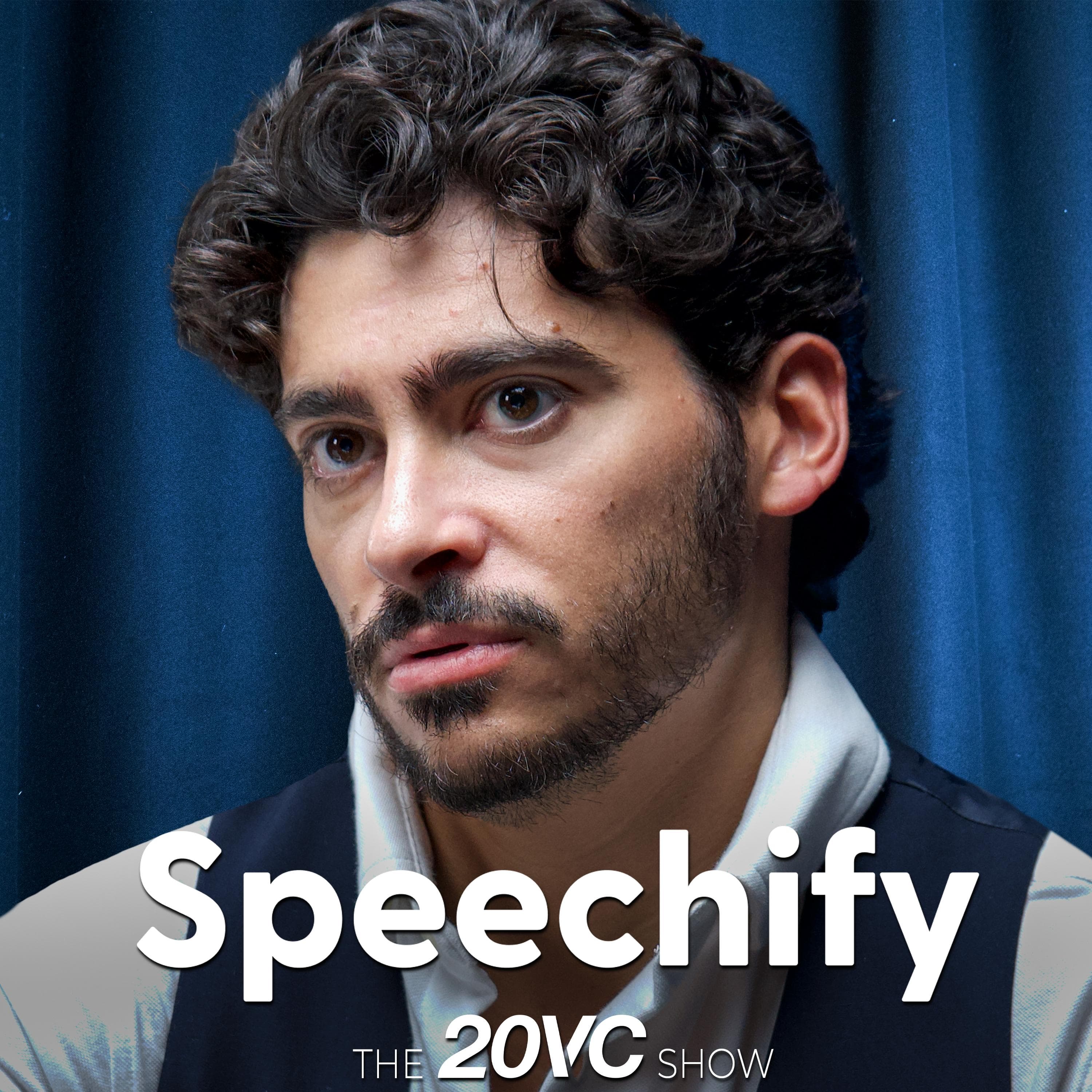
Speechify's Weitzman on owning GPUs, ElevenLabs, and the AI talent war
Speechify’s owned-GPU strategy compares $35,000–50,000 annual H100 rental with roughly $30,000 to buy, potentially lowering compute costs.NVIDIA’s deal with Blackstone, BlackRock, Apollo and Goldman Sachs could create a liquid secondary market and price floor through buybacks up to 25% of GPU value.Weitzman calls missing B2B his biggest strategic mistake; Simba 3.2 costs $10 per million characters versus ElevenLabs’ $100, but execution against an “unstoppable” rival remains unresolved.

Jensen's Open-Weights Letter | Google Cloud Grows 82% But The Market Tanks
Jensen Huang’s 50-company open-weights letter, signed by Microsoft, Meta, IBM and Sam at OpenAI but not Anthropic, signals that frontier labs now face competition from their own customers.Open weights threaten Nvidia’s CUDA margins while LLM agents create a likely security catalyst, and Google’s negative free cash flow plus upcoming CIO budget ceilings could amplify AI volatility.

Perplexity CEO: Micron Will Be More Valuable Than Meta & How Export Controls Helped Not Hurt China
Harry StebbingsAravind Srinivas
Aravind’s headline call is that Micron could surpass Meta in value within 6-12 months because memory remains the bottleneck after prices rose 5x.His broader thesis shifts value from commoditized search and models to orchestration and token value per watt, while power constraints, China’s vertical integration, and a 20-30% DeepSeek-moment risk remain key watchpoints.
Nebius Co-Founder on AI Infrastructure Bubbles | How Price Elastic is Demand for Compute
Nebius’s 40% one-week stock drop during DeepSeek panic coincided with its best commercial week, as cheaper intelligence made more inference workloads viable and increased consumption.Nebius has raised prices yet faces pipeline pressure, while its four-layer stack expands from scarce bare-metal capacity to managed inference and speculative agentic workloads; consolidation into three or five super-model empires remains the key risk.

Peter Thiel and Softbank Sell NVIDIA - Why? & Why VC Will Hit $1TRN and The Opening of Retail
Cursor’s valuation depends on AI coding becoming universal infrastructure, with proprietary models, distillation and hardware efficiency potentially lifting margins despite reliance on model suppliers that are also competitors.The key downside is a price war enabled by portable prompts and thin integrations, while illiquid late-stage marks, concentrated AI exposure and uncertain inference utilization could turn a rapid financing cycle into a fast correction.
Cerebras CEO, Andrew Feldman on Why Raise $1BN and Delay the IPO & Why NVIDIA’s Worried About Growth
Cerebras raised $1bn at a record valuation because it had margins while rivals had negative ones, despite still intending to go public; UAE orders may have represented 75-80% of revenue and consumed manufacturing capacity.Feldman argues two-year chip depreciation is empirically wrong and Nvidia’s pre-announcements and OpenAI investment signal defensive demand capture, while power sits in the wrong places; investors should watch utilization, customer concentration, permitting, and whether AI adoption delivers productivity.
Groq Founder, Jonathan Ross: OpenAI & Anthropic Will Build Their Own Chips & Will NVIDIA Hit $10TRN
Jonathan Ross says OpenAI, Anthropic and every hyperscaler will build chips for control over their own destiny, while Nvidia could be worth $10 trillion in five years.Doubling inference compute could nearly double their revenue within one month as rate limits suppress engagement, making HBM, energy, Groq’s six-month supply chain and the United States’ 2-3 year away-game window key signals.
Andrew Feldman, Cerebras Co-Founder and CEO: The AI Chip Wars & The Plan to Break Nvidia's Dominance
Cerebras argues that GPU off-chip HBM is a fundamental inference bottleneck, while wafer-scale SRAM could challenge NVIDIA’s near-total market share.Feldman sees inference demand exceeding 100 times today’s market within five years, with chip providers potentially worth more than model companies, though G42’s 87% revenue concentration remains a key risk.
Steeve Morin: Why Google Will Win the AI Arms Race & OpenAI Will Not | E1262
Steeve Morin sees an H100 oversupply risk potentially emerging “probably this year,” as five-year compute economics shift toward 95% inference and latency-sensitive agents expose Nvidia’s architectural vulnerabilities.Google owns the product, data, and compute triangle, while AI builders face a margin stack dominated by TSMC, Nvidia, and Amazon; AMD’s opportunity depends on reducing switching costs, and new architectures must overcome SRAM economics, energy, and talent constraints.
Jonathan Ross, Founder & CEO @ Groq: NVIDIA vs Groq - The Future of Training vs Inference | E1260
Groq’s differentiated inference wedge avoids scarce HBM, supporting claimed 5x lower cost and one-third the energy per token while Nvidia concentrates on training.Aramco-backed capex and $1.5B in revenue—not fundraising—support a target of at least half of global inference compute by end-2027, but a power bottleneck in three to four years and Nvidia’s uncertain trajectory remain risks.