PERSON DIRECTORY
Sarah Wang
Sarah Wang appears in 10 indexed conversations across The a16z Show, Latent Space. This directory brings every appearance, source, TL;DR, digest, and transcript into one searchable feed.
Why Would AI Companies Want to Slow Down?
Ali GhodsiMartin CasadoSarah Wang
Frontier AI’s immediate enterprise risk may be cyberattack acceleration: CVE-to-exploit time fell from 2–3 years in 2018–19 to “basically hours” now, while most organizations lack automated detection and threat hunting.Ghodsi says recursive self-improvement shows none of four required conditions; enterprises need context and cost control more than smarter models, though a frontier freeze would be disastrous to the labs.
The Company That Made AI Coding Feel Inevitable
Martin CasadoSarah WangMatt Bornstein
Cursor’s interface-over-model thesis challenged Microsoft’s Copilot despite its VS Code, OpenAI weights, 100 million developers, and enterprise distribution.Rejecting a $25–50M ARR self-serve ceiling, it built enterprise sales reaching over 50% of the Fortune 500, where margins matter; its IDE-to-agent-to-model shift still faces model releases such as Opus 4.5 and an unnamed acquirer’s potential compute-distribution-data fit.

How Decagon Runs 90% of Its Agents on Open-Source Models
Sarah WangKimberly TanJesse ZhangAshwin Sreenivas
Decagon runs 90% of production workflows on open-source models, where task-specific fine-tuning delivers higher accuracy, lower latency, and lower cost than frontier systems on bounded jobs.Frontier models remain the discovery engine, while Decagon’s continuously rebuilt model factory and enterprise infrastructure turn deployment pain into reusable product; migration will remain constrained by proprietary data, security, and governance.
Ben Horowitz and Ali Ghodsi: How to Run a $100 Billion Business
Ben HorowitzAli GhodsiSarah WangErik Torenberg
Databricks escaped the open-source trap after PLG stalled at roughly $3 million ARR, adding proprietary software and enterprise sales.Its Microsoft partnership paired a portfolio gap with 60,000 sellers, while sacrificing “12 months of our roadmap” and surviving a deal that “died” around 10 times.Ali prioritizes people and integration over revenue, while reported $100 million AI offers remain uncertain.
From Vibe Coding to Vibe Researching: OpenAI’s Mark Chen and Jakub Pachocki
Mark ChenJakub PachockiAnjney MidhaSarah Wang
GPT-5 makes adaptive reasoning and agentic behavior the default, shifting competition toward thinking budgets, latency, reliability, and economically relevant discovery rather than saturated benchmarks.OpenAI’s automated-researcher ambition requires longer planning, persistent memory, and honest recovery from failure, while scarce compute, energy, and robotics capacity remain constraints worth monitoring.
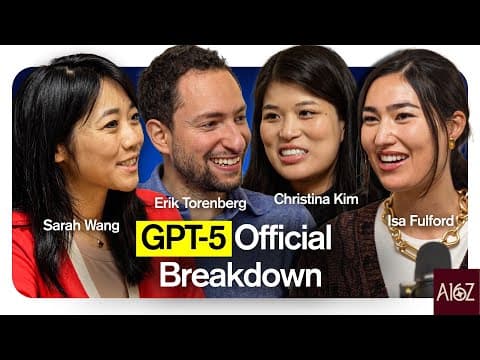
GPT-5 and Agents Breakdown – w/ OpenAI Researchers Isa Fulford & Christina Kim
Erik TorenbergIsa FulfordChristina KimSarah Wang
GPT-5’s commercial signal is a “huge step change” in coding and writing combined with available price points, expanding the applications that capable but costlier models could not support.Minutes-long front-end demos suggest implementation is becoming less binding, potentially enabling more indie businesses while shifting advantage toward ideas and taste.Usage, high-quality task data, and trust remain the key constraints as agents move from asynchronous research toward documents, bookings, and other irreversible actions.