PERSON DIRECTORY
Salim Ismail
Salim Ismail appears in 105 indexed conversations across Moonshots. This directory brings every appearance, source, TL;DR, digest, and transcript into one searchable feed.
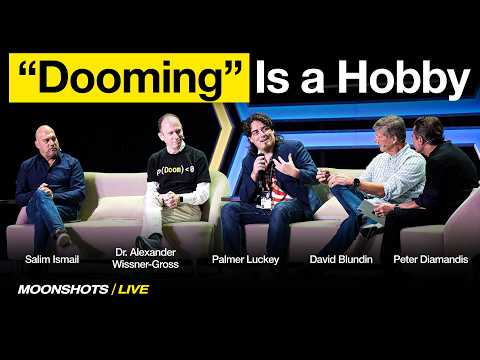
Palmer Luckey: Autonomous Weapons Are Ancient and Why Anduril Won't Build Humanoids | EP #295
Peter DiamandisSalim IsmailDave BlundinAlexander Wissner-GrossPalmer Luckey
Anduril’s $2.2 million wildfire XPRIZE win, including $1 million from Lockheed, shows its autonomy workflow can transfer to emergencies where a 10-minute versus hour-long response requires different tools.Luckey’s specialized, verifiable systems and self-funded product model challenge a market where five companies once captured roughly 80% of major defense acquisition programs, while Anduril’s choice to use rather than build humanoids keeps platform scope and procurement scale in focus.
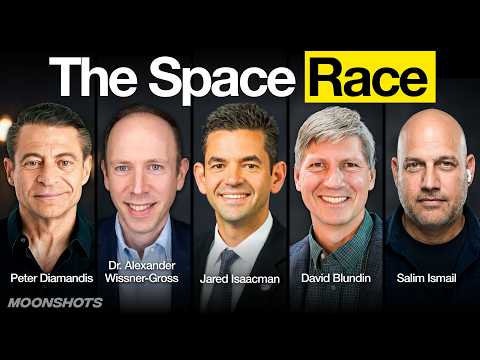
Jared Isaacman: NASA's Moon Base by 2028, Optimus Robots on the Moon, and 15 Years to Mars | Ep #274
Peter DiamandisSalim IsmailDave BlundinAlexander Wissner-GrossJared Isaacman
Jared Isaacman’s NASA reset centers on modular programs, reusable transport and a few near-impossible objectives, arguing that $25 billion annually can fund more progress through sharper capital allocation.A 2028 lunar landing would begin with frequent low-cost robotic failures and learning, while nuclear propulsion, autonomous science and commercial orbital data centers could determine the timeline toward returnable Mars missions.
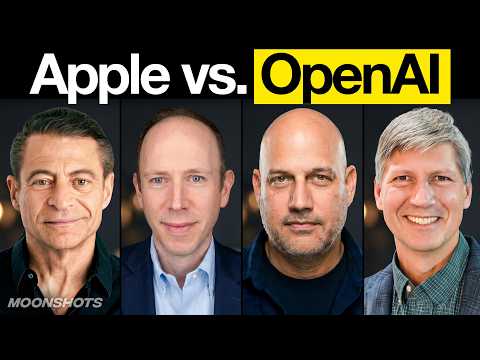
Grok 4.5 vs gpt-5.6, Apple Sues OpenAI, and China Catches up to Elon | #270
Peter DiamandisSalim IsmailDave BlundinAlexander Wissner-Gross
Four model launches in seven days placed Anthropic, OpenAI, Meta, and xAI on the cost-performance frontier, shifting competition from a duopoly toward continuous convergence.Distribution can drive consumer adoption, but scarce compute, GPT Live’s full-duplex interface, Apple’s hardware lawsuit, and regulation will determine where economics and platform power accrue.

Sonnet 5 Drops, China’s $4,900 Robot, Fusion’s First Plant Gets Licensed W/ Philip Johnston | #268
Peter DiamandisSalim IsmailDave BlundinDr. Alexander Wissner-GrossPhilip Johnston
Fable 5’s 15-day shutdown over national-security concerns made frontier-model access a regulatory and supply-chain risk, while Sonnet 5 monetizes scarcity.Unitree’s $4,900 R1 and China’s 500,000-unit 2030 forecast point toward commodity bodies, shifting value to software, workflows and manufacturing scale.Helion’s approved Orion plant targets 50 MW for Microsoft in 2028, while StarCloud’s orbital GPU tests make launch the constraint.
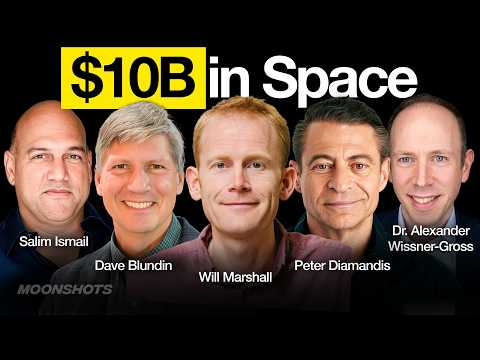
The $10B Satellite Empire Putting AI in Orbit, Why Chips Beat Rockets & China's #1 Open Model | #266
Peter DiamandisWill MarshallSalim IsmailDave BlundinDr. Alexander Wissner-Gross
Planet’s roughly 200 satellites generate 25 TB daily and a 150-PB, ten-year archive with 3,000 observations per land point, creating an irreproducible data moat as AI makes Earth searchable.Owl, Pelican, and Tanager add resolution, revisit rate, latency, and spectral depth, while orbital compute could become cost-competitive at $200-$300 per kilogram; inference efficiency, export policy, and GLM-5.2 remain key variables.
SpaceX IPOs at $2.89T Market Cap, US Govt Suspends Fable & Mythos 5, Altman Delays OpenAI’s IPO |265
Peter DiamandisSalim IsmailDave BlundinAlexander Wissner-Gross
SpaceX’s $2.890 trillion IPO valuation bundles launch dominance, Starlink cash flow and orbital AI, but roughly $1 trillion of shares may unlock after six months while quarterly profit is about $1 billion.The Fable 5 shutdown shows governments can allocate frontier-model access, raising enterprise demand for local models and failover, while transformer shortages and 3.3x annual compute growth keep terrestrial infrastructure in focus.

Pope Leo vs. AI, GPT 5.5 Beats Claude, and Sam Altman Walks Back Job Apocalypse | EP #259
Peter DiamandisSalim IsmailDave BlundinAlexander Wissner-Gross
GPT-5.5 scored 70% on Deep Software Engineering versus Claude Opus 4.7’s 54%, while token prices fell to 50 cents per million as usage reached 25 trillion monthly.That combination shifts leverage toward compute access, model contracts, verification and pricing control, while the Vatican’s 42,000-word encyclical and shelved 90-day review expose governance’s race against China’s estimated three-to-eight-month frontier-model gap.
SpaceX’ $75B+ Historic IPO, GPT5.5 Outperforms Polymarket, AI Solves 80yr old math problem | EP #257
Peter DiamandisSalim IsmailDave BlundinDr. Alexander Wissner-Gross
SpaceX’s proposed $75 billion IPO at a valuation probably above $1.75 trillion would give Musk a public acquisition currency, with Starlink and terrestrial data centers underpinning the infrastructure case.Starship V3’s 100-ton payload, orbital-refueling tests, and planned docking hardware are the near-term proof points for converting that narrative into a packet-switched transport network.GPT-5.5 Codex’s 25% FutureSim score and reported Super Bowl forecast win suggest prediction is becoming an AI advantage, while concentration of capital, compute, and financial interfaces remains a risk to monitor.
SpaceX Goes Public, Claude’s Mythos Release, and the US Data Center Delay | EP #246
Peter DiamandisSalim IsmailDave BlundinDr. Alexander Wissner-Gross
SpaceX’s proposed $75 billion IPO at a $2 trillion valuation is primarily a Starlink monetization event, with Peter Diamandis assigning 75%-80% of value to the satellite business.The thesis depends on exceptional growth, orbital data centers and unproven Starship refueling, while Anthropic and OpenAI compete for the same scarce IPO capital and Mythos raises unresolved cybersecurity and release-timing risks.
OpenClaw Debate: AI Personhood, Proof of AGI, and the ‘Rights’ Framework | EP #227
Peter DiamandisSalim IsmailDave BlundinDr. Alexander Wissner-Gross
OpenClaw’s breakthrough is autonomous, continuous agents that combine frontier or local open-weight models with memory, tools, and native messaging interfaces rather than a new foundation model.That distribution unlock also creates the gating risk: agents with access to email, payments, and open ports could cause industrial accidents, while compute-equity deals and falling intelligence costs accelerate infrastructure demand before personhood and control are resolved.