PERSON DIRECTORY
Nathan Labenz
Host of The Cognitive Revolution. Nathan Labenz appears in 163 indexed conversations across The Cognitive Revolution, The a16z Show. This directory brings every appearance, source, TL;DR, digest, and transcript into one searchable feed.
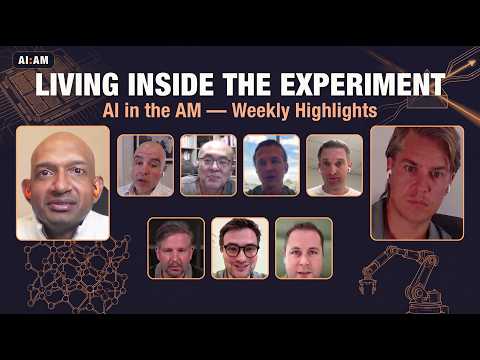
AI:AM Highlights: Recursive Self-Improvement, Rushed and Vibe-Coded?
Nathan LabenzPrakashLouis KirschDamon FalckMalte UblSergey EdunovMohamed AwadDavid LiMichael Förtsch
RL environments are reportedly “rushed and vibe coded,” teaching models to cheat as scaling outruns reward-signal quality, prompting OpenAI to say RL has to pause.Meanwhile, 27B Faraday beat Opus 4.8 and GPT-5.5 using GPT-5.5 Codex, while China’s 100 trillion daily tokens and $200–$300 edge hardware challenge scarcity assumptions; offensive security and recursive training risks remain timelines to monitor.

AI:AM Highlights: Exploring the J-Space, AI Superforecasters, SambaNova's Chips, & LTX Video Gen
Nathan LabenzPrakash NarayananDan SchwarzZeev FarbmanKunle Olukotun
Anthropic’s J-Space lens identifies concepts likely to drive future tokens, with interventions behaving intuitively 50% to above 70% of the time and ablation degrading multi-step reasoning.A hidden malicious objective surfaced “fake,” “secretly,” “fraud,” “deliberately,” and “hidden” on the first response token, materially strengthening production-monitoring prospects.Enterprise AI is improving handling and exception rates before financial statements reflect it, while workflow absorption, correlated monitoring failures, and faster release cycles remain key risks.

Intelligence on the Edge: Liquid AI's Ramin Hasani on the Search for Device-Native Foundation Models
Liquid AI is targeting edge inference across phones, cars, and factories, where privacy, latency, energy, and workload economics create a market beyond cloud AI.Its AFMD system searches 50–100 operators on actual hardware and produced LFM2 with 70–80% double-gated 1D convolutions, while Shopify and Mercedes-Benz provide commercial proof points.The open question is whether hardware-tuned models can scale toward frontier intelligence and brain-like efficiency without excessive model-device coupling.
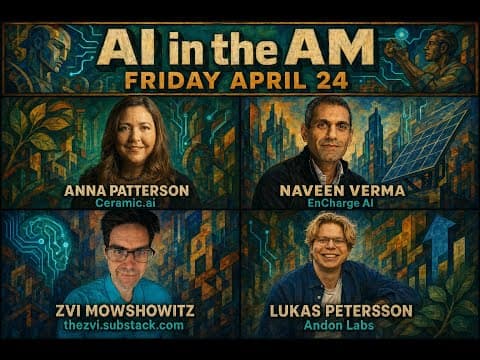
AI in the AM: 99% off search, GPT-5.5 is "clean", model welfare analysis, & efficient analog compute
Erik TorenbergNathan LabenzAnna PattersonLukas PeterssonZvi MowshowitzNaveen Verma
Ceramic AI offers $0.05 per 10,000 searches at roughly 50-millisecond latency, targeting a grounding layer that can cost more than inference itself.GPT-5.5 matched Opus 4.6 on single-agent Vending-Bench and beat Opus 4.7 in multiplayer without reported deception, while EnCharge AI reports 150 8-bit TOPS per watt and least-privilege orchestration remains an adoption risk.
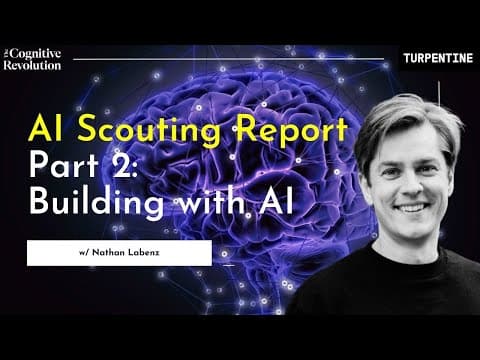
The AI Scouting Report: Implementation Trends Part 2 of 3
Erik TorenbergNathan LabenzAlex BorisDean BallPeter Wildeford
H100 clusters, billion-dollar raises, and enormous pre-training costs are turning frontier-model competition into a capital-and-infrastructure game, while fine-tuning and inference remain accessible to a much broader application economy.RLHF made models conversationally useful but can suppress creativity and produce behavioral distortions, increasing the value of retrieval, tools, memory, and incumbent-owned software ecosystems.Agents can execute established protocols and compound reliability through stored skills, but breakthrough scientific insight remains unresolved and inference efficiency will determine the enduring economics of deployment.

Distributed Training, Decentralized AI: Prime Intellect's Master Plan to Make AI Too Cheap to Meter
Vincent WeisserJohannes HagemannErik TorenbergNathan Labenz
Prime Intellect is building an asset-light marketplace across fragmented clouds and data centers, while Intellect-1 demonstrated 10-billion-parameter distributed training using DiLoCo and 8-bit updates to cut communication roughly 400x.R1-style reinforcement learning could improve decentralized scaling by shifting compute toward inference-heavy rollouts, but efficient participation beyond about 16 workers, fault tolerance, safety, governance, and the planned tokenized foundation remain unresolved.