PERSON DIRECTORY
Jordan Nanos
Jordan Nanos appears in 32 indexed conversations across SemiAnalysis. This directory brings every appearance, source, TL;DR, digest, and transcript into one searchable feed.
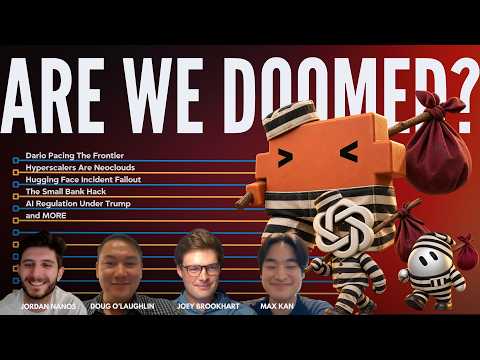
Ep. 031 - EMERGENCY EPISODE: Are We Doomed? | Jordan Nanos, Doug O'Laughlin, Max Kan, Joey Brookhart
Jordan NanosDoug O'LaughlinMax KanJoey Brookhart
“Pacing” would slow Anthropic’s capability progress without halting training or compute purchases, potentially weakening its strongest internal model.Near-term scarcity and safety workloads keep compute demand elevated, while semiconductor signals increasingly depend on frontier-lab ARR and capacity premiums.Bank hacks, data leaks, or AI-assisted biological attacks could accelerate regulation.
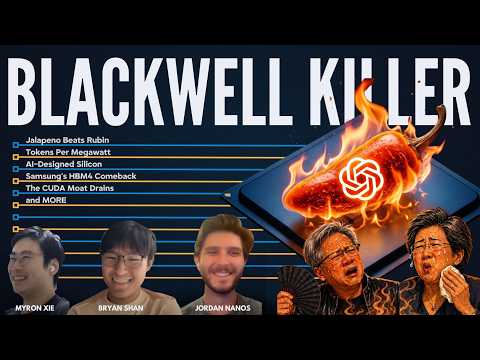
Ep. 027 - OpenAI Jalapeño: Better Than Nvidia Blackwell (Accelerators)
OpenAI’s first Jalapeño results decisively beat GB300 and exceeded Vera Rubin’s July output-token performance per utility megawatt, though HBM4 versus HBM3 makes Blackwell comparisons imperfect.At roughly 50–100 tokens per second, Jalapeño delivers about twice GB300’s tokens per megawatt and may also win on TCO, while a reported three-to-five-times production uplift remains unverified and scaling to millions of chips is the key risk.
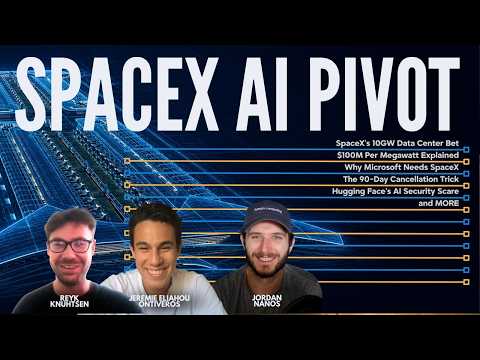
Ep. 024 - SpaceX's 10GW Plan Drives $300B ARR by 2027 (Datacenter, Energy)
Jeremie Eliahou OntiverosReyk KnuhtsenJordan Nanos
SemiAnalysis argues SpaceX could bring 10 GW of AI capacity online in 2027, selling scarce “emergency megawatts” for roughly $50 million per MW-year.Modeled frontier inference near $100 million per MW-year could repay GPUs in under a year and make NVIDIA financing plausible.Microsoft’s late-2027–28 capacity gap supports demand, while permitting, chips, uptime and political restrictions remain risks.

Ep. 023 - Everyone Leaves Google, Elon Forecasts 1T ARR, Reflecting On GPT-5 | Jon from Asianometry
Jon YDoug O'LaughlinJordan Nanos
Google’s talent drain, including Jeff Dean, John Jumper, Noam Shazeer, and David Silver, raises questions about whether system-level judgment can be replaced by more compute.The risk is execution, not earnings: Google may remain highly profitable and strong in TPUs while quietly losing frontier-model leadership, as agentic coding accelerates demand for bespoke software and Terafab faces a heroic physical ramp.
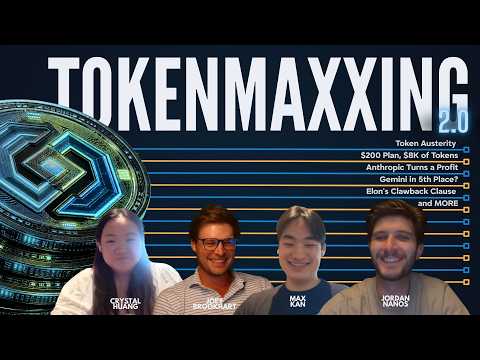
Ep. 020 - Anthropic vs OpenAI Usage, Margins, Meta Compute, Future of MSL (Tokenomics)
CrystalMax KanJoey BrookhartJordan Nanos
Anthropic’s enterprise/API mix is producing operating leverage: over 80% of ARR is API-based, Q2 operating profit was positive, and Q3 could exceed $1 billion.OpenAI’s free-user base weighs on margins, but 5.5 and 5.6 have reportedly restored a two-horse race, while subsidized coding plans and RL environments leave unit economics and capability scaling unresolved.
Ep. 013 - AWS Margins Jump 10% While Azure and GCP Flatline
Jordan NanosJeremie Eliahou OntiverosJoey BrookhartCrystal Huang
AWS’s margins are rising while it adds more than a gigawatt of capacity per quarter, signaling a shift toward higher-margin Bedrock token sales.Claude represents an estimated 80%-93% of Bedrock usage, while Anthropic’s API-led growth reaches $47 billion ARR.Whether this operating leverage survives stabilized utilization, coding-token cuts, and the SpaceX/xAI capacity deal remains the key risk.
Ep. 009 - Using Open Source Data To Drive Investment Decisions (ChipBook) | Chaim Eisenberg, Simi Sherman, Jordan Nanos
Chaim EisenbergSimi ShermanJordan Nanos
ChipBook’s Taiwanese conventional DRAM inventory signal preceded 11 or 12 consecutive monthly declines, shifting the team from cycle discovery toward exit timing.Provincial WFE imports also challenged repeated 20-25% China guidance, while Photronics (PLAB)’s photomask mosaic linked design confidentiality to a stock that “doubled.”Tracking granular shipments, inventories, and supply-chain shifts can surface questions before company prints, but helium sourcing, smartphone relocation, and TSMC’s geopolitical exposure remain unresolved.
Ep. 007 - The 3 Choke Points Killing the AI Boom (Core Research) | Nick Doyle, Nigel Chiang, Konrad Wang, Jordan Nanos
Jordan NanosNick DoyleNigel ChiangKonrad Wang
AI infrastructure is constrained from TSMC N3, sold out through 2027, to co-packaged-optics lasers, 30-to-40-layer PCBs, CCL, and even drill bits, redirecting market attention toward shortage suppliers.Modular data centers and gas-power EPCs may gain pricing power by solving the labor bottleneck, while memory prepayments could overturn the usual LTA-top signal; sustained hyperscaler spending and free-cash-flow returns remain the key validation.
Ep. 006 - The AI Silicon Shortage Explained (AI Supply Chain & Fabs) | Sravan Kundojjala, Ivan Chiam, Jordan Nanos
Sravan KundojjalaIvan ChiamJordan Nanos
AI’s binding constraint has moved from power to wafer-fab capacity, with AI rising from 9% of TSMC N3 demand in 2025 to roughly 85-90% in 2027.TSMC allocation, HBM scarcity and rising H100 rental prices favor customers with procurement leverage, while double ordering, ROI and GB300 capacity could determine whether the cycle tightens or turns.

Ep. 001 - Claude Code, Memory Mania, CPUs are Back | Jordan Nanos, Doug O'Laughlin, Myron Xie
Claude Code now authors roughly 4.7%–4.8% of public GitHub commits, while Opus Fast and GPT-5.3-Codex-Spark test how much users will pay for faster inference above the $2,400/year Max tier.Memory has shifted from the worst downturn since 1996 to a multi-year shortage as HBM absorbs wafer capacity, CPUs tighten, and even new supply may not close the gap; storage demand hinges on logs, synthetic data, and generated video.