PERSON DIRECTORY
Elad Gil
Host of No Priors. Elad Gil appears in 53 indexed conversations across No Priors, Latent Space. This directory brings every appearance, source, TL;DR, digest, and transcript into one searchable feed.

Redefining Chip Architecture with Arm CEO Rene Haas
Arm moved from IP licensing into physical silicon with the Arm AGI CPU after Meta sought a general-purpose agentic CPU no one else could provide.AI reaches 80% to 90% of engineers, while Arm’s documentation and test benches may make proprietary IP more trainable; supply may remain constrained for 3 to 5 years, with data-center construction a possible next bottleneck.

Re-engineering the Semiconductor Supply Chain with Intel CEO Lip Bu Tan
Lip-Bu Tan’s Intel turnaround starts with faster accountability, balance-sheet repair and product simplification, while inference and agentic AI could lift CPU demand from one per eight GPUs toward one per four or one per one.Intel Foundry remains a costly trust and supply-chain bet against TSMC, with IP, yield and cycle time as the proof points; its potential may surface around 2030–2032 as packaging, power and materials become harder bottlenecks.
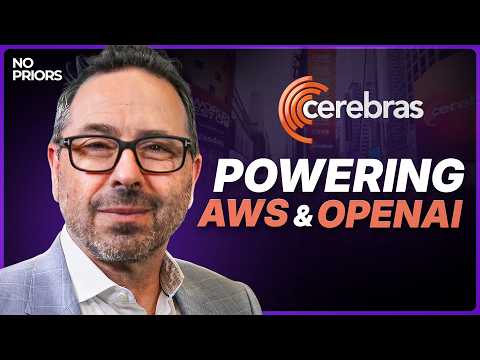
The Story Behind Cerebras’ $63 Billion IPO with Founder and CEO Andrew Feldman
Elad GilSarah GuoAndrew Feldman
Cerebras says useful AI in 2025 made inference latency a daily constraint, with systems running 15, 18, 20x faster than GPUs.G42’s $1 billion order enabled cluster testing, while an OpenAI agreement Feldman says exceeds $20 billion and an AWS deployment raise the stakes for a 10x manufacturing increase this year.Delivery and governance now matter as much as contrarian architecture.

NVIDIA’s Jensen Huang on Reasoning Models, Robotics, and Refuting the “AI Bubble” Narrative
Reasoning, search grounding, and confidence routing have made tokens valuable enough for customers to pay, while AI factories expand demand for chips, energy, construction, electrical, networking, and technical labor.Falling inference costs, open-source research, programmable hardware, and vertical specialists challenge permanent frontier concentration, but industrial deployment still requires reliability approaching 99.99999%; energy capacity, export controls, robotics adoption, and sustained demand will test NVIDIA’s anti-bubble thesis.

No Priors Ep. 144 | The 2026 AI Forecast with Sarah & Elad
AI adoption is “blinding” among doctors, lawyers, and compliance teams, even as a weak Nvidia quarter could trigger panic; verticals such as coding, medical scribing, and legal software such as Harvey are consolidating.Monitor robotics timeline slippage and whether an AI IPO becomes a reflexive benchmark trade; Sarah forecasts somebody will make “hundreds of millions of dollars trading markets with LLMs” in 2026.

Applied Intuition: The Operating System for Self-Driving Vehicles
Qasar YounisPeter LudwigElad Gil
Applied Intuition has reached a $15 billion valuation, more than 1,000 employees, hundreds of millions in revenue, and sustained profitability by extending engineering tools into a vehicle operating system and autonomy applications.Its compatibility layer could remove thousands of dollars in hardware as autonomy approaches mainstream US vehicles within five years, but potential commoditization by 2030-2035 creates a critical risk to recouping $12 billion-$15 billion development costs.
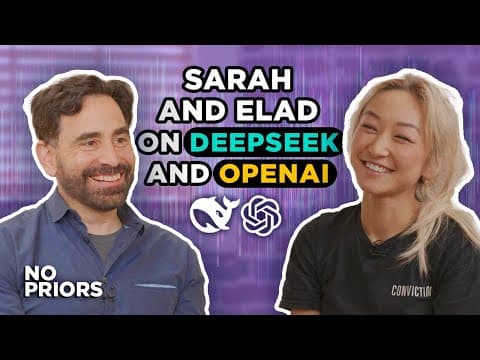
No Priors Ep. 100 | With Sarah and Elad
DeepSeek’s R1 is a genuine open-source reasoning advance, but its reported $5.5 million final run was not the full program, tempering claims that frontier AI has become cheap.GPT-4-equivalent inference costs fell 180x in 18 months, while Deep Research raises the analyst bar but still requires users to audit outputs.Frontier clusters may retain distribution and recursive research advantages, yet 2025’s opportunity map favors vertical AI, agents, autonomy, and domain-specific data generation.