PERSON DIRECTORY
Dwarkesh Patel
Host of Dwarkesh Podcast. Dwarkesh Patel appears in 66 indexed conversations across Dwarkesh Podcast, Hard Fork, The a16z Show. This directory brings every appearance, source, TL;DR, digest, and transcript into one searchable feed.
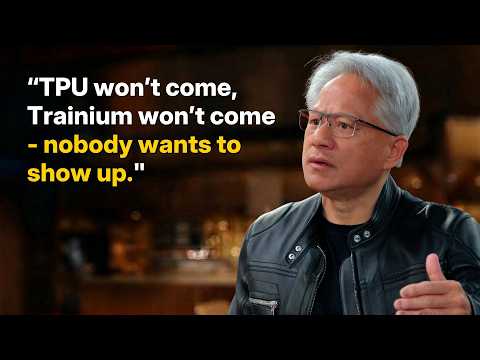
Jensen Huang – Will Nvidia’s moat persist?
Jensen argues TPU and ASIC growth is concentrated in Anthropic, while Nvidia’s broader programmable platform and supply-chain commitments preserve its reach and unit-TCO advantage.Groq expands Nvidia into premium low-latency inference, with Vera Rubin and Feynman targeting annual order-of-magnitude token-cost declines; China export controls remain an unresolved strategic risk after a direct security challenge.

Mark Zuckerberg — AI will write most Meta code in 18 months
Meta expects AI agents to write most code for its AI efforts within 12–18 months, moving beyond autocomplete into testing and autonomous improvement.Yet compute, energy, permitting, and human testing capacity remain bottlenecks, while Meta AI’s near-1B monthly users are concentrated outside the US.Monetization hinges on premium compute and product value, with open-source adoption, security, and China’s infrastructure lead unresolved.
Satya Nadella — Microsoft’s AGI plan & quantum breakthrough
Hyperscalers should capture AI infrastructure value as agents multiply compute demand, while open source and enterprise buyers constrain single-model dominance.Microsoft’s $13B AI revenue is a spending governor amid expected overbuild and cheaper leased capacity in '27 and '28; Majorana One’s fault-tolerant timeline remains '27, '28, '29, while agentic SaaS faces legal and change-management risks.
Tyler Cowen — The #1 bottleneck to AI progress is humans
Tyler Cowen argues that AI will transform the world without producing an explosive economic takeoff: as intelligence becomes abundant, adoption, institutions, infrastructure, and other constraints become the bottlenecks.He weighs rapid capability gains against slow diffusion, unusually normal markets, diminishing returns, and the risk that technological progress makes future wars more destructive.