SHOW DIRECTORY
Lex Fridman Podcast
Long-form conversations with researchers, founders, scientists, and public figures across AI, technology, science, philosophy, and geopolitics.
BIDCLUB DESCRIPTION
DHH: Future of Programming, AI, Agentic Engineering, Vibe Coding & Linux | Lex Fridman Podcast #501
Agents are moving software’s bottleneck from implementation to product judgment: DHH says Quattro shipped with 100% agent-written code, while Basecamp needed human cleanup.Fable led his benchmark, but Sol and Grok 4.6 delivered comparable results at roughly one-tenth the token cost.Omarchy’s tens of thousands of downloads and 330 plugins in three days strengthen Linux’s platform case, though human review remains limiting.
Jensen Huang: NVIDIA - The $4 Trillion Company & the AI Revolution | Lex Fridman Podcast #494
NVIDIA’s competitive unit has expanded from the GPU to the entire AI factory, co-designing computation, models, data, networking, memory, power, and cooling around modern workloads.CUDA’s ubiquitous install base remains the foundational moat, while four compute-driven scaling laws and falling token costs support demand for increasingly specialized infrastructure.Six-month model cycles versus three-year hardware cycles, plus power and supply-chain constraints, remain key execution risks as Huang describes a potentially much larger computing economy.
Rick Beato: Greatest Guitarists of All Time, History & Future of Music | Lex Fridman Podcast #492
Generative music makes judgment and authenticity scarcer: Rick Beato found only three good ideas among roughly 130 AI songs, while audiences may increasingly value effort and recognizable human identity.Streaming expands discovery but commoditizes music, and rights enforcement can divert all revenue from a one-hour video over 20 seconds; Beato’s lawyer overturned 4,000 Content ID claims across 2,100 videos, highlighting creator leverage and unresolved platform economics.
OpenClaw: The Viral AI Agent that Broke the Internet - Peter Steinberger | Lex Fridman Podcast #491
OpenClaw’s differentiated wedge is a messaging-first agent that recombines existing models, CLIs, browser automation, and local tools into an extensible personal operating layer, driving more than 175,000 GitHub stars and thousands of contributions.Its utility is inseparable from system-level permissions: prompt injection, weak-model gullibility, and exposed interfaces remain adoption risks, while Steinberger weighs Meta and OpenAI partnerships against $10,000–$20,000 monthly costs and his open-source commitment.
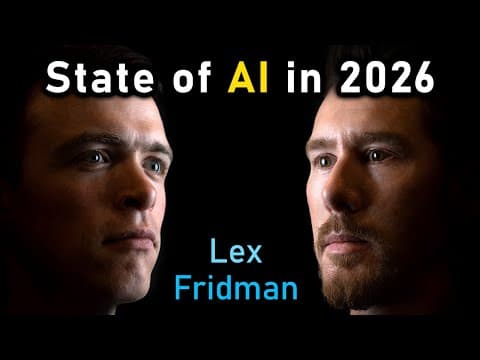
State of AI in 2026: LLMs, Coding, Scaling Laws, China, Agents, GPUs, AGI | Lex Fridman Podcast #490
Lex FridmanNathan LambertSebastian Raschka
The 2026 AI race is becoming plural, with ideas spreading across DeepSeek, Qwen, Kimi, MiniMax, Z.ai, Google, OpenAI and Anthropic while compute, hardware access, culture and distribution determine advantage.Scaling laws now span pre-training, post-training and inference, making coding the clearest monetization wedge and open weights strategic infrastructure; gigawatt-scale Blackwell clusters could support longer RL runs and premium inference, but data rights, benchmark contamination and serving economics remain risks.
Pavel Durov: Telegram, Freedom, Censorship, Money, Power & Human Nature | Lex Fridman Podcast #482
Telegram’s operating model combines 100% founder ownership, a roughly 40-person core team, and automation across almost 100,000 servers, creating exceptional leverage but extreme key-person concentration.It became profitable for the first time in 2024 through Premium subscriptions, contextual ads and ecosystem commissions, without behavioral advertising or sharing private messages.France’s investigation—roughly 15 alleged user-generated-content crimes attached personally to Durov—alongside encryption proposals and renewed bans keeps sovereign intervention the central risk.
Dave Plummer: Programming, Autism, and Old-School Microsoft Stories | Lex Fridman Podcast #479
Microsoft’s 1990s moat came from exceptional talent density paired with distribution: making MS-DOS the PC standard created leverage that compounded for decades.Dave Plummer’s 87K Task Manager, shareware businesses, and debugging discipline show how reliability, scarcity, and end-to-end ownership can turn small tools into durable infrastructure, while Windows customization and AI’s limits remain open questions.
Demis Hassabis: Future of AI, Simulating Reality, Physics and Video Games | Lex Fridman Podcast #475
Demis Hassabis argues that natural systems contain exploitable structure, allowing classical learning to navigate spaces as large as roughly 10^170 Go positions and 10^300 protein structures.Veo 3’s passive observation of liquids, materials, and human dynamics suggests useful intuitive physics, while AlphaEvolve and the virtual-cell roadmap extend model-guided search into science and engineering.Hassabis assigns a 50% chance to AGI within five years, but compute demand, safety research, labor disruption, and whether scaling needs another architectural leap remain important uncertainties.
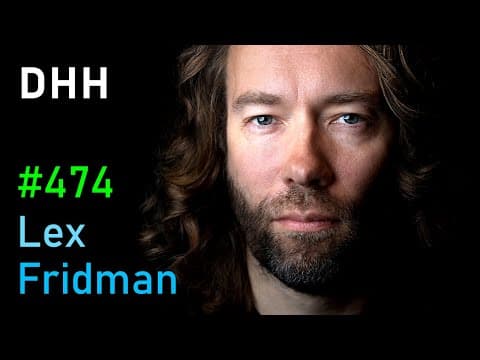
DHH: Future of Programming, AI, Ruby on Rails, Productivity & Parenting | Lex Fridman Podcast #474
Lex FridmanDavid Heinemeier Hansson
DHH argues Rails’ leverage comes from reducing ceremony, with Shopify’s roughly 1 million dynamic requests per second and approximately $120 billion market capitalization illustrating the runway of concise software.AI raises programmer leverage but may separate code production from competence, while 37signals’ AWS exit cut infrastructure costs by roughly one-half to two-thirds and saved close to $2 million annually.
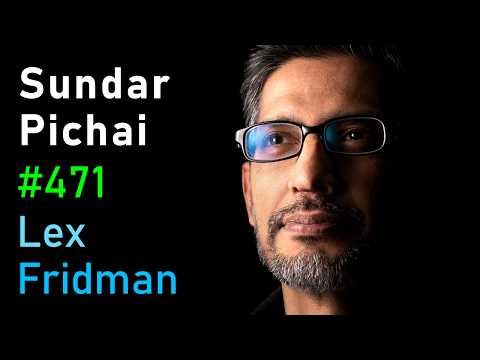
Sundar Pichai: CEO of Google and Alphabet | Lex Fridman Podcast #471
Sundar Pichai’s central bet is that Gemini becomes a horizontal intelligence layer across Search, coding, Android, Waymo and robotics, with monthly token volume rising from 9.7 trillion to 480 trillion in 12 months.Search is being rebuilt around AI-mediated discovery while serving cost and latency constrain model deployment, and Alphabet’s 2026 Waymo scaling, AI Mode rollout and agentic web remain catalysts to monitor.