PERSON DIRECTORY
Tim Scarfe
Host of Machine Learning Street Talk. Tim Scarfe appears in 43 indexed conversations across Machine Learning Street Talk. This directory brings every appearance, source, TL;DR, digest, and transcript into one searchable feed.

How a Voice Agent Learns the Rhythm of Conversation — Shawn Wen
Tim ScarfeTsung-Hsien (Shawn) Wen
Enterprise voice is shifting from commoditized ASR, LLM, and TTS components toward audio-native turn-taking that recognizes pace, hesitation, noise, and unfinished meaning while retaining text for guardrails and auditability.Production conversation data, self-hosting, precomputation, and latency-budgeted reasoning target the real bottleneck—when to respond—while a planned benchmark within “the next month or two” will test whether evaluation and control become the enterprise value layer; privacy and adoption remain unresolved risks.

AI Can Write the Proof. Who Checks It? — Leonardo de Moura
Lean combines a tightly governed core with permissionless extensions, while Lean FRO’s roughly 20-person ownership distributes stewardship.An AI-linked apparent Collatz refutation exploited separate bugs in Lean’s official kernel and Rust-based Nanoda, making proof-checker security an urgent risk.AI-assisted zlib passed C tests and proved round-trip correctness across every compression level and input, but Mathlib’s 2.4 million lines raise scaling pressure.
Can Rewriting an AI Agent Bend the Intelligence Curve? - Zhengyao Jiang
Weco’s AIDE recursively optimized prompts, tools, and search, outperforming the hand-built platform on MLE-bench Lite, ALE-bench Lite, and out-of-distribution WeatherBench 2.Jiang places it at RSI level 1, not level 2: the promoted inner loop was only slightly faster, while failed anti-reward-hacking defenses leave human creativity and evaluation as constraints.
How Deep Learning Finally Cracked Messy Tables - Frank Hutter
TabPFN signals a breakthrough in tabular AI, outperforming CatBoost and XGBoost through in-context learning rather than dataset-specific training.Synthetic training gives Prior Labs control over priors without leakage or memorization, while scaling from 1K to 1M rows and outperforming Google’s TabFM on speed.SAP-backed distribution targets agentic API usage, while Do-PFN’s potential to reduce RCT requirements remains a high-stakes, theory-dependent catalyst.

Why Information Has a Price in Intelligence - Alexander Mattick
Flow matching extends language-model-like scaling to continuous domains by learning a chosen transport path as supervised regression, shifting expensive work into training and enabling easier sampling across images, audio, video, and physical trajectories.Mattick cautions that prediction still does not supply search, action selection, or guarantees, so autonomous intelligence remains unproven and robot economics hinge on repeatability and failure consequences, not compelling demos.

How Physical AI Learns Across Language, Video and Action — Ming-Yu Liu
NVIDIA’s Cosmos 3 unifies video understanding, generation, and action, using a reason tower to initialize a diffusion generator and leveraging human video to address scarce robot-action data.Its first practical edge is policy verification: preserving checkpoint rankings could reduce costly real-world fleet testing, but simulator hacking and harmful cross-embodiment transfer remain unresolved risks.
When Talking Becomes the Main Way We Use Computers — Pavan Muddireddy
Pavankumar Reddy MuddireddyTim Scarfe
Commercial speech recognition remains unsolved in deployment: Mistral customers report heavy scaffolding across millions of sessions, with quality dropping outside top languages and in noisy factories.Voxtral's audio-native design may reduce transcript-to-LLM error propagation, while Forge makes smaller audio models cheaper to adapt on sensitive, precise in-distribution data; latency and 4–5-person diarization remain execution risks.
Why Scientific Taste Must Be Learned Through Practice — Edward Hughes
Agent Faraday, a GRPO-post-trained Qwen 3.6 27B using a frontier coding agent, beat Claude, GLM-5.2, and GPT-5.5 Codex on held-out AI-for-science replication tasks.The result supports Inherent’s bet on putting generalizable capability into weights rather than harnesses, while cheating risks and hindsight evaluation remain execution tests for AI-accelerated R&D and autonomous labs.
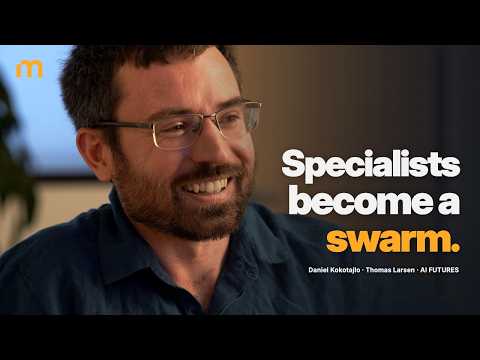
How Many Narrow AIs Could Behave Like One Superintelligence - Daniel Kokotajlo and Thomas Larsen
Daniel KokotajloThomas LarsenTim Scarfe
AI 2027 is roughly 75% of predicted speed; Plan A proposes a 6–12 month pause, a US–China deal, and superintelligence in 2040.Machine-led economic replication could accelerate growth, but transparent training would let Microsoft or Alibaba catch up and pressure frontier-lab valuations; silent misalignment remains unresolved as behavioral evaluations may miss deceptive models, making white-box interpretability important before further scaling.
Designing How AI Grows — Tom McGrath
Tom McGrath argues interpretability could be an AI-speedrun natural science, potentially accelerating research by an order of magnitude in the next couple of years.Goodfire’s gradient-reading prototypes, feature-based rewards, and manifold geometry point toward closed-loop training, but reliable interventions and oversight remain unresolved as reward hacking exposes limits in chain-of-thought monitoring.