PERSON DIRECTORY
Sarah Guo
Host of No Priors. Sarah Guo appears in 71 indexed conversations across No Priors, Invest Like the Best, Latent Space. This directory brings every appearance, source, TL;DR, digest, and transcript into one searchable feed.
Why Diffusion Will Win AI Inference with Inception Co-Founder and CEO Stefano Ermon
Diffusion inference is becoming a commercial signal: at GPT-2 scale, it matched autoregressive perplexity using the same data and parameters while generating text roughly 10x faster.Mercury extends the wedge to production: Ermon says OpenCall moved from Cerebras to NVIDIA GPUs for comparable speed, lower cost, and higher quality, while Inception’s proprietary stack and frontier-intelligence gap remain key tests.

Sarah Guo - What the 250 People Building AI Believe - [Invest Like the Best, EP.489]
Patrick O'ShaughnessySarah Guo
Sarah Guo says competitive open-source AI is already widespread, so US restrictions could handicap law-abiding American businesses while adversaries ignore them.Her roughly 250-person network sees recursive self-improvement and “some sort of exponential intelligence” as a one-to-two-year possibility, while Sunday Robotics targets home-robot beta by year-end.Compute independence, regulation, and physical supply chains remain constraints, while Chai Discovery’s $10 million contract and customer adoption test AI’s ability to capture value in biology.
Building a $200M Bootstrapped Chess Empire with Chess.com CEO Erik Allebest
Chess.com is on track for a little over $200 million in revenue this year with 10M DAU, 40–50M MAU and 250M+ registered members, achieved without primary capital after a $56K 2005 domain purchase.Cash-flow-funded product and community compounding lifted the baseline through successive demand waves, while the secondary-only CVC deal and General Atlantic reinvestment improved operational maturity.Gambit and the billion-player ambition extend expansion paths, while cheating enforcement and AI governance remain risks to monitor.
Chasing Trillion-Dollar Companies, Founder Ambition, Token Budgets, & Regulatory Capture
Anthropic, OpenAI, and SpaceX’s leap toward $1 trillion is a five-year anomaly, while reaching that scale likely requires $50 billion-$100 billion of revenue with good margins.AI’s opportunity may be far larger than current per-seat models imply, but compute bottlenecks, founder exit timing, recursive-self-improvement uncertainty, and token allocation by return on invested tokens remain decisive constraints.
Building an Autonomous Delivery Experience with DoorDash Co-Founders Andy Fang and Stanley Tang
Sarah GuoAndy FangStanley Tang
Ask DoorDash is shifting demand, with 50% of restaurant-order trajectories reaching new-to-customer venues and grocery baskets roughly 40% larger.DoorDash’s 10 billion delivery history supplies pickup and handoff ground truth for routing DOT, drones and Dashers, but scaling now depends on hardware, operations and supply chains rather than autonomy alone.
Really Big Test-Time Compute in AI Changes Benchmarks, Safety and Research with OpenAI's Noam Brown
Noam Brown argues that model quality must be measured as a cost, token, or time curve, because fixed benchmark scores hide gains from test-time compute.Models can keep improving beyond 100 million tokens, while safety policies still lack a clear budget for evaluating cyber, bio, and other dangerous capabilities.Routing and orchestration businesses therefore face a demanding test: outperforming a single stronger model allowed to think longer at the same cost, with gains that transfer beyond benchmarks.

Re-engineering the Semiconductor Supply Chain with Intel CEO Lip Bu Tan
Lip-Bu Tan’s Intel turnaround starts with faster accountability, balance-sheet repair and product simplification, while inference and agentic AI could lift CPU demand from one per eight GPUs toward one per four or one per one.Intel Foundry remains a costly trust and supply-chain bet against TSMC, with IP, yield and cycle time as the proof points; its potential may surface around 2030–2032 as packaging, power and materials become harder bottlenecks.

Biohub: The Future of Biology is Open-Source with Zuckerberg & Chan
Elad GilSarah GuoMark ZuckerbergPriscilla ChanAlex Rives
Biohub’s $500 million, 10- to 15-year commitment targets purpose-built biological data, combining frontier AI with wet labs from proteins to cells and whole systems.ESMfold predicted structures for more than 1.1 billion proteins and produced nanomolar binders from 96 synthesized designs without antibody-specific training, while open release could accelerate research but leaves biosafety and clinical translation unresolved.

We Need An Ecosystem in AI, And Every Company Can Win A Place In It
Sarah GuoElad GilswyxSatya Nadella
Microsoft’s AI strategy centers on an ecosystem where customers create differentiated intelligence through clean-lineage models, traces, private evals, and specialist training.Private evals could become enterprise IP: swapping models while improving on protected outcomes indicates control over the stack, not dependence on one vendor.Agents pressure SaaS to unbundle data and business logic and add consumption pricing, while data-center expansion faces a 12–18-month test of public benefit.
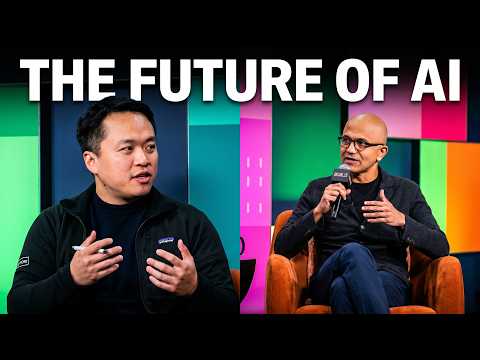
Satya Nadella on AI: @NoPriorsPodcast x Latent Space Crossover Special at Microsoft Build 2026
swyxSarah GuoElad GilSatya Nadella
Satya Nadella’s platform thesis puts value above the model: companies should control private evals, context, tools, and agent traces, potentially turning tacit knowledge into a “company veteran agent.”Deployment is the constraint, as 100 agent sessions demand rebuilt interfaces and SaaS pricing shifts toward consumption; data-center expansion likewise needs visible community gains within 12–18 months.