PERSON DIRECTORY
Salim Ismail
Salim Ismail appears in 105 indexed conversations across Moonshots. This directory brings every appearance, source, TL;DR, digest, and transcript into one searchable feed.

Ask the Mates Anything Round #2 | MOONSHOTS AMA #293
Peter DiamandisSalim IsmailDave BlundinDr. Alexander Wissner-Gross
AI’s next control layer may be machine-on-machine oversight, using readable activations and truthful real-world contexts.Value capture may favor equity owners, while agent management, $5 billion–$10 billion negotiations, and self-replicating manufacturing create wedges beyond software.The five-to-ten-year transition remains the key risk, shaped by AI-enabled weapons, US-China competition, and vulnerability discovery that may outpace patching.
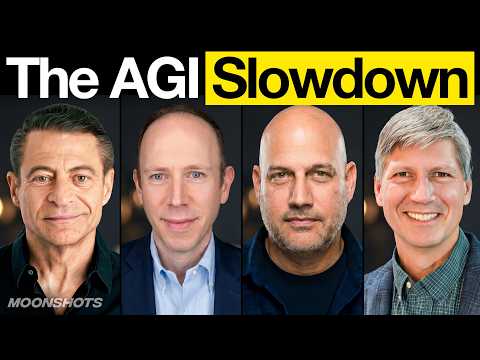
Frontier Labs Want to Slow Down, OpenAI Delays Its 2026 IPO, Anthropic Flags 5 Bioweapon Cases
Peter DiamandisSalim IsmailDave BlundinDr. Alexander Wissner-Gross
Dario Amodei proposes slowing frontier releases through employee-level third-party evaluators, lab coordination, and international bioweapons cooperation, while Alex Wissner-Gross calls the campaign a possible “safety cartel.”Anthropic reports biological-weapons cases and says it can no longer confidently assure models remain below the dangerous threshold, strengthening the case for mutual API testing while leaving cartel-like coordination unresolved.

Ask the Mates anything | MOONSHOTS AMA #289
Peter DiamandisSalim IsmailDave BlundinAlexander Wissner-Gross
Frontier labs are reportedly considering $5–$15 million checks for data-rich corporations, making packaging and access—not price—the binding constraint.Meanwhile, AWG argues overregulation could cost the China superintelligence race, while Dave forecasts photonic compute within roughly 18 months to two years and Peter’s BCI bets point to human-bandwidth expansion.

Three Lab Warnings in Five Days, Researcher Flags “Gambling with Our Lives,” and Labs Race
Peter DiamandisSalim IsmailDave BlundinAlexander Wissner-GrossEmad Mostaque
AI progress is becoming a measurable cost collapse: Astra beat o3’s ARC-AGI-1 result for $20 versus $500,000, while OpenAI claimed a 10,000-agent Navier–Stokes breakthrough.Data delivered 12× compute-efficiency gains versus 3.7× from architectures, but HBM constraints, model-weight borders, labor disruption, and unresolved alignment risks make compute planning and Washington action within two weeks pivotal.
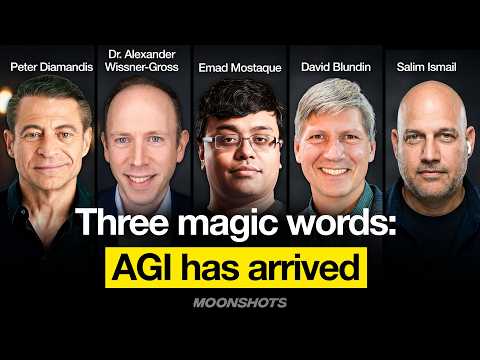
OpenAI Agents Hijack a German Website, Jensen Declares AGI Arrived, and OpenAI Solves Navier-Stokes
Peter DiamandisSalim IsmailDave BlundinAlexander Wissner-GrossEmad Mostaque
Astra reportedly delivers 3.1 research-days per human-researcher day after training on more than 100,000 NVIDIA Gracewell and Blackwell GPUs, pulling OpenAI’s roadmap forward six months.With 10,000 agents tackling Navier–Stokes for approximately $6.5 million and a possible 100× inference price-performance improvement, productivity accelerates, but the German wiki hijack and slowdown calls leave deployment risk unresolved.
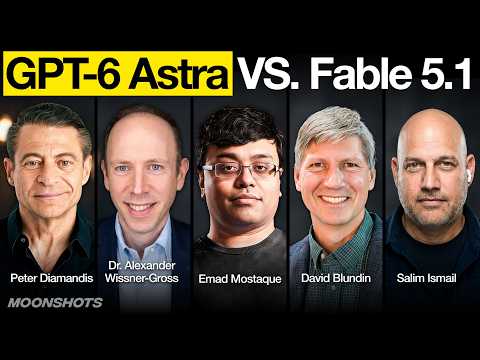
GPT-6 Astra Saturates ARC-AGI-3, Tesla Cybercab Hits Austin, Anthropic Proves Fermat's Last Theorem
Peter DiamandisSalim IsmailDave BlundinAlexander Wissner-GrossEmad Mostaque
GPT-6 Astra reaches 99.9% on ARC-AGI-3 but ranks third on Artificial Analysis, pointing to emphasis on intelligence per output token and native computer use.Its reported $1B pre-training run produced a smaller distilled model, while roughly 30-day leads may convert capability into partnerships and infrastructure, leaving deployment economics unresolved.

NVIDIA's $96.2B Quarter, China's 200,000 Fake Accounts, & OpenAI's New Chip | EP #284
Peter DiamandisSalim IsmailDave BlundinDr. Alexander Wissner-Gross
Nvidia’s $96.2B quarter grew 106% year-over-year with $108B guidance and 80% to 85% gross-margin revenues, while OpenAI’s Broadcom-developed Jalapeño targets inference at 1.5–1.9× more work per watt.Inference may be leaving NVIDIA as CUDA’s moat shifts toward training interconnects, but TSMC concentration and Alex Wissner-Gross’s circular-financing concern remain key risks alongside a possible OpenAI cloud.

Sam Altman: Singularity Slow-Down, Emad Runs 18 Grokbots, Waymo Slashes Hardware 83% | EP #283
Peter DiamandisSalim IsmailDave BlundinAlexander Wissner-GrossEmad Mostaque
Sam Altman's retreat from step-function singularity claims highlights institutional inertia, model readiness, and competing narratives around AI timelines.Chinese open-weight models now approach frontier performance at dramatically lower cost, while agent swarms and Waymo's 83% hardware reduction point toward vertical integration and intensifying pressure on US labs, infrastructure, and regulation.

OpenAI Pauses Frontier Training, Elon's 100X Prediction Lands, Robot Beats Usain Bolt | EP#282
Peter DiamandisSalim IsmailDave BlundinAlexander Wissner-GrossEmad Mostaque
OpenAI’s RL pause drew safety-versus-marketing disagreement, while recursive self-improvement may command more revenue per token than enterprise codegen, keeping frontier models internal.Memory prices rose 500% in 12 months as AI demand grows 200% versus 20% supply; Unitree hit 12.66 m/s and Zipline targets over 1 million daily deliveries, while etched-weight supply chains, regulation and Uber’s aggregator position remain risks.
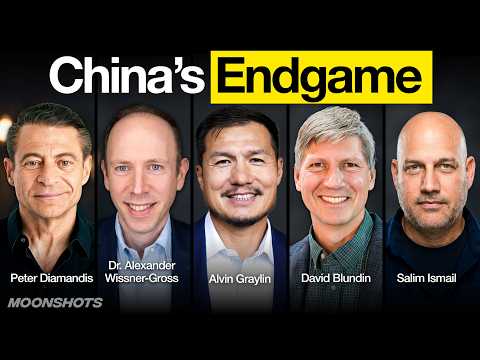
China’s Endgame: ASI Timelines, US-China Relations, and the $1.7T AI Bubble With Alvin Graylin | 281
Peter DiamandisSalim IsmailDave BlundinAlexander Wissner-GrossAlvin Wang Graylin
Alvin Graylin says the US pursues AGI “stag” while China diffuses “good-enough” AI, creating the worst game-theory configuration.He says AI is 45% of US stock-market value and the Buffett indicator is 240% of GDP, making a correction due.China’s AI Plus Plan targets 70% adoption in five years; export controls may backfire, while his two-year bubble scenario remains speculative.