PERSON DIRECTORY
Salim Ismail
Salim Ismail appears in 105 indexed conversations across Moonshots. This directory brings every appearance, source, TL;DR, digest, and transcript into one searchable feed.

Meta Buys Moltbook, GPT 5.4, and Fruitfly Brain Upload | Moonshots Live at The Abundance Summit 238
Peter DiamandisSalim IsmailDave BlundinDr. Alexander Wissner-GrossEmad Mostaque
Recursive AI self-improvement and GPT-5.4’s reported 38% FrontierMath Tier 4 score point to reasoning and computer-use capability advancing beyond conventional chatbot benchmarks.Agents are becoming a new customer class as synthetic experimentation, AutoResearch, and faster inference expand the addressable market while compute, memory, electricity, security, and scarce attention remain bottlenecks.Whether a handful of frontier labs consolidate the value—or open models and tiny systems redistribute it—remains the key competitive question.

Andrew Yang: UBI Before UHI, Solving Job Loss, and the Future of Work | #236
Andrew YangPeter DiamandisSalim IsmailDave BlundinDr. Alexander Wissner-Gross
AI-driven job displacement could hit 20% to 50% of 70 million US office workers within 12 to 18 months, rewarding layoffs through higher margins while hollowing out demand, offices, and the college pipeline.Yang sees UBI as the urgent bridge before universal high income, but a larger floor may be necessary and financing remains unresolved as private pilots, payroll subsidies, and cheaper basic services compete with delayed Washington action.
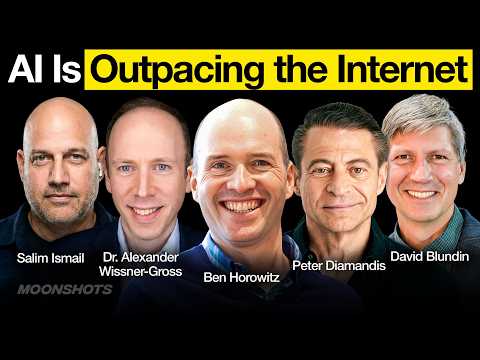
Ben Horowitz: xAI Executive Exodus, Apple's AI Crisis, The Pace of AI | EP #232
Peter DiamandisBen HorowitzSalim IsmailDave BlundinDr. Alexander Wissner-Gross
Recursive self-improvement is already operating as frontier models propose experiments, optimize inference loops, and develop successor models, even with humans still pressing approval buttons.AI economics favor capital-intensive platforms and rapid distribution, while Apple’s local-agent hardware opening and the unresolved xAI departures make infrastructure, talent controls, and adoption timing key variables to monitor.

AI CEOs Come Online: Sam Altman's Replacement Plan, Job Loss & 'Solve Everything' Launches |EP #230
Peter DiamandisSalim IsmailDave BlundinAlexander Wissner-Gross
AI is moving from executive copilot to governance actor, with the panel saying a $1 billion run-rate company may already be AI-run behind a human CEO.OpenAI’s cited release interval fell from 97 days to 29 as post-training and successor-writing systems compress the model clock.January 2026 job cuts reached 108,000, 118% above January 2025, making task destruction and productivity distribution the unresolved risks.

Cathie Wood's 2026 Vision: 7% GDP Growth, AI, Robotaxis and Bitcoin
Peter DiamandisCathie WoodSalim IsmailDave BlundinDr. Alexander Wissner-Gross
Cathie Wood argues that robotics, energy storage, AI, blockchain, and multi-omic sequencing could lift real global GDP growth above 7% as falling costs unlock explosive unit demand and convert household labor into measured commerce.The thesis concentrates capital around power, open-source AI, robotaxis, and convergent platforms, with $10 trillion of global power investment and Tesla’s potential $0.20-per-mile rides as catalysts, while China’s open-source lead and legacy infrastructure remain key uncertainties.

The Singularity Countdown: AGI by 2029, Humans Merge with AI, Intelligence 1000x | Ray Kurzweil
Peter DiamandisRay KurzweilSalim IsmailDave BlundinDr. Alexander Wissner-Gross
Ray Kurzweil maintains separate forecasts for AGI by 2029 and a human-AI singularity by 2045, defined as becoming “at least a thousand times more intelligent.”He expects longevity escape velocity around 2032 through AI-driven biological simulation, making near-term health preservation a practical priority while UBI-equivalent systems address displaced work.Physical AI, ambient interfaces, and energy-efficient computing are nearer-term opportunities, but Kurzweil allows “some chance that things will go wrong” despite rating the future a 10.
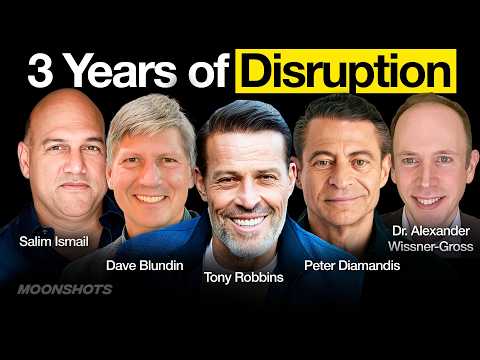
Tony Robbins Takes AI's Hardest Questions: Job Loss, Purpose, and The Hard Times Ahead | 222
Peter DiamandisTony RobbinsSalim IsmailDave BlundinDr. Alexander Wissner-Gross
AI’s investable disruption risk is the speed mismatch between labor displacement and human adaptation, with forecasts ranging from 3–5 years to 3–10 years.Robbins argues that pattern skills, growth, and contribution can support resilience, but AI mental-health products could become scalable infrastructure or “emotional junk food.”

The 2026 Timeline: AGI Arrival, Safety Concerns, Robotaxi Fleets & Hyperscaler Timelines | 221
Peter DiamandisSalim IsmailDave BlundinAlexander Wissner-Gross
AI, robotics, and space infrastructure are accelerating together, with Claude Opus 4.5 extending autonomous work, robotaxis approaching mass deployment, and factories potentially producing robots that help build their successors.The commercial upside spans autonomous vehicles, humanoids, orbital compute, and Starship economics, but capability and safety efforts remain intertwined, while persuasion, cybersecurity, mental health, regulation, and uncertain growth metrics create unresolved risks.

Our Updated AGI Timeline, 57% Job Automation Risk & US Debt Crisis
Peter DiamandisNaveen JainSalim IsmailDr. Alexander Wissner-Gross
Frontier AI is shifting from brute-force scaling toward research, self-verification, and agentic action as labs enter a potential sprint from quarterly to weekly or daily releases.The cited 57% automation exposure and 80% task-time reduction could reshape labor, productivity, energy, and fiscal policy, but the speakers remain divided over job elimination, GDP measurement, and debt discipline.
The AI Wealth Gap: Why 40x Deflation Changes Everything w/ Dave Blundin, Salim Ismail, Dr. Alex Wissner-Gross | EP #208
Peter DiamandisDave BlundinSalim IsmailDr. Alex Wissner-Gross
Reported 40× year-over-year deflation in intelligence costs, including Moonshot AI’s $4.6 million Kimi training run, could make frontier capability broadly accessible and pull healthcare, energy, food, and other costs downward as demand expands.The transition may first widen inequality, with power infrastructure, enterprise AI, and science discovery creating major investment flows while European regulation, labor resistance, embryo editing, weather control, and the missing technology of social cohesion determine who captures the gains.