PERSON DIRECTORY
Erik Torenberg
Erik Torenberg appears in 137 indexed conversations across The a16z Show, The Cognitive Revolution. This directory brings every appearance, source, TL;DR, digest, and transcript into one searchable feed.
How AI Is Reinventing Computing from Chips to Power
Ben HorowitzMartin CasadoRaghu RaghuramErik Torenberg
a16z’s new AI infrastructure fund captures a founder migration into hardware, with top-founder hardware pitches rising from roughly 3–5% to “north of 20% or 30%.”Hyperscaler capex, booked-out GPUs and resale premiums support opportunities across chips, power and cooling, while grid shortages, regulation and uncontrolled agent spending remain constraints.
The RL Fine-Tuning Playbook: CoreWeave's Kyle Corbitt on GRPO, Rubrics, Environments, Reward Hacking
Erik TorenbergNathan LabenzKyle Corbitt
RL can push capable open-weight models higher by reinforcing rare outcome-changing decisions while preserving pretrained “grooves,” unlike SFT’s broader risk of catastrophic forgetting.For enterprise agents, the clearest wedge is latency: RL can bring small models to roughly 30% of frontier latency and improve cost per token by at least an order of magnitude, though slower iteration and reward hacking remain risks.
Marc Andreessen's 2026 Outlook: AI Timelines, US vs. China, and The Price of AI
Andreessen sees AI three years into an 80-year revolution, with customer revenue validating unusually rapid adoption across an already-built global distribution network.Falling token costs, competing chips, smaller models, and US-China rivalry could expand demand dramatically, while state regulation remains a major unresolved risk.
AMA Part 1: Is Claude Code AGI? Are we in a bubble? Plus Live Player Analysis
Erik TorenbergNathan LabenzZvi MoshowitzGregEugenia KuydaAli BehrouzLogan KirkpatrickJungwon Hwang
AI’s strongest proof point is its performance alongside Nathan Labenz’s son’s oncologists, with minimal residual disease below one cell per million after remission before round two.Claude Opus 4.5 may be software AGI, but jagged failures and holiday hype leave full AGI unresolved, while context management, multi-model judgment, and infrastructure financing remain key risks.
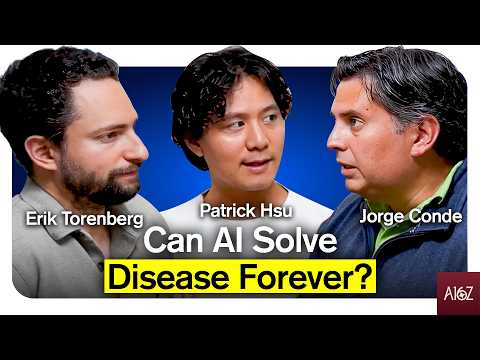
Faster Science, Better Drugs
Erik TorenbergPatrick HsuJorge Conde
Arc is combining neuroscience, immunology, machine learning, chemical biology, and genomics to reduce organizational and experimental latency, with virtual cells aimed at navigating diseased cells toward healthy states.The commercial prize depends on better targets, drug design, higher clinical success, lower capital intensity, and shorter timelines, but physical testing and human endpoints remain serial bottlenecks while virtual-cell capability sits somewhere between GPT-1 and GPT-2.